
↓
 

The Spellman Report

The Spellman Report, Where the Economy and Markets Meet

  • About
  • Blog
  • News and Views
  • Video
  • Investment Management
  • Speaking Engagements

Tag Archives: government debt

Post navigation

Newer posts →

On Saving the Economy: Plan B

The antidote to a troubled macro environment since Keynes wrote the book in the 1930s has been the dual demand-side sledgehammers of government deficit spending and monetary expansion.

Both were thought to induce private spending with multipliers that would generate output and absorb the unemployed. Well, that’s how the theory went.

When it was first applied, it was not a theoretical experiment but rather the necessity of paying for and financing WWII.

At that time, the twin necessities of fiscal and monetary policy jolted the economy forward with such force that the unemployment rate was driven down to 1.2%. It appeared to provide validation of what fiscal and monetary policy could do, and economists and policymakers around the globe embraced it (and they still do).

After all, it simply required legislation for spending, raising the debt ceiling, and the Fed’s Open Market Committee’s agreement to go along with it. Basically, it was Bureau of Engraving and Printing policy that printed both the Treasury securities to pay for the deficit spending and the dollars to purchase them.

It was the easy way out, which became Plan Ain times of economic distress, whether they’re related to shortfalls of income or jobs. And now it’s also intended to rebuild wealth, save banks, and cheapen the dollar as well.

But for these macroeconomic sledgehammers to work, they are not cheap. US Government debt to GDP has increased from 62.7% to 101.6% in the last eight years. The relative size of the Fed’s wartime quantitative easing was a 50% expansion of its balance sheet — as opposed to a 300% expansion in the modern day reincarnation of QE. But alas, unemployment has been driven down to but a narrowly measured 6.7%.
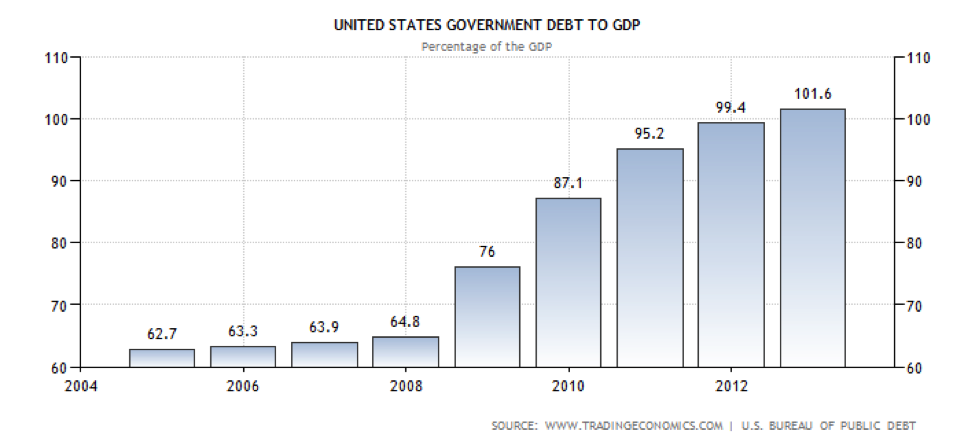
So it’s obvious that something else is afoot, and it has to do with the question of why the twin sledgehammers are not working as well anymore. And furthermore, what is the “something else” that policy makers are now turning to? That is to say, what is Plan B?

The basic answer to why the sledgehammers are not working is that both monetary policy and fiscal policy are debt-financed spending, either by the government or the private economy. The problem is that it works as a cyclical remedy, as long as the debt doesn’t accumulate — which implies that in the prosperities that follow, debt reduction should take place. That is what George W. did not do, but Bill Clinton did.

The need to avoid accumulating debt was forgotten as the economic high just induced a greater desire for prosperity with mindless expansion of the debt-to-income ratio.

Basically, debt-driven spending — whether public or private — is a cyclical policy that is not meant to be a long-term secular fix. If a government and the Fed keep at it as a secular fix, it has offsetting effects when a greater share of income is required to service debt.

This is not lost on the private economy, as consumer debt relative to income has been worked down since it peak in 2007, which in turn continues to slow the economy today. Nor was it lost on Keynes himself. But governments didn’t get the memo, and they keep on piling up debt, which restricts the economy by creating a need for more revenues to service that debt.

The twin forces of stimulus from debt-financed spending and the subsequent need to service or retire debt is becoming evident today. As an example, in Japan since the last election, Abonomics has employed the macro sledgehammers with great force but has followed up with a national consumption tax that offsets Plan A. Much the same is happening in Europe and in the U.S. with QE tapering and fiscal sequester reining in the expansion of Plan A.

So what becomes Plan B when Plan A is being made to face the facts — specifically that secular debt accumulation is ultimately counterproductive?

Politicians are now doing what is pragmatic to attract business to their geographical location without the benefit of Ivy League economic theory. This is being done city against city, state against state, and now country against country. Plan B at the country level was the subject of the recent G-20 meetings as a response to the Fed’s tapering of QE, so it’s going global.

Plan B takes the form of reducing taxes as compared to your competitor, enacting less costly and burdensome regulations, and even underwriting business start-up expenses. It also takes the form of job training and infrastructure development. Those and other efforts are supply-side efforts to be relatively more competitive.

Some of them are outliers by historical example. That would include Michigan, which became a right-to-work state in 2012, and others in the Midwest are following.

There is a significant difference in the public perception of Plan B as compared to Plan A. In B there is little accompanying press and no photo opps for the politicians or the Fed Chairman, and hence fewer images to drive Wall Street expectations. But these low-profile policies are relentless, albeit slow. On the surface they appear to be policies that do more in totality than merely change the location of business. The benefits come in the form of greater efficiency (measured by output per worker) and less debt accumulation, either public or private.

Are they enough to offset the unintended debt consequences of previous demand stimulus? That we shall see, but at least this is a move in the right direction toward offsetting the ill effects of secular debt accumulation.

A major question is: Can these policies that are associated with the Right Wing be implemented by Left Wing majorities in many places? Well, if Liberals are in political control, they are also responsible for economic outcomes. So they will find ways to implement typical conservative platforms packaged as inspired liberal genius.


Sign up to receive the Spellman Report. Bracing financial and economic insight. Now with free delivery!

Is the Cyprus Bank Fiasco the Template for the Future?

cyprus_bankWe are living in profound times. The Great Recession, followed by epic levels of deficit spending sustained by monetary policy, is now having short-term remedial effects on the U.S. economy.

But before we declare victory, we need to be clear that the real battle lies ahead. Over the next four decades, the government will be under unrelenting pressure to finance the commitments of the developed world governments and pay interest on its accumulated debt.

Even if the political miracle of balanced budgets were adopted (along with ultra-pro-growth policies), that wouldn’t eliminate the interest expense on the debt that has already been accumulated. Governments will need to marshal the political will shortly, if it’s not already too late.

If they don’t, what lies ahead are more Cyprus-type events in which bank deposit cram-down is, in effect, a tax on private wealth — the result of government pressures to sell debt.

Here’s how this occurs: Governments delude themselves and their constituencies to think there is no sovereign debt finance problem and hence no need to stop spending. A favorite tactic in this self-delusion has been to force-feed government debt onto the balance sheets of the country’s private banks and non-bank financial institutions.

Within the EU, that tactic went pan-European. This means Greek debt (remember that?) is sprinkled onto the balance sheets of institutions across Europe — especially the Cyprus banks, as it turned out. Financial regulation encourages this sprinkling of debt by declaring government debt to be safe and sound, pushing private institutions to expose themselves to government debt risk.

This is typically done before governments turn to their central banks to support their bonds, an outcome that has only occurred recently.

Basically, the regulated financial institutions were made into piggy banks to finance their government’s deficits and allow them to keep on spending. In piggybanks economics, governments pilfer the funds and leave a confessional note, which in this case are their government’s bonds. After all, who would criticize the banks for being a party to the pilfering when the government’s debt is classified by regulators and rating agencies to be Tier 1, or riskless?

This is not a solution — it is merely an enabling device that allows the government to avoid short-term pain and financial embarrassment from not being able to sell their bonds to market investors at reasonably low yields. But it builds on itself and blossoms into later and greater pain.

It’s an attempt to cure cancer with aspirin, covering up the underlying financing discomfort of the government debt overload. But with the advance of time, the aspirin has worn off and the cancer has spread. It took down the banks in Cyprus, which had purchased a large helping of Greek government debt that subsequently took a 74% haircut.

To add to the government’s financial problems, piggybank finance in turn triggers deposit insurance payouts, typically by the same government whose bonds were written down. When government bonds depreciate due to market risk valuations, there is a multiplier effect on fiscal demands, accelerating the decline and fall of both governments and banks.

Since European governments only recently took up pan-European bank supervision and joint responsibility for bank losses, it was too late to prevent the crisis in Cyprus, as there was no time to build up a deposit insurance trust fund. That requires many years of banks paying a deposit insurance fee that actually goes into a lock box, so bank bailout assistance needed to be pay- as-you-go.

When the German and Dutch voters contracted a well-deserved case of assistance fatigue for southern European banks, this ushered in the era of private wealth meltdown in the form of depositor haircuts.

In the words of the Dutch finance minister, what you just saw in Cyprus is the template for future insolvent banks. In an interview with reporters in Brussels after the Cyprus plan, he indicated:

“What we’ve done last night is what I call pushing back the risks (onto depositors).…If we want to have a healthy, sound financial sector, the only way is to say, Look, where you (depositors) take on the risks, you must deal with them, and if you can’t deal with them, then you shouldn’t have taken them on … that is an approach that I think … now we should take.”

What has abruptly occurred is a shifting of the burden and responsibility to the private wealth owner, and an end to the pretense of government responsibility for financial stability, safety and soundness.

This is the end of the post-Depression era in practice since the bank runs of the 1930s, in which governments sought to preserve, protect and defend private wealth owners — and had some ability to do so.

Heretofore in the saga of Euro sovereign financial strains (now in its fourth year), all revisions and reinterpretations of the underlying treaties, laws, collateral agreements, benchmarks, and other policies that formed an understanding of the rule of law were protective of the individual in times of extreme stress. That is, hastily assembled Euro country bailout funds and the ECB’s extraordinary LTRO financing of banks and its support of various government bonds was in violation the rules but for the benefit of private wealth owners.

This has been replaced by reinterpreting the rule of law to benefit governments at the expense of private wealth owners, pushing depositors to the front of the line to take losses in order to protect the government.

This is a tectonic shift. It raises questions about the future costs and changes that could stem from the loss of confidence in government protection of wealth, especially among bank depositors.

This loss of confidence will drive risk premiums on bank deposits of both insured and uninsured deposits. This natural financing response by depositors implies a higher deposit rate commensurate with the perceived risks before depositing, resulting in shrinkage in banks’ spreads between the yields earned on assets and paid for funding.

As it happens I was involved, along with co-author Doug Cook, in a study of the size of the risk premiums depositors required when confidence in deposit insurance protection was in question in the U.S. during the Savings and Loan crisis of the 1980s. Even with deposit insurance pledges by the government (but with a yet to be recapitalized deposit insurance fund), the market assessed on average 370 basis points to the bank’s cost of funding due to the insurance risk (as apart from the bank’s risk) in the geographic areas where it was thought the banks’ assets were weak.

This represents an enormous shrinkage of the banks’ underlying profitability even in the absence of further asset write-downs. And moreover, banks have become especially vulnerable when central banks drive down asset yields to a floor of zero and the market forces its funding costs upward. There is no margin left in the middle, which is a banking disaster in the making.

To give you an idea of where we may be heading, the net impact of government guarantee risk on the U.S. Savings and Loan industry is that the industry no longer exists. This raises the question of where Euro banking will migrate, as there is a large demand for riskless transaction assets.

No doubt some Euro bank funding will find the U.S. shores, but the same underlying softness exists in U.S. deposit insurance guarantees, as the FDIC is barely solvent and the U.S. government is central-bank dependent. Hence, the U.S. suffers from the same cancer, albeit at an earlier stage.

The Cyprus fiasco was well more than a reorganization for the Bank of Cyprus. It is a revelation that developed-world banking is not anchored on terra firma for those with claims on the piggy banks, whether they are bank deposits, annuities or private pension funds. They are all at risk now and are no longer government supportable.

The bottom line, as stated by the Dutch Finance Minister, is that investors now need to examine carefully their chosen private financial institution’s balance sheets and their wealth holdings with a new understanding of risk in this new millenium.


Sign up to receive the Spellman Report. Bracing financial and economic insight. Now with free delivery!

The Now Generation Government Has Failed the Marshmallow Test: Making Sense of the Fiscal Cliff Outcome

Over the past five years, the government has applied the usual demand-side remedies in the epic battle against The Great Recession. The graph shows the time profile of past recessions and recoveries as compared to the Great one that we are still in. Though stimulus fiscalcliff1has been applied in heroic proportions, the employment high ground of five years ago has not been revisited. This graph clearly reveals this recovery lags all others in the post WWII era in which stimulus spending was considerably lower.

At this moment in history, the realization that continuing to run deficits to win the recessionary battle is compromising the ability to win the war of fiscal sustainability — and without that goes future entitlements, at least in real terms. Thus a trade-off of now vs. the future needed to be confronted.

As former Wells Fargo CEO Richard Kovacevich puts it, at the end of the day, the fiscal cliff deliberations continued to put the stimulus on the overstretched Federal Credit Card. In his words our federal budget is equivalent to a family earning $22,000 per year, but spending $38,000 per year with an existing credit card debt of $143,000. The next leg of the saga is to raise the debt ceiling so we can continue to max out a higher credit card limit.

What all this did was to reveal in plain sight that our leaders, who are likely a reflection of our population at large, are members of the Now Generation.

Overcoming our current inability to deal with the bigger problem of fiscal sustainability is key to economic growth as well as maximizing future fiscal proceeds and government benefits. To do so requires an inter-temporal trade-off.

This is a classic test of immediate vs. deferred gratification.

This trade-off was memorably tested in the “Marshmallow Experiment”fiscalcliff2 of children aged 4 to 6 by Stanford psychologist Walter Mischel who found in a follow-up study that children who were capable of deferring gratification eventually went on to earn higher scores on their SATs and achieved other life accomplishments that require some front-end investment.

Now it is important to note that the Stanford Marshmallow Experiment offered higher returns as compared to present returns. That is, the promise of two marshmallows later vs. one today was made by Professor Mischel, not the U.S. fiscal system.

In our case with projected growing entitlements, we just can’t vote them in and expect them to happen. We need an environment that would be conducive to fiscal discipline so as not to allow unaffordable debt overhead, lest Reinhart and Rogoff effects of slower growth and government default set in. While this might seem Utopian it has happened, even in the U.S.

The Gramm-Rudman-Hollings Balanced Budget Act nearly 30 years ago addressed the issue of defining a framework to self-control government deficits. Basically, the Act created the requirement that adding a dollar of spending would require identifying a specific spending reduction. This caused each dollar of additional spending to be traded against some existing obligation as a yardstick of value.

Well you can image how popular that was, even then, when leaders could pass the marshmallow test! Regrettably, the automatic self-constraint mechanism was found to be unconstitutional and was replaced by a succession of legislation that watered down the spending and deficit constraints and brought us to our current state of allowing debt to compromise the economic growth engine along with fiscal sustainability.

In today’s societal trade-off, Congress likely has already put us in an environment in which one marshmallow today will only perhaps generate a fraction of a marshmallow tomorrow. That is, growing marshmallows for the future requires deferred gratification today so that today’s debt is not a deterrent to economic growth and future government revenues and marshmallows.

One factor that reinforces the lack of will to bring about deficit and debt control that could lead to additional future marshmallows is the unwritten American ethic to not willingly fork over to the federal government more than 20 percent of annual GDP in all forms of collected taxes. If individual income tax rates would generate Treasury Revenue that exceed that proportion of total GDP, deductions and exemptions have been added to the tax code to keep the checks written within society’s actual shadow ceiling.

Even during the height of WWII, with an economic boom and confiscatory individual and corporate income tax rates, the government was only able to raise an income share of 20.9 percent of GDP from all tax sources — even though the federal spending shares of GDP was 43.6 percent in that wartime period.

Since then, only capital gains of the tech era generated a Treasury revenue share of GDP barely in excess of 20 percent of total income. The state of the economy is the primary determinant of the Treasury taxes paid, so a slow-growth economy spells big trouble for the deficit almost irrespective of tax rates being agonized over in Washington.

The rates that Congress does apply are more for political showmanship and a statement of the collective values, wants and needs of its members rather than a reflection of actual revenues received — though I doubt most of them realize it.

In 2011, the Treasury collected only 15.4 percent of total GDP against spending of 24.1 percent, accumulating debt equal to 8.7 percent of the current GDP pie. This will continue for as long as the eye can see or until the deficit can no longer be financed or pawned off on the central bank.

On top of those implicit American inhibitions, the issue of shared sacrifice in the face of imminent danger is also a passé American ethic, as discussed here by Lacy Hunt. In 2011, the bottom half of the income spectrum contributed but 2.4 percent of individual income taxes receipts, and the recent taxing the “wealthy” adjustment only reduces that proportion.

We can only guess what tomorrow’s marshmallow allotment will be. But with no deferred gratification constraining debt blow-up, no shared sacrifice, and no willingness to give up more than 20 percent of GDP, future gratification will fall on the back of the central bank until inflation inescapably reduces tomorrow’s marshmallows in real terms.

If there is any rationality to it, what Congress and the President seem to be saying is that they realize there is no Professor Mischel to supply two future marshmallows and that the government’s ability to do so is already lost, except via money illusion of the printing press. So, their logic has become, deferred gratification on our watch is senseless.

Investors thus far have been concerned that would be the unintended consequence, but it now appears to be the unspoken plan. Investors would be wise to protect themselves.


If you enjoy this blog, please forward it to others who may be interested. Sign up to receive the Spellman Report. Bracing financial and economic insight. Now with free delivery!

Roadblocks to Recovery an Interview with Dr. Lacy Hunt

The extent and implication of the U. S. debt overload. Neither monetary nor fiscal policy can solve the debt problem nor the profound side effects of excess debt.


Download .pdf
Welling at Weeden Interview

The Anatomy of a Financial Meltdown

The Euro debt situation continues to deteriorate and the U.S. is not far behind. All the distress that is now focused on government debt comes from excessive private indebtedness as developed world countries seek to support the private sector. This has shifted the debt burden to the government sector, and now the government is the problem, not the solution. This is the outcome of a debt-bloated economy. For more background on this topic, I recommend that you watch the splendid discussion I had with Dr. Lacy Hunt a week ago — the video, “The Morass of Debt,” is linked and posted below. It covers the extreme difficulty of resurrecting an economy that has a debt overload. Regarding the Greek debt containment status, consider the following;

The grand containment scheme — as noted in the previous two posts, “Why These People Are Smiling” and “As Greece Goes So Goes Europe: How the Unthinkable Happens” — continues to deteriorate. Cover-ups tend to unravel when there is a hole so large and getting larger relative to the resources available to fill it; this happens even faster when the cover-up involves so many moving parts and requires so many volunteers to take the hit, particularly when there are strong private incentives not to volunteer. A partial list of the unraveling of the past week is as follows:

The banks that were to rollover Greek debt at ridiculously low yields, considering their risks, have largely already dumped their bonds to get out of the charity business.

The rating agencies have shown some backbone (or creditability survival instincts) by downgrading Portugal and Ireland to junk, expanding the necessary cover-up.

Depositors are fleeing Greek banks (and probably others, as short-term funding rates in Europe rise), creating a liquidity crisis in which banks are loath to lend to other banks for fear of a default. A liquidity crisis morphs into a solvency crisis if banks are forced to dump bad assets at the already depreciated market terms and dump otherwise good assets at deep discounts to fund the deposit withdraw. Each asset sale is noted by the bank accountants as a reduction of income and capital.

Greece and other Euro banks are under a depositor flight that used to be called a bank run. The ECB is called in to lend to these banks, but the rules require investment-grade collateral for these loans. Since the banks do not have unpledged investment-grade collateral available, the ECB has indicated that it would accept virtually any opinion of quality (besides those of the three major rating agencies, which are now being realistic) to qualify as lawful collateral. The standards are depreciating, and the ECB will be left holding the bag of bad assets, adding to the loss of confidence in holding wealth denominated in the Euro.

To make matters even worse, a new bank stress test is supposedly being released that will make some ludicrous assumption of the value of government bonds. It is an intended cover-up of the situation and will add to Knightian Uncertainty —increased uncertainty from not having the facts to evaluate the risk causes depositors to flee and markets to sell off banks’ stock, making it impossible for banks to raise replacement capital of any form, except for the charity of the central bank.

In order to prevent financial insurance claims, the rules of the game are being altered. A “limited” Greek debt default is being created for the “volunteer” banks that are being forced to roll over Greece’s debt at below-market yields. The” limited” designation is to provide the basis for the argument that all other Greek debt outstanding is good, hence protecting against a financial insurance payout. We’ll see if that holds up in court as those who took out insurance want it to be paid — but that will be much later.

And now, Italy has come into focus as the second “I” in “PIIGS.” The market is turning against their bonds.Lastly the IMF, now under the former French finance minister (as of a week ago), is hardening its terms to provide budgetary help to Greece. It sea former classmate of mine, as the outgoing IMF acting managing director, pushed through a higher hurdle for Greece’s lending before the arrival of the Madame from France. Furthermore, the IMF is sticking to it as the developing countries are in the process of reining it in to prevent it from being an exclusive developed world slush fund.

There is more trouble for Greece and the PIIGS: Not only do they have debt that can’t be sold in the market and political inability to contain deficits, but the veterans of sovereign defaults from Argentina looked at the situation and claim the Greek situation is DOA (my interpretation). They point out that even if all Greek debt were somehow to disappear via default without any compensation to the debt holders whatsoever, Greece still runs a fiscal deficit.

Furthermore, in a very insightful piece, John Gilbert of GR-NEAM questions the sustainability of Greece and Portugal’s economies apart from the burden of past, present and future debt. It seems these countries have an extreme dependence on foreign energy that causes their trade deficit to balloon when oil approaches its current $100-a-barrel price tag. That is, apart from debt, these economies are toast because they can’t export enough to pay for imported energy.

Lastly, the distressed Greek assets are not finding eager buyers who are ready, willing and able to pay what Greece had hoped for.

All of the above components are the makings of a financial crisis on par with the Lehman weekend. The banks’ condition no doubt will be favorably spun with the new stress test, and the market will still run the banks. Even the Federal Reserve is making noises about the possible need for a new QE this week (what a retreat from last week), pinning the problem on slow U.S. economic growth. But the Fed’s real intention, it seems to me, is to be poised to be lender of last resort to back up the ECB as depositors flee banks here and abroad, as they did in 2008 in amounts greater than $1 trillion.

This is the outcome of a leveraged financial system that has taken a large position in an asset category (government bonds) that has subsequently been deemed to be risky: It all cascades down. The financial institution assets depreciate, and the liability side of bank balance sheets is compressed when depositors run and the banks’ capital account is written down. The market forces them to face the reality that neither the banks nor their governments wanted to face. Financial gravity ultimately wins despite the best and deceitful government efforts.

One aside: When Mexico was faced with a similar situation in 1982, banks were failing and depositors were fleeing. The response was to beef up the containment package by requiring government permission to exchange local currency for foreign currency, and on top of that, all banks were nationalized so the government could determine who was withdrawing pesos in a capital flight. Unless you stay one step ahead of regulation, you risk becoming a “volunteer” to help out the banks. I think most have had enough of that.

Now the important and relevant question is where the private wealth will flee. It is the question of the systemic flight to quality asset. The usual response, as it overwhelmingly was in 2008, was the U.S. dollar and the U. S. Treasury — but that depends on the perceived riskiness of the U. S. situation, which is not likely to be resolved before the Euro situation comes to a head. So it appears the answer will be that wealth will not flee to the usual places even if a U.S. debt ceiling deal is done on time.

This is a vital issue and I am working on an analysis of it, as all investors need a safe haven asset if they wish to preserve their wealth. Euro bank deposits are obviously not it, and U.S. investors might be shocked to understand that the usual “risk off” asset of money market funds is also not the safe haven it once was.

The Morass of Debt


Interview with Dr. Lacy Hunt on the pervasive effects of accumulated debt on the economy and financial market pricing.


Post navigation

Newer posts →

Receive The Spellman Report Monthly for Bracing Economic and Financial Insight


Click to Subscribe Now
Click to Email Dr. Spellman
Tweets by spellmanreport
Lew Spellman

Lew Spellman is Professor of Finance at the University of Texas McCombs School of Business. The Spellman Report seeks to interpret current and future trends in the economy and financial markets from the perspective of history, theory and policy.

Other Commentary

Frank Beck, Beck Capital Management
Bill Gross, Janus
The Grumpy Economist
Jeffrey Snider, Real Clear Markets
Ben Bernanke
Hoisington Management, Economic Overview

RECENT POSTS

  • The Pernicious Effects of Debt Accumulation: An Interview with Lacy Hunt
  • Is your Child’s Lemonade Stand Against the Law?
  • For the Millennials, The Social Security Chickens have Come Home to Roost
  • Does Mega Money Result in Dead Weight Debt?
  • In The New Monetary Ballgame, the Game Is Rigged for US Treasuries (Part 2)
  • It’s a Whole New Ballgame: The Fed Has Been Stymied: (Part 1)
  • The House of Cards: EU Edition
  • The Mad Genius of the Zero-Forever Bond
  • Bond Refugees Flee to Stock Lands
  • Negative Interest Rate Neverland

POSTS BY TOPIC

Disclaimer: The Spellman Report is not an offering for any investment. It represents only the conclusions and analysis of Professor Lewis Spellman. Any views expressed are provided for information purposes only and should not be construed in any way as an offer, an endorsement, or inducement to invest.
© 2016 The Spellman Report
↑