Tell Spellman It’s an Art, Not a Science

science-copy

Economies mutate. This occurs when responses among variables in the economy start to change. In the terminology of economics, the elasticities have changed and they, in turn, change the behavior of the entire economic system.

These can be due to changes in incentives (or the reactions to incentives), changes in the rules (either regulatory or legal), or changes in supply conditions. And then there is technology, which constantly morphs.

So relationships that one has become accustomed to may not hold up as they did for decades. Ultimately, they were not written in stone.

For the designated managers of the US economy, The Federal Reserve Open Market Committee who influence financial variables as a means to bring about desired changes to a national economy such as for employment and inflation, this is a perplexing task. To manage it, economists have endeavored to model the economic system mathematically based on a history of economic reactions. They then seek to derive simple rules for adjusting the variables subject to their control to bring about the desired end results.

Therein lies the development of “rules of thumb” for how to manage the economy. One such example is the Taylor Rule for interest rates to smooth economic cycles. Another was Milton Friedman’s dictate to keep the money supply growing at a constant rate. And there are a lot more.

However, once these simple rules of thumb are developed, often mutations creep in and the rules no longer work as well (or at all), and policy becomes a perplexing endeavor — and that’s where we are today.

It’s in this context that we should view the work of the besieged members of the Federal Open Market Committee who make the call as to whether or not to attempt to raise interest rates. It’s clear they have been perplexed for some time as to whether or not to pull the trigger.

Rather than scorn these poor public servants, it would be more appropriate to pity these mere mortals who are tasked to keep the economy and financial markets running smoothly as per their instructions via the Full Employment Act of 1946.

The question of raising interest rates at the moment has become a much ballyhooed event for which every investor, financial writer, and taxi cab driver no doubt has his or her own opinion mostly held with near certainty.

After all, it’s a momentous event when, after seven years of buying securities and adding quantum leaps to its balance sheet, the Fed contemplates switching to selling securities in order to lower financial prices and raise interest rates as a means to glide to a new economic growth path.

To undertake the task of economic management that was thrust upon the government about 70 years ago, economists both inside and outside the Federal Reserve attempt to systematically estimate as exactly as possible the restraining and simulative effects of Fed actions.

That is, the financial variables that are life and death to investors are, to the Fed, a means to an end: economic stabilization. More broadly, the mandate is to adjust the financial variables in order to iron out the excesses of the spending cycles — both the highs and the lows relative to the available resources. The objective is to produce smooth spending growth that matches the level of and the growth of the supply capability.

The supply side target is called Potential GDP and it’s not static. That is, the supply side target moves through time when labor and capital resources grow and productivity advances and the matchup would result in no more than 5% unemployment and an inflation rate of about 2%. Undershoot it and the unemployment rate is higher and over shooting would result in higher inflation.

So this process of matching up spending with the growing supply capability is akin to trying to send a rocket to the moon and produce a soft landing. The policymakers are trying to produce a spending trajectory that neither misses the moving target to either the high or low side, least we have unacceptable unemployment or inflation.

Obviously, this requires a good deal of estimation of not just the path of the target but how the system will move and react to policy controls to reach the target.

To do so, the science (or, some would say, the art) of econometrics was developed to mathematically model the systems reactions to the financial variables that the Fed can control based on past data.

From the point of view of the econometric creators of the mathematical version of the economic-financial system…this was the linkage from the Fed’s controlled variable to the variables that Congressman tasked them to hit …some version of full employment and price level stability.

So for many years since at least the l960s, econometric models of the system of responses have been built and added to each year. Of course, it’s based on the precious little data. Because there are many variables to be estimated, accuracy requires that economists collect a lot of data.

More important, reducing estimation errors also requires collecting more relevant data. For example, in picking the voters’ choice for the Republican nomination, one would not to care to rely on a sample of fifteen voters which is not much greater than the number of candidates. More accurate estimates of many variables derive from a sample of many thousands.

So as to be able to obtain as much data as possible to make estimates of how the variables of the economy react to each other, the economists had to go back to the data bin of past experiences and recreate the data starting in 1929.

But herein lies the rub of the scientific approach: to enlarge the sample size, which is still at bare minimum levels relative to the number of variables that are involved, they looked backwards and relied on history — but history can be fickle. Mutations to the underlying elasticities create a misleading database.

So they have been in a quandary as to whether or not to raise interest rates because the system they had thought they understood suddenly stopped working in its usual way.

Stimulus was applied in some great multiple of any previous stimulus, but the reaction has been weak and late to materialize.

The source of the uncertainty is the new context of the economy as it labors to produce positive results within an open global system of not just foreign goods competing with domestic goods but also with the wild card of foreign capital flows that are capable of gushing in or out of a country and offsetting or magnifying Federal Reserve changes in available market funding.

Moreover, exchange rates have become flexible and no longer fixed by governments, and there is no insulation from foreign capital inflows or outflows. So when the US dollar strengthens, as it has, the products of US multi-nationals get priced out of foreign markets. Further, the changing exchange rates drive capital in and out of countries, which accounts for far more financial buying power than the Federal Reserve would dare employ.

To make matters more difficult, foreign central banks are motivated to protect their own end of the global bargain and offset Fed actions that are self-serving to the US. Furthermore, the US banking system has not responded to the availability of cash reserves remotely near past responses.

So one should understand the complications are not just determining the path of the “moon” that our rocket is chasing but also the responsiveness of the rocket to the Fed’s control tower.

So the question is, is policymaking today an art or a science given that the models they have to go on fail to capture the essence of today’s elasticities?

This idea causes me to harken back to an experience I had in the l960s when I was an economist at the Federal Reserve. At the time, economists (myself included) were agog over the science of being able to model the responses to policy.

To do so, I constructed a model of the economy on an analog computer, which was ideal for tracking the interactions of the financial and economic variables over time. There was a lot of experimentation to set the elasticities so that the resulting system reactions followed patterns that were similar to the then-current economy.

To give the experiment some life, I set about simulating what the Fed’s Chairman at the time described to be his method of stabilizing the economy. He called it “leaning against the wind.” While highly suggestive, it needed to be fleshed out. I came up with a few versions of practical implementations of what could arguably be a policy rule for “leaning against the wind.”

I presented the methodology and results to a staff economist colloquium that also included most of the Governors who sit on the Federal Open Market Committee.

The response was dramatic among those tasked with deriving a mathematical response to policy stimulus. Alas, the paper and news of the presentation reached the Chairman whose considered response was that someone should “tell Spellman that monetary policy is an art, not a science.”

Over the following decades, the scientific approach to modeling has attempted to be more precise, but during those same decades, the underlying system mutated and there is insufficient historical data that’s relevant to today’s mutated economy.

So now we have come full circle. The Fed, in making its historic interest rate decision, is left only with art and models built from less relevant data, which for them is an uncomfortable place to be as the policymakers these days are trained scientists, not artists.

Let’s hope they have the courage to move on even though they lack the scientific proof that, indeed, raising interest rates would push the economy toward absorbing the last of the unemployed while not trigging incipient inflation, nor which would send the economy back into the Great Recession.

At this point in life, decades later, I’ve come to agree with the Chairman of bygone days. Policymaking is an art, not a science. This is not to say they shouldn’t lean on what science would suggest.

This is not a comfortable place to be when having the responsibility for the outcomes ahead, so I do watch for nervous twitches as they testify before Congress and global financial opinion.

Sign up to receive the Spellman Report. Bracing financial and economic insight. Now with free delivery!

The Cats and Dogs of the Equity Markets

dogcatSome 70 years ago, Congress spelled out the economic growth objectives for the U.S. economy in the Full Employment Act of 1946. The mandate was for the government to support policies that would bring about sufficient economic growth so that employment would become “full.” Congress also included a restraint to the mandate that would limit inflation, but over time, both interpretations and priorities change. After all, this is politics as well as policy.
In aiming for full employment while controlling for inflation, the greatest responsibility fell on the shoulders of the Federal Reserve, which had the short-term flexibility to vary the cost of credit to manipulate aggregate demand.

To do so, there had to be an understanding of how much aggregate spending was needed to generate employment levels considered to be “full” without accelerating the inflation rate. This led to the development of a macroeconomic target called “Potential GDP,” which defined how much GDP spending would be needed to create enough demand in markets that would cause firms to hire just the number of workers consistent with full employment. Too few, and targets wouldn’t be met. Too many, and there would be inflation.

The goal, then, was for the Fed to match an equal amount of demand to Potential. This concept and its calculation was the work of Arthur Okun in l962 that become known as Okun’s Law.

The second link of what needed to be established is how that amount of aggregate demand would relate to the Federal Reserve’s main policy instrument, the short-term interest rate. This was accomplished by the Taylor Rule in the early l990s. It provided an estimate of the short-term interest rate that would generate the demand that would cause business firms to hire enough workers so as to be at full employment.

All these machinations of determining the right short-term interest rate to drive spending to the right number that would, in turn, cause businesses to hire the right number of workers to claim that employment is full is an ongoing exercise because the relationships that determine that interest rate are constantly changing. That is to say, the latest calculation of Okun’s Law (how much spending is needed) and the Taylor Rule (what interest rate creates that amount of spending) are subject to the latest economy-wide responses — and those do change.

For Wall Street, the Federal Reserve’s plan to raise interest rates, is seen as an attempt to put a dent in the economy and, hence, corporate profit growth and — in turn — stock prices. What Wall Street doesn’t realize is that the interest rate adjustment is supposedly one that will get the economy to full employment (and prevent inflation acceleration) and keep it there.

But the stock market’s obsession with the Fed’s intention to raise interest rates is largely misplaced: The Fed is looking to maintain growth, while allowing for some inflation which is viewed as a means to depreciate debt outstanding. To the extent there will be an interest rate increase, it’s likely to be little and late and an almost symbolic fulfillment of their duel Congressional mandate.

Nonetheless, all the major stock market indexes for U.S. equities since the beginning of the year are flat, reflecting a deterrent to growth that the Fed rate adjustment would supposedly create.

But there is other reason for Wall Street to be concerned with the general advance of stock prices.

When employment growth occurs, as it has, in this slow-motion up-cycle, labor becomes relatively scarce and wages increase. That’s the whole point of the macroeconomic exercise of targeting full employment. But in turn, rising wage rates increase the costs of production, which reduces profit margins and total profit.

We are at that point for many firms. Actually, we are beyond that point.

The more ominous rate for Wall Street should be the wage rate — not the interest rate — that flows into corporate employee costs. This creates a larger dent to overall profit than is being added either by more output and/or higher prices as the economy approaches Potential.

The wage component of employee costs is now bumping along at close to a 3 percent rate, but that only partially reveals the deterioration of profit due to employee compensation. There is a rarely viewed government statistic called the ECEC, or the Employer Cost of Employee Compensation. This calculates the employment cost to employers, taking into account not only wages but also benefits. Those have amounted to a 4.9 percent increase over the past two quarters.

The employee cost component is rising, but employee benefits are rising at a more substantial pace as the Affordable Care Act (among others) kicks in.

But that still doesn’t fully reveal the dent in corporate profit that will be delivered from tighter labor market conditions. It’s not just employee expenses that matter but also the extent to which those costs are offset by greater productivity of labor. That is, if labor costs rise and are offset by more output per employee, labor cost per unit of output can actually decline, resulting in a larger bottom line. But that’s not happening. Rather, the opposite is occurring.

The Bureau of Labor Statistics indicates: “Productivity decreased 3.1 percent in the nonfarm business sector in the first quarter of 2015; unit labor costs increased 6.7 percent (seasonally adjusted annual rates).” In manufacturing, productivity decreased 1.0 percent and unit labor costs increased 3.4 percent.

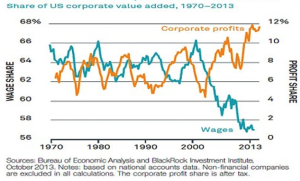
The significance of this 6.7 percent increase in unit labor cost must be compared to profit margins per unit. On average, pre-tax profit (as a percentage of corporate value added, as a proxy for profit margins) is at a very high 12 percent per unit produced, as can be seen below. Hence, we are looking at a collection of firms potentially losing half of pre-tax operating profit to employee compensation — and stock market shocks will follow.

Thus there is a built-in contradiction of achieving macroeconomic success of driving the economy to where employment is full and simultaneously providing stock market returns. The only way the two can simultaneously occur is if firms invest in capital equipment to raise productivity more than the growth in employment costs. But that happy state of affairs is not occurring.

dogs


So at this juncture of the business cycle expansion, we are looking at increasing labor cost per unit produced with a large dent to profit margins and reduced profits for firms with heavy dependence on U.S. labor. This implies U.S. service industries are the most vulnerable.

But yet there is still a stock market opportunity with widening profit margins for firms that use foreign labor (via outsourcing) and are paid in cheaper foreign currency given the stronger U.S. dollar.

Some firms will benefit from global access to cheaper employee costs. Basically, there will be a dispersion of positive and negative shocks from firm to firm with the ratio of the advancing-to-declining stock decreasing. Some stocks will become dogs and other will be purring cats of profit expansion due to cheap foreign labor.

The implication for investing in a broadly diversified range of firms would mix the dogs with the cats and the outcome would reflect the same: stagnant returns on average, along with a general sense of uncertainty as some firms experience earnings surprises, both positive and negative.

Firms that benefit from this macroeconomic environment are those that deliver goods to U.S. consumers that are produced more cheaply abroad. Detecting and targeting those cats from the dogs in this environment is more the issue for U.S. stock market investors than a generalized fear of interest rate liftoff.


Sign up to receive the Spellman Report. Bracing financial and economic insight. Now with free delivery!

Manna from Heaven and Government Debt


mana

Baby Boomer entitlements, long viewed as an over-the-horizon problem, are now upon us. These unfunded liabilities are morphing from a forecast into actual debt, a process that will continue for decades, and the accumulated debt is already undermining aggregate economic performance. It’s a problem that is crying out to be addressed and the sooner the better.

The implications of government debt accumulation have been the subject of posts on this site and throughout the blogosphere, but the topic usually receives a “head in the sand” treatment from governments and politicians, alike because the implied cure — to rescind entitlements — is a political third-rail.

If not addressed, debt default ultimately occurs, but that doesn’t seem to even arouse a response other than the hope that it occurs on someone else’s watch. (Observe the Greek debt theatre being played out.)

So the question is: What fixes can governments apply now that can still sustain the economy and all the things that go with it? Certainly supply-side policy should be front and centre in that discussion. Everything the government does needs to be viewed from the prism of economic growth which provides the income to sustain debt.

Having run out of conventional solutions within a government toolbox of macroeconomic fixes, the European Central Bank (ECB) is implementing a desperate or some might say a creative and subtle use of its money printing ability. Sadly for Europe though, it will have unfortunate side effects.

The policy, while being labelled quantitative easing (QE), is much more than a monetary policy to create extreme low interest rates. It also has a Manna from Heaven component that can be used for multiple purposes. Allow me to explain.

Quantitative easing originated in Japan and also turned up in the U.S. as large-scale central bank bond purchases. While it seems on the surface to be Keynesian interest rate policy, its more pressing, unspoken reason was debt service containment, both for government and private debt.

Manna from Heaven is unleashed when QE, as implemented by the ECB, is taken to the next extreme level. The ECB intends to buy a large quantity of Euro investment-grade debt, including sovereign debt on secondary markets. To reach their target requires that the ECB offer a higher price to induce present owners of investment-grade debt to sell their holdings to the central bank.

Investment-grade bond purchases by the ECB have been targeted to be approximately twice the current issuance of investment-grade debt (for both private and government issuers) hence reducing the available supply of investment-grade bonds in the market. That puts financial institutions and foreign central banks in a bind given their mandates to hold bonds of this character.

Therefore, there is great competition for Euro-denominated investment-grade debt, and it becomes scarcer with each ECB purchase, driving investment-grade bond prices not just higher but in excess of the principal and all interest until maturity for most debt issues. This is the definition of negative interest rates and reveals how it comes about for market-traded debt. The premium prices paid for by new money issuance is the Manna from Heaven and generates windfall gains for the sellers.

And in the hope of not being considered too irresponsible, the ECB has put a cap on the price premium above the bonds’ total proceeds of 20 percent (which puts a floor under just how “negative” interest rates can go).

Despite the premium prices the ECB is willing to pay for investment-grade bonds, it has come to believe that there will not be sufficient availability of offered bonds on secondary markets to meet their quantity objectives. As a cover narrative, they claim their quantity goals can only be reached if they also purchase original issuance of Euro sovereign bonds at up to the 20 percent premium despite the Euro prohibition on such transactions.

Now think about what that means, as it means a lot.

First, the premium prices paid produce negative yields not only for the central bank buyer but also for pension funds, insurance companies, banks, and endowment obligations (or savers in general who invest in this market). While the central banks can “afford” negative yields, most certainly the private institutions cannot — and they are ultimately on a collision path of not being able to fulfil their contractual obligations when their investment income derived from bonds declines so dramatically. They then become future government bailouts waiting to happen that would substantially add to government debt.

Second, the ability of the central bank to pay premium prices for investment-grade bonds results in windfalls for both debt holders and debt issuers. For them it’s veritable Manna from Heaven financed via central bank printing.

Third, with the price paid being greater than all future commitments on the part of the debt issuers’ means there now becomes a large incentive to keep issuing debt, including government issuers, as they receive greater proceeds than their corresponding obligations. Or to put it another way, they are being paid to borrow.

Fourth, the Manna becomes a new free policy option for governments. Their choice becomes to use the excess cash proceeds to either retire other government debt obligations and dissolve their debt overhang or will they choose to issue yet more debt for which they are being paid? Or yet will they take the cash proceeds and lock up an amount equal to their future obligations of principal and interest and spend only the Manna? They are being given those three options by the ECB. Whatever way is chosen it’s an incredible test of the inclinations of government to act responsibly and address the debt problem or keep on spending and borrowing.

Fifth, irrespective of governments’ use of the Manna, there is a balance sheet effect for the government whose debt is purchased by its own central bank.

As an aside, when the ECB as a policy board orders a buy of a country’s debt, it is purchased by the country’s own central bank. (Yes, the individual country central banks continue to exist even though there is an ECB. The individual country central banks are the operational banks within the Euro system, as are the 12 Federal Reserve Banks carrying out Federal Reserve policy.)

Now, if a Euro central bank purchases its own government’s debt, it defeases (annuls) that debt. A balance sheet defeasment occurs when the government and its central bank balance sheets report on a consolidated basis. The debt of the parent organization (the government) is owned by its subsidiary (its central bank) and, as a result, only net debt not owned by the subsidiary can be reported. Indeed, the U.S. now reports government debt outstanding on a net basis to mollify those concerned about government debt balances.

Sixth, the ugly government debt problem disappears (on a net basis) when central banks buy its sovereign’s debt and pays monetary premiums for it but, in its place, there is a classic fear that there will be an inflation tax. That is a real reduction in the value of fixed income assets held by the public due to inflation. This is a fear that is totally justified despite today’s weak and deflationary-prone environment, as the increase in the monetary base would be very, very large.

For example, in the U.S., if the Fed were to monetize the total outstanding $18 trillion of U. S. government debt, and with some premium paid above that amount equal to the ECB premium, the total monetary base would easily go above $20 trillion. This compares to a monetary base of $0.8 trillion at the outset of the Great Recession. That would cause a 25-fold or 2500 percent increase in the money base as compared to a cumulative 13 percent increase in real output over the same period. It might take some time to play out but this will certainly lead to inflationary devaluing of fixed income assets and currency and result in capital flight to a more stable medium of exchange.

This is no way to run a government and its finances if a country expects the world and its own citizens to hold wealth denominated in its own currency. Indeed, it is second-best policy not just due to the inflationary potential but also as a result of undermining insurers, pension funds, banks, and endowments to perform on their obligations. Furthermore, negative yields create a poverty class of retirees, of which there will be many.

But somewhere between zero defeasance and total defeasance of government debt is likely to be a better place for debt overloaded countries, giving them the option to use the proceeds to retire rather than squander the proceeds or give in to the incentives to borrow and spend even more.

Manna from Heaven, on its face, can be helpful if done on a very limited and disciplined scale, but when have we ever seen governments do that? The Manna becomes a litmus test of governments’ inclination to act responsibly and effectively, as it could either defease debt or be incentivized to add to debt.

At best it can only be a small help as compared to policies to unleash the supply-side of the economy to generate growth that will sustain the developed world’s debt problems.

Given all this, we find that the monetary sleight-of-hand to produce Manna only goes so far before producing unwelcomed side effects. It’s not a replacement for containing debt within supportable limits. All in all, John Maynard Keynes did a disservice some 80 years ago to suggest otherwise.

We must conclude, the rules of propriety have changed. Many naïve among us believed that when governments borrowed they intended to subsequently tax in order to retire debt. But at least it was thought that taxes would pay interest to service the debt. This too has proved to be a false premise as central banks drive interest rates to zero or negative to accommodate over indebted governments. And now in the final assault on propriety, governments are being paid by central banks to issue yet more debt.

Sign up to receive the Spellman Report. Bracing financial and economic insight. Now with free delivery!

The Point of No Return for Government Debt

Economic growth in the developed world is falling well short of the post-WWII experience, and there are identifiable causes.
Globalism — the opening of global trade — has caused developed economies to lose exports to lower-wage emerging nations and is but one factor. Another is the slowing of population and labor force growth (and, in some cases, both are shrinking). This contributes to the problem of slow economic growth as it restrains both aggregate supply and demand.

Furthermore, when populations stop growing, what outpace economic growth are age-related government entitlements as the age-profile of the population becomes top heavy with retirees. This, in turn, means taxes rise disproportionately on the backs of the relatively fewer workers, or the country — more realistically — resorts to debt financing.

Entitlements accelerate the accumulation of government debt now being piled on top of decades of Keynesian deficit spending that were an attempt to nudge higher growth rates.

It has long been a vague concern that government debt accumulation would be the ruination of an economy, and that sovereign defaults would occur as they have many times in that past. That issue is now front and center in both Europe and Japan, with the U.S. perhaps a decade behind.

Larger debt loads, however accumulated and whether from Keynesian economic stimulus, entitlements, war financing, or financial guarantees, cause tax rates to be higher than would be otherwise be necessary to pay yesterday’s incurred interest. It becomes a struggle for a government to merely pay interest without the possibility of retiring debt.

For example, in Japan, the debt-to-income ratio is a staggering 250 percent. This means that despite very low interest costs on government debt, 43 percent of tax proceeds are devoted to paying interest on its past debt.

Raising tax rates to pay debt service impacts the present as it becomes a negative incentive for investment spending. So past debt retards today’s economic growth.

The great danger of a high debt-to-income ratio is that it becomes self-reinforcing: We induce higher debt ratios not only via higher taxes to pay interest but also because the resulting economic slump unleashes Keynesian automatic stabilizers that have been built into an economy’s spend-and-tax reflexes.

As an economy’s growth rate slows, this kicks in income maintenance programs like unemployment support. At the same time, a slumping economy’s tax revenues erode more than in proportion to the slowdown in economic growth, which is a by-product of a progressive tax structure.

For example, in the first year of the Great Recession, U.S. government debt expanded by 15.8 percent while income declined by 2.8 percent, and together they ratcheted upward the debt-to-income ratio.

The economic slump produced by debt adds to government deficits resulting in yet more government debt and more taxes, which in turn reinforces the slump. The causation runs both ways: debt slows growth, and slow growth widens country deficits and accumulates debt.

What is being described is a self-reinforcing endogenous debt accumulation process in which the debt-to-income ratio rises until it can no longer be financed, resulting in a sovereign default.

The critical threshold when the self-reinforcing process of debt accumulation outpaces income growth has been aptly called thebang pointby Reinhart and Rogoff (R & R). Their research, contained in their book “This Time Is Different,” shows that over many years, for many countries, that the threshold for debt to grow exponentially occurs when the debt-to-income ratio reaches approximately .9 — that is, when a country’s debt is 90 percent of its GDP.

R & R find that on average, for many countries, when that threshold level of the debt ratio has been reached, economic growth becomes retarded by 1 percent. In today’s world, much of Europe (and certainly Japan, too) is well above that point, and income growth has certainly declined and is barely positive.

For the U.S., at a debt-to-income ratio of 100 percent, economic growth is also being sucked into the endogenous web of debt in which, at best so far, GDP growth appears to be have been retarded by 1 percent annually.

The U. S. finds itself this year in a relatively weak cyclical upswing in which the growth of income and debt are both rising at approximately the same 2 percent rate so that the debt ratio is being maintained at the present time, but any slump in growth accelerates the debt ratio.

As a deterrent to debt accumulation, a heroic attempt is taking place in Japan and the U.S. to reduce the interest expense of government debt. Europe, via its European Central Bank (ECB), has recently engaged in a similar battle.

The debt service reduction is being described as Quantitative Easing and is being discussed and sold to the public as being a monetary policy to offer lower interest rates to stimulate interest rate-sensitive private spending. That is, low rates to stimulate growth.

Indeed, many of the central bankers are well trained Keynesians and they think that way, but to the political class, the central bankers are used as pawns to neutralize the government’s debt burden.

There is much debt service to be neutralized at current levels of debt, especially in Japan and Greece. What greatly complicates the problem of maintaining debt service with a high debt ratio is that the government bond market, when it senses that the debt problem is getting out of control, will only finance the government’s debt with elevated interest rates that imbed a sovereign risk premium.

To get a sense for a country’s interest cost exposure to sovereign default pricing, take a simple example of a debt-to-income ratio of 1 and an (unrealistic) interest expense that averages 1 percent on all government debt issues. In this case, taxation would only need to capture 1 percent of a nation’s GDP to service country debt. This expense is manageable.

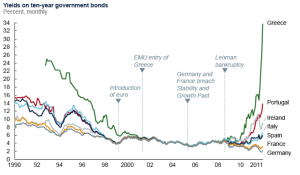
But to be more realistic, sovereign bond yields on 10-year debt maturities are shown below for several different recent European sovereign bond market eras.

Untitled


Prior to the common currency that arrived in 1999, when the Euro countries were on their own (in the sense of no support from by each other or by a central bank), sovereign yields were priced to reflect sovereign risk.

At the start of the common currency in 1999, the sovereign rates came together at Germany’s base rate during the honeymoon of the Euro zone when it was presumed that the stronger countries would come to the aid of the weaker if need be — and if not, there was a central bank to provide assistance. Also debt control was a pre-requisite to be a member of the Euro zone.

This presumption of aid to the weak became questioned after the financial crisis, and there was a weakening of country debt control. This relevant era began in 2008, at which time the market priced country vulnerability with little or no help from neighbors or by the central bank because “monetary finance” (or central bank financing of governments) was still taboo.

That environment reveals clearly how hard markets will punish sovereigns with debt problems. High single digit sovereign yields existed, and Greece, which was headed for its first default, experienced a 30 percent market cost of finance for 10-year maturities.

In this case, for a country with debt equal to 250 percent of annual GDP, and if its sovereign average cost of funding for all maturities was merely 10 percent, that country would need to capture fully 25 percent of GDP to pay interest alone without any of the other costs of government being covered. There would be debt cost of that magnitude likely for both Greece and Japan.

That is the process by which default is brought on when the debt-to-income ratio reaches the bang point. It might take a few years, but the process grinds on until the income lost attempting to tax and service the debt becomes impossible to bear.

So, in a last ditch effort to avoid default, the central bank intervenes with quantitative easing to reduce interest rates paid by sovereigns. QE is in process in Europe, but as things currently stand, Greece’s sovereign debt is not investment-grade and, hence, is not eligible for purchase by the ECB unless the rules are bent or the rating is changed which is a likely response in the pragmatic business of saving the sovereign, otherwise known as “Whatever it takes.”

Alternatively, Greece would need to drop out of the currency union, likely default on its debt in whole or in part, and go back to its own currency from which they can continue to play the money game to depress interest expense. In the case of Japan, the pretense continues, but they are past the bang point and — short of some new exogenous source of demand for their products revealing itself — they are sinking deeply into the morass of debt and debt service.

But will central bank QE really contain the debt service problem? The answer has to be no because the side effects of the debt solution becomes its own problem.

With such low investment returns in-county, capital flees to higher-yielding locations and, without capital, there is no financing of private investment and the real physical capital stock becomes a relic of yesterday. This erodes income and raises the debt-to-income ratio further.

Once having reached the bang point, QE is too late and counterproductive


Sign up to receive the Spellman Report. Bracing financial and economic insight. Now with free delivery!

Oil Boombustology

boombustologyIt’s long been in the DNA of economists and market observers, going back at least to the Austrian School of Economics, that when boombustology_2money growth outpaces the economy’s growth, booms are created and so are busts: Boombustology, as coined by Mansharamani of Yale University.

Certainly quantitative ease as practiced in serial form by today’s central banks fan that concern, but for the most part, the sentiment of central bankers, politicians and the market seems to be “please let there be a boom” and we’ll dodge the bust.

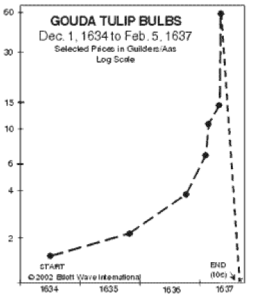
There are all kinds of booms and busts. Some are of a benign form called behaviourism. They are born of the belief of ever-increasing prices. Tulipomania during Holland’s seventeenth century was a classic. Though it might not carry an entire economy into excess but the rise and fall of tulip bulb prices surely redistributed wealth.

But some booms involve financing to purchase the item that is booming whatever it is. In that case lenders also have to buy into the boom to make it happen. When the item booming requires industrial equipment to produce it, the economic ripples become far reaching.

The boom mood creates over-building of the capital goods and eventually, the oversupply of the booming item whether we call it tech, housing or commodities. Then, the rising price of the item that precipitated the borrowing and building turns into a free-fall of prices, borrowing and building. There follows an air pocket of demand for the capital goods in question which can then become a generalized demand suppressant and a financial bust.

The lethal combination of reduced demand and over-supply brings into play all the D Words: deflation, default (on the financing), depressions if wide spread and possibly devaluation of the currency, if capital flows to safer ports of call.

Certainly the Great Recession was deep and long not just due to the overindulgence of borrowing and home building but also the permanence of the physical structures left behind that creates a following air-pocket of demand in some places called Ghost Estates. boombustology_3That is, the durability of the over built real capital determines the duration of following depressed demand and soft prices. And this condition continues and defines the duration of the bust as long as the excess supplies are a silhouette on the horizon as shown to the right.
In contrast, was the boombustology of over-built agricultural capacity during World War I to feed a world at war. At the war’s conclusion, Europe went back into production and this expansion of U.S. agricultural capacity created a supply glut in the commodity markets when Europe went back into production. But given the short life span of the crop and the ability to cut back production, the US deflationary depression of 1920-21 that followed was short, sharp and self-correcting.

In today’s post Great Recession environment, fear still persists that the economic ship has not been righted. The duration of a housing bust has been long given the duration of the over-built houses that still dot the landscape in some places.

Central banks are reluctant to take their foot off the proverbial gas pedal and, instead, push the pedal to the metal. And they, still with faith in the Keynesian multiplier, apply ever-cheaper credit (if that is any longer possible).

So where has the money induced boom arising out of the central banks QEs been hiding? To pick up the trail, all one needs do is follow the deflating prices of what is over-built. That leads us to oil, and much the same can be said about commodities in general, especially in the emerging nations.

During the boom phase in the U.S., oil drilling and boombustology_4extraction have been highly instrumental to the U.S. cyclical recovery.
The oil boom didn’t quite take the overall U.S. to a giddy boom, unless you were in Texas or North Dakota or a few other states but its contribution to spending of $300 to $400 billion per year has been the difference between a 2 percent real growth rate and an economy being dead in the water.

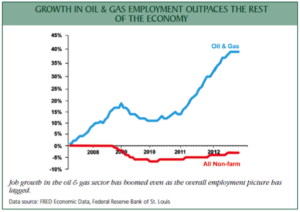
Furthermore, as reported by the Manhattan Institute, the economy’s employment growth has been highly concentrated in the oil and gas industry (with other sources of employment growth barely moving the employment needle).

As it turns out, the shale oil industry mainly via the energy investment banks of the region financed over $1 trillion — or an amount equal to approximately 40 percent of Fed-provided liquidity during the Great Recession.

Bloomberg reports that there was $353 billion of IPO in the industry, $286 billion of joint ventures, boombustology_5and $786 billion in lower rated bonds financing this capital intensive undertaking.

Now the oversupply of oil from their success has turned against the drillers. The U.S. marginal increase in oil and gas production to global supply along with generally softening economies in the developed world has caused oil prices to decline in the neighborhood of 50 percent. This boom is now in the bust phase, and additions to production are in retreat.

This represents a world of hurt for the investing entities (generally small firms) and their employees as well as those who hold the energy securities in the form of low-rated bonds or commercial bank loans. Fortunately, the amount does not threaten the mainline financial institutions that hold only a small portion of them, so the financial bust is confined but the physical remains of the boom are silhouetted on the landscape as shown above.

But there is a silver lining to this boombustology. For one, the active life of a fracked well is in the neighborhood of two years during which time 90 percent of product is extracted. The short duration of the income stream from fracked wells allows for a smoother adjustment on the downside and re-fracking will only continue if supported by price increases.

But more importantly, the 50 percent price decline for energy which is used by all other sectors of the economy is provides a large cost savings that is equivalent to a tax cut. Moreover, for the corporate sector, the cost savings represent an increase in net cash flow and higher profit margins and hence broad market support for both stocks and bonds.

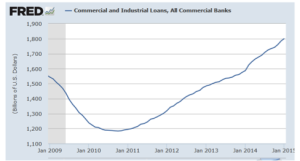
But the real issue is will the economy shift gears and sustain the growth of recent years in the absence of an oil thrust? The now-50 percent increase in bank lending to commercial and industrial uses since the bottom of the Great Recession in 2009 along with the “energy tax cut,” suggests that the usual mechanisms of monetary policy are beginning to work to sustain economic expansion beyond oil and commodities.

There are all kinds of booms and busts, and this one could well have a silver lining of generalized higher income after energy costs across the landscape, without a generalized financial meltdown. All in all, the oil and commodities booms and lower prices, even with their industry losses have a net positive effect on economic growth, all things considered.

So, on the spectrum of booms and busts this one will likely be more in the category of the self-limiting agricultural deflationary depression of the early 1920s than the housing boom and bust of recent memory.

Indeed, it has been sufficiently underway to cause the Fed to state its intention to end its quantitative ease. Furthermore, now that there is a stated intention to shift to a monetary tightening, it raises the question of what is left of growth in the US economy without oil expansion? The oil and commodity bust leaves us with a tilt toward deflation and an expansion that remains to be seen.

Sign up to receive the Spellman Report. Bracing financial and economic insight. Now with free delivery!

Goodbye to the Robinson Crusoe Bond Market

image003With the U.S. economy having achieved lift-off momentum, the Federal Reserve has ended, at least for now, large-scale bond buying — better known as quantitative easing. Furthermore, the Fed is taking a big gulp and is working up its collective courage to move to interest rate “normalization,” if anyone can remember what that is.

The thinking is that by merely removing the Fed’s large-scale demand for U.S. Treasury bonds, those prices would revert to whatever private buyers will sustain. And with less demand and lower prices, we would get to the correspondingly higher market interest rates. If so, this would be the normalization of rates on autopilot, as no further Fed action would be needed.

That intuition is so strong that a recent Bloomberg survey of economists showed they forecasted not just higher interest rates for 2015 but also that the 10-year T-Bond yield would rise from its year end lows of near 2% back to the 3% level as it was in the beginning of 2014 (shown below).

crusoe1Moreover, not only was this the economists’ consensus, but all participants forecasted higher rates in defiance of the multi-year downward trend, including last year. It is indeed a rare event when economists’ forecasts are not merely a trend extrapolation but rather based on deeply ingrained training and historical experience.

The intuition behind this forecast is, no doubt, based on the classical idea that absent a Fed intervention, market demand rests solely on the shoulders of motivated savers and with the bond sell-side being dominated by businesses that offer bonds up to the point at which their borrowing cost is just supported by investment returns to real capital.

For the sake of argument, let’s call this the Robinson Crusoe island world of finance. It’s quaint, uncomplicated by government actions and constraints, and all bond buyers and sellers are domestic investors. It is the veritable island economy without a central bank.

However, with the advent of globalism, government buying and selling, and regulatory manipulations of all sorts, market-determined interest rates have moved to a new setting. With the elimination of capital barriers, the global financial industry can now move capital across borders for many purposes and reasons and, in so doing, move U.S. financial prices. Of all markets that are not islands, it would be the U.S. Treasury bond market that is still the main holding for other countries’ external reserves and global investors’ go-to asset.

The U.S. 10-year Treasury bond is nearing a 2% yield, and while that is very low both in absolute terms and by historical comparison, it is much higher than similar 10-year government debt in a host of countries that matter.

With Germany at 50 basis points, Switzerland and Japan at 30 basis points, and even troubled Spain at 60 basis points, these countries make the U.S. 10-year T-bond’s 200 basis points very appealing, especially when the U.S. dollar is appreciating against other currencies.

And then there have been institutional developments and a regulatory framework that influences asset choice. Accumulated consumer savings now reaches the demand-side of bond markets via pension funds, banks, wealth managers, and insurance companies where interest rates reflect many categories of private risk. The one that stands out most is the fear of deflation taking place in Europe and Japan and with falling oil prices in many other places as well. This biases the demand toward fixed rate financial contracts in the strongest currency.

Bingo, dollar-denominated Treasuries win again.

And then there are other contortions to market demand for Treasuries when fearful regulators weigh the default risk of different assets in an institutional portfolio and assess a charge in the form of risk-weighted capital. And, as you might have guessed, U.S. government regulators assume U.S. Treasuries are absolutely riskless and, as a result, no institutional capital need be set aside for owning Treasuries as compared to private debt.

Well, the recent push for more stable and capitalized banks suddenly makes the U.S. Treasury asset class more desirable for regulated institutions even at extraordinarily low interest rates because U.S. Treasuries provide capital shields in addition to their puny interest rates. As a result depository institutions have added over $120 Billion to their portfolios in the last three years.

And then, as discussed last month, there are the central banks of the rest of world. They are lining up to buy U.S. dollars (and in turn U. S. Treasuries as a foreign exchange reserve) with their own printed currency. This is a bi-product of the “currency wars” for the purpose of depressing the relative value of their own currency in order to recapture lost global exports.

crusoe2

Just behind the official foreign government purchases are the foreign private investors that are sucked into US dollar assets as a result of the twin appeal of higher U. S. yields and the US dollar appreciation that is occurring relative to 31 currencies. None of this was ever seen in a Robinson Crusoe bond market.

And this phenomenon is likely to kick into higher gear shortly as the European Central Bank (again) reassures its constituents that it will have a QE of its own. It will be directed to Eurozone Sovereign bonds in the first instance, but with Euro domestic yields already so puny, the expectation of a Euro QE is already causing private investors to redirect their wealth away from Euro investments into higher yielding, dollar-appreciating U.S. Treasuries.

As you look up and down the line-up of players and motivations, interest rate normalization will not likely take place by the Fed simply sitting on the sidelines of the Treasury bond market. There are too many other sources of Treasury demand in this divergent, deflationary, regulated economic world causing T-Bond demand to wash up on our shores. Rising rates attained on autopilot, as a result of the Fed’s ceasing to be a buyer of Treasury bonds, will not be enough.

So then if rates were to return to historically normal levels, it’s likely to require not just a hands-off autopilot approach by the Fed but also that it enter the market as a seller of U.S. Treasuries (and if not Treasuries, then something else). That would be a reverse QE, if you will.

And it’s possible that the Fed doesn’t have enough 10-year Treasuries on its balance sheet to sell to drive the price downward in the face of these motivated foreign buyers. But it does have a larger supply of shorter dated Treasuries that can be sold. Additionally, by raising the rate that it lends to banks, it can drive short rates higher and pull some private demand out of the long-dated Treasury market, effectively leading to a yield curve flattening.

In general, it’s a good bite easier for central banks to drive bond prices upward by turning on the printing press and buying something in large enough quantity so long as they do not run out of paper and ink. But to directly lower prices of a financial asset, it needs a sufficient inventory of the item to sell.

There are other manipulations possible to push rates higher: the Fed could raise the cash requirement of commercial banks to take bank-allocated funds out of the treasury market and even force commercial banks to shrink their balance sheets. But this runs counter to all their efforts during the Great Recession and seems unlikely.

And then there is the new, interesting weapon in the Fed’s arsenal to raise rates: sell Federal Reserve debt. That would be a refinancing of the Federal Reserve’s liabilities side of its balance sheet. Sell Federal Reserve bonds that are paid for by Federal Reserve Notes (cash). But does the Fed have the statutory ability to sell Federal Reserve debt? Well technically no, but it has been engineered around to functionally do so.

The Fed has entered the “Reverse Repo” market, selling claims collateralized by its U.S. Treasuries holding, of which it has an abundance on its balance sheet. This end-run provides the same result, and the Fed has been running about $200 billion as an experiment of the technique. Allowing the Fed to issue bonds or interest-bearing debt is a novel idea to suck some of the cash out of the system, and it has finally come to fruition. In this complicated global world, it needed an additional instrument of market control.

So whether or not the market self-corrects to the Fed’s interest rate target, it can still achieve its objective. But it will not be Robinson Crusoe on autopilot.

The interest rate environment is not what it used to be in the good old days of a closed country home central bank monopolized game. Now there are other central banks effectively creating monetary policy in U.S. markets.

Achieving policy objectives in a global financial system is a far more difficult, multi-faceted problem when foreign flows, both private and governmental, offset the domestic policy dictates. The Fed is no longer all-powerful over U.S. markets.

Slow or chronically weak economies with deflation and with foreign governments hell-bent on achieving export share are causing financial spillover into the U.S. market that would be difficult to offset, leaving the future course of longer maturity Treasury yields a major question. Rising rates would depend on how determined the Fed is for normalization, even if it has to sell a lot of something to mop up excess currency.

Welcome to the Brave New World of domestic policy constrained by open global financial markets. Robinson Crusoe would hardly recognize it, and for that matter, many Fed Governors don’t recognize it either.

Sign up to receive the Spellman Report. Bracing financial and economic insight. Now with free delivery!

The Slow-Moving Train Wreck Has Picked up Speed: Foreign Depositors in European Banks Will Be Outed

slow1In a recent Texas Enterprise presentation, I described how losses to Cyprus depositors could occur elsewhere. Moreover, I suggested that this was not a one-time aberration of our understanding of normal. Rather, this is the new normal, better described by a Texas Enterprise reporter as “a slow-moving train wreck.”

Since his phrasing was more eloquent than mine, let’s go with that as a title to this month’s blog. Except in the short time since that title was conceived, the impending train wreck has just picked up speed.

The notion of a train wreck for an economy is of course in sharp contrast to our notion of “old normal,” in which an economy chugs along spewing off the multiple gifts of jobs, income and wealth all by itself, even without much need for government locomotion or correction.

That is the way it was for a long time. Yes, there were occasional interruptions in that steady progress, most of which proved to be no more than minor and short-lived recessions. But the train kept chugging along, because economies do have natural self-correction mechanisms to keep the train on the tracks and moving at a normal speed. This is the notion of an equilibrium growth path.

Primary among the natural economic mechanisms are prices of inputs and currencies. In recessions, unemployment creates low wages, and low demand for capital causes yields to diminish. With capital outflows, currencies decline, and goods become cheaper to produce and eventually become attractive to foreign buyers. Hence the economy’s engine turns around all by itself and keeps on chugging. In an economy’s boom episodes, those same resources become expensive — which is a self-moderation mechanism that slows sales and production.

During booms, interest rates increase due to scarcity and the inflation premiums that markets price into debt contracts. This means that in that economic environment, there is relatively little need for the Federal Reserve to further raise interest rates.

However, after WWII, self-correction gave way to statutory imperatives to not allow prices to reflect scarcity, which somewhat deterred the self-correction mechanism. Minimum wages prevented the unemployed from offering their services at a lower market rate, and reserve currency prices had a built-in upward bias so exports would not pick up. Hence the self-correcting market mechanisms were somewhat compromised.

For the most part, following WWII, monetary policy and contra-cyclical fiscal policy added to demand so as to keep the locomotive running at the highest maintainable speed, never mind a little inflation. In addition, the Fed’s routine fine- tuning required flexibility and timely policy to keep the engine’s mechanisms in working order — the locomotive would lurch forward when policymakers gave it some gas, and it would slow down when they applied the brakes.

But now, what was considered “normal” back then is almost unachievable: Not only is the engine in sad repair, but the ground under the tracks is giving way.

One reason for this is that we are now facing what the Fed calls “headwinds” — when they push the accelerator to the floor, there is no acceleration, but it’s not due to lack of trying. Same is the case in Europe and Japan: They are trying but getting no traction.

But now the old locomotive has sprung several more disconnects. For one, it suffered through The Great Recession just as old age caught up with both machinery and the work force. The aging population also requires fiscal resources to make good on government entitlements. That process tends to slow the old locomotive, as the government finances entitlements by diverting private resources.

Another slowdown occurs when the government foists its entitlement debt on first banks, financial institutions and, most recently, on central banks across the world — making them weaker and compromising the engine’s traction even further.

But now in a new bold move to come up with the funding for entitlements, European governments have chosen to cannibalize depositors in their own banks (and, in turn, the banks themselves) by forcing them to reveal the identities of foreign depositors to their home governments.

The end to Euro bank secrecy has already given rise to witch hunts for depositors, basically requiring them prove to their government that they paid taxes on funds in their foreign bank accounts. But since the truth will not be revealed until the end of the year, depositors have ample time to seek new ports for their holdings — which will no doubt be outside of the EU. The total amount of the deposits that are likely seeking a new home is estimated at about $21 trillion, or about twice the amount of U.S. commercial banking system deposits.

If that were not enough incentive for depositors to flee Europe’s banks or seek other alternatives, the EU has also made it clear that the ad hoc Cyprus bank formula for large bank resolution — in which depositors and other debtors take a hit when the bank goes insolvent — will be applied across all future EU bank insolvencies.

Needless to say, holding government bonds as assets is a leading cause of bank insolvency — if the government can’t service its debt, it certainly can’t rescue the bank’s supposedly insured depositors.

To add to the risks that Euro depositors face, the IMF has indicated a new policy for assisting financially strapped governments that rationalizes not assisting them. The IMF wisely decided that it will not rush in and be a lender to distressed sovereigns an act which often provides the funding needed to save banks.

Instead, it will wait until after the sovereign defaults on its existing debt as it wants no part of being written down with the rest of the bond holders. This no doubt removes an important source of emergency funding for the sovereign and the bank depositor, which the IMF has come to realize simply enables the sovereign to keep on spending at its expense.

With support for bank deposits being removed, the conclusion is Euro depositors are at risk without much in the way of government back-up whether or not deposit accounts are anonymous. So Cyprus is the new rule and not the exception.

Banking and moreover, financial globalism — a system in which capital is free to flow toward the best use that promotes economic growth — is being sacrificed to support state deficits. But the sacrifice will not be confined to Europe, as the U.S. and the Euro zone are placing maximum pressures on all haven countries to do the same so as not to lose competitive advantage.

So with Europe in the sixth consecutive quarter of recession, the slow moving train wreck has just picked up speed, no matter how much gas the monetary authority gives the aging locomotive.


Sign up to receive the Spellman Report. Bracing financial and economic insight. Now with free delivery!

Is the Printing Press Engaged for the Duration?

spell1A printing press is a handy thing to have. When a government or central bank can fund itself with money or claims on money, it can buy a lot of things and solve a host of problems, all without the need to tax. I wish I had one.
Developed world governments have lots of problems these days and hence are using the printing press overtime. And with lots of problems comes the thought, at least to an orderly mind, to somehow prioritize the buying. Or, if there is no order, than the disorder of whatever comes next is the order.

This Great Recession experience of the past five years has been an epic chapter of buying in the nearly 100-year history of the Federal Reserve.

In the modern era, economy-wide sustainable growth has been the Fed’s guiding light. It worked quite well for some 50 years to temper the oscillations of the business cycle, both the highs and the lows. And the modern business cycles orthodoxy and Keynesian upbringing is causing the Fed to turn on the printing press to achieve an unemployment rate of 6.5% in this Great Recession, so they claim.

While defining success in terms of unemployment brings clarity as to what Fed policy is about, it opens up monetary policy to an unintended exit if factors other than economic recovery were to reduce unemployment. And financial markets in a bubble state as a result of the Fed’s buying fear that outcome.

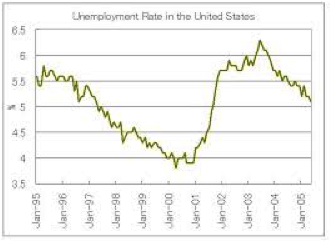
As it happens, labor force dropout due to demographics or inadequate skills is occurring. Furthermore, work is being reorganized and parceled out so employees do not exceed 30 hours per week, lest their employers become subject to the Obama Health Care tax. All these factors are bringing down the unemployment rate more quickly than fundamental economic improvement.

Each month, there is a dread fear in financial markets that unemployment will decline sufficiently to cause the Fed to exit QE as they have pledged. Indeed it is the major risk to investors holding positions in an asset bubble market, whether it be in debt, equity, commodities or real estate.

spell2So as we approach the target unemployment rate without much economic recovery, the question is, can and will the target be redefined to be the unspoken necessity of supporting Treasury debt obligations?
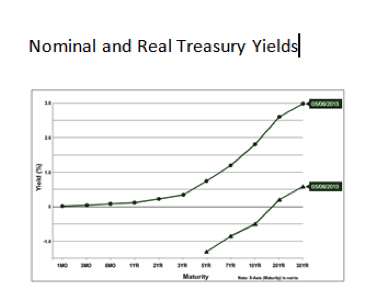
The last time the priority of Fed buying switched from supporting banks and the economy to supporting the government effort to sell Treasury bonds was at the beginning of WWII.

In the three months following Pearl Harbor, given the expectations of the size of wartime debt issuance and with some inflation expectations thrown in, long Treasury yields ratcheted up.

The Fed then approached Treasury (not the other way around) indicating its willingness to enter an agreement to support Treasury bond prices at the March 1942 level for the “duration” of the war.

The Fed did this by buying enough Treasuries along the yield curve to prevent their prices from falling and the market yields from rising — a policy that became known as the Fed’s interest rate peg. It took a tripling of the Fed balance sheet in four years to do the job, which is roughly in the same league as the Fed balance sheet growth since the commencement of the Great Recession.

When the war concluded, federal government deficits turned into surpluses, and there was no longer pressure for the Fed to be the buyer of net new government debt. And furthermore, there was high inflation. This caused the Fed to claim the “duration” had arrived and that it was time to exit (there’s that word again). But there was a catch.

To Treasury Secretary John Snyder, exit in the name of economic stabilization was all academic heresy or a potentially expensive distraction from the core responsibility of a government to finance its debt at the most affordable rates. That is, he didn’t care for the idea that Treasury bonds would not be supported ad infinitum at par in the primary and secondary debt markets. Furthermore, he was backed by a gentleman in the White House by the name of President Harry S. Truman. Such is the core concern of a government as to the cost of its interest expense.

The Fed’s post-WWII exit attempt spilled over into widely followed Congressional hearings conducted by Senator Paul Douglas before the Joint Economic Committee. The core question was, did the Fed’s responsibility for full employment and controlling inflation trump the need for propping up the price of Treasuries so interest rates would not rise?

Despite Congressional support for the Fed to exit, it still took years until the Fed became determined to pursue a path independent of Treasury dictates, as inflation soared at the commencement of the Korean War.

While the brouhaha concerning exit continued from 1946 until 1951, an opportunity to back out of the Treasury bond support agreement occurred in 1951 (almost six years after the “duration”). At that time Treasury Secretary John Snyder was incapacitated and in the hospital and his next-in–line at the Treasury, William McChesney Martin, negotiated an exit agreement with the Fed at the White House with the President presiding. The agreement became known as the Accord and was the monumental turning point that allowed Fed independence to foster economic growth without inflation for the next half century.

However, there was a catch. The Accord set the Fed free to pursue economic stabilization so long as there continued to be a strong tilt to Treasury bond support. To accomplish that, Martin suggested, or perhaps insisted (as the folklore goes) that he be installed as Chairman of the Federal Reserve Board of Governors to represent Treasury’s interests in monetary policy — which required a resignation of the existing Fed Chairman. This was all accomplished before Snyder left the hospital. Such is the difficulty of Fed exit when the government’s ability to sell debt and service the interest expense is at stake. (For a revealing account of that history go here.)

What was most interesting about the 1951 exit is that after becoming Fed Chairman, Martin had a Beckett moment, or more like a Beckett career. In his almost 20 years as Fed Chairman he constantly tilted in the direction of containing inflation and would not peg Treasury rates below market even during the Vietnam War, which caused Lyndon Johnson to unsuccessfully seek his resignation.

In the context of today’s financing strains that will grow over the next four decades due to Boomer entitlements, consider the following: The U.S. gross debt-to-income ratio is in excess of 100%, and the CBO projects that ratio to reach 400% in the out years of entitlement growth. Hence, each hundred-basis-point increase in the average interest rate the U. S. pays to service its debt (above the present 2 percent average carrying cost) requires additional taxes to drain another percentage point from the income stream — a drain we can ill afford. You can do the math for the required tax drain when the debt-to-income ratio approaches 200% or 300% and if interest rates were allowed to reflect sovereign or inflation risk.

The CBO has estimated that in the out years of Boomer entitlements, tax revenues will need to be as much as 25% of annual income as compared to today’s 2% to merely service the projected interest expense on the debt, (even if market yields were to remain at average historical levels).

spell3Today there is a de facto peg already in place. It goes under the title of zero interest rate policy (ZIRP). It is also known as financial repression, which includes ZIRP along with positive inflation causing real yields to go negative all the way out to almost 20 year maturities and has become the explicit policy of the Japan and implicitly of Europe as well.

Given the perspective of the machinations at the end of WWII, is it reasonable to expect that Treasury (and the President and Congress) will allow the Fed to exit its already existing de facto peg? The new “duration” is the length of the entitlements.

Hence, the only likely exit for Fed QEs is an exit from the pretense that QE is an economic stabilization policy that can go away if unemployment hits the Fed’s target. It’s a cover story that is about to be uncovered. Fed buying is the supporting backbone of the Treasury bond market with $500 billion in annual purchases which, in turn, promotes foreign central bank currency wars. With the proceeds, they are investing as much as the Fed is in U. S. Treasuries.

Hence, current Treasury Secretary Jack Lew will have an important say as did John Snyder, in the selection of the next Fed Chairman (if he doesn’t wish to stand in himself). The change of guard will likely occur before the year’s end, when Bernanke returns to Princeton to write his account of the Great Recession.

Hence, what needs to be built is a graceful institutional transition for the Fed to exit stated economic stabilization priorities in favor of Treasury debt priorities without actually exiting its asset purchase program. Otherwise the Fed will morph from one pretense to another as they have done with a loss of their credibility.

So relax, bond market, interest rates will be pegged until inflation is no longer containable at the 2.5% level and that could well not stop them.


Sign up to receive the Spellman Report. Bracing financial and economic insight. Now with free delivery!

The Stock Market, QE3 and Voodoo Finance

As we look across the economic landscape there is an abundance of reason to anticipate a global economic slowdown. It is already well in the works as reflected in anticipatory data. It would not be a garden-variety recession emanating from some lull in spending but rather the grinding process of over-indebtedness and uncertainty due to tax and health care issues.

At the same time, over-indebtedness also creates a withering of financial valuations, which sets off another chain reaction called systemic financial meltdown. This reduces the value of assets held by individuals and institutions such as banks, which in turn further dissolves financial wealth when assets are dumped in order to pay off fleeing depositors.

As a result, financial intermediation withers so that the process of matching of savers, if there are any, with investments is impeded. This in turn negates future growth. For example, systemic financial forces causing a recession visited the U.S. in the late 1980s. At that time large commercial banks were overburdened with Latin American loan defaults and simultaneously savings and loan associations (remember them?) were decimated when inflation depreciated their book of long-term mortgages. This limited systemic financial event resulted in a prolonged 1990 recession.

Hence whether the over-indebtedness first strikes spending or financial intermediation, it is difficult to discern as they interact and both income flows and financial valuations suffer, whichever occurs first.

Today, the developed world’s over-indebtedness reactions of the combined recessionary forces and bank runs are emanating from Europe’s southern tier. Unemployment numbers in Greece and Spain rival those of the Great Depression.

But the question on the table is the ability of Northern Europe and the U.S. (and, for that matter, the rest of the world) to escape at least temporarily the ill effects of the above degenerative process.

To gauge that, the market looks to the ability of monetary and fiscal policy to come to the rescue, and if the rescue is attempted will it work? Given the succession of bailout funds established but without the means to fund them, it is not a realistic option. To the extent country debt has been carried by other contributing countries, it is extremely limited and if, indeed, the Spanish bank bailout takes place, it exhausts all bailout funds from the Eurozone’s willing contributing countries.

Nonetheless, the contributing countries keep promising more and more, with the latest being a bank deposit insurance fund — and the market somehow believes it.

If fiscal resources from other contributing countries are extraordinary limited, what is the extent of monetary funding to aid both a recession and systemic financial meltdown? Well, there is some defense to the systemic financial event as long as the Fed and the ECB and other central banks are willing to keep expanding their balance sheets. There is no theoretical or legal limit to how much can be purchased to keep financial asset valuations afloat in order to prevent imminent financial meltdown, but to go overboard they are willing to give up all discipline of monetary control, and with it, holders of the currency go elsewhere.

Given the vulnerabilities present, how then can one explain stock price buoyancy? Since the beginning of the year the S&P 500 index is up approximately 6% and FTSE 100 index is up 2 percent despite the onset of recession and bank runs.

If there is any logic to it, it seems to be resting on less than a firm foundation. While equity investors rely on current known information such as earnings, they also project forward the value of the claims they are purchasing, hence making financial pricing a mixture of facts and a learned history to project forward.

What you often hear these days is a general awareness of the economic and debt problems but a faith that the bigger the problem, the bigger the government response will be. That is to say, any investor citing “in my 25 years’ experience” is a candidate to be projecting a future based on the Great Moderation Period of Greenspan Puts and currency solidarity in Europe.

Financial prices are inherently an extrapolation of a history, but it’s certainly not the Great Moderation, though that was the dominant influence in the thinking of the 25-year U.S. veteran stock market investor.

But then there is a newer history called the Bernanke Put, best characterized as a succession of QEs or other outside-the-box monetary stimulus, the latest of which is operation twist.

It’s now a common attitude that if the situation becomes bad enough there will be a response equal to the task needed to keep financial values afloat. Now being cited is the above chart showing how equity markets respond to QEs. It seems that the Fed has well trained stock market investors in Voodoo financial logic. The worse the economic problem, the better it is for stocks despite declines in earnings.

As a side note, QE faith stock valuations are throwing noise into the long term relationship of stock prices to earnings and as an early indicator of a recession. This is one of many structural changes that are occuring which implies that one must be careful of which history is chosen to extrapolate.

Before one relies on Voodoo finance and a faith-based QE3, one should note that additional Fed stimulus is almost certain in the face of a systemic financial institution collapse but is less certain and will be less dramatic due to a softening economy. Systemic financial defense was the raison d’etre for the Fed and remains its number one policy objective, but some token form of monetary aid has now become necessary to prevent a collapse of the Voodoo expectations the Fed has created. If that occurs, expectations have become self-fulfilling.

If you enjoy this blog, please forward it to others who may be interested. Links to forward and sign up to receive are in the right hand column.