The House of Cards: EU Edition

houseofcards-copy

It’s been an implicit theme of this blog that ultra-low interest rates, even into negative territory, pursued by economically failing developed countries, are more a problem than a solution.

Allow me to make that explicit.

The policy derives from a complete and exclusive focus on Keynesian thinking: The lower the cost of credit, the more of it will be sought and used to finance spending for consumer durables and capital equipment. This in turn might generate income and jobs. With capital investment prospects being painfully limited (which is the problem not being addressed), the enticement of low interest rates, even at subsided (negative) rates has had a meager advantage.

However, negative rates are undercutting financial intermediaries. This will only create major disasters that governments will have to underwrite.

Basically, no financial intermediary would seek to place a loan or purchase a fixed income instrument at a negative rate unless they were forced to do so. That force is called financial regulation. Simply put, negative rates do not generate investment income. Therefore, the financial intermediaries — be they banks, credit unions, pension funds, or insurance companies — will be unable to perform on their obligations to their customers.

That is, insurance companies will be unable to service annuities; banks will be faced with insufficient income to generate income for themselves or pay a positive deposit rate; depositors will flee; pension funds will need to revise upward pension contributions (and they are in the process of doing so) and will, in addition, roll-back promised pension benefits.

With all these private contracted benefits being challenged and ultimately being unmet, there becomes an enormous pressure on governments, not just from countries ruled by social democrats, to save the majority of voters who are adversely affected.

This then becomes an additional burden on government finance for countries already being supported by their central banks. In fact, the European Central Bank, despite an explicit treaty provision not to monetize government debt, is already doing so in earnest. Additional challenges to cover financial intermediary failures puts the ECB farther into unchartered waters for the use of the printing press.

Another source of funding would be to lean upon other governments to bail out depositors, as was done with Greece and Cyprus. However, this only strengthens pro-exit political parties in the countries financing the bailouts.

What one can expect next in these circumstances is capital flight because of the ultra-low returns-to-fixed-income investment and bank deposits becoming risky. This turns into full throttle capital flight at advanced stages, as the capital outflow continues to make the currency relatively cheaper. And wealth owners will flee that.

At that stage, financial prices reflect a flight to quality – a preference for currencies and debt instruments of countries not facing these issues – and precious metals.

The downer in economic circumstances becomes so great that countries then seek to reinvent themselves in a political-economy dimension. For European governments, compromises made in the context of the benefit of unification are re-appraised, seeking some advantage to go it alone. Going it alone allows a country its own rules and its own currency that cheapens with capital flight. The cheap currency becomes an equilibrating device as exporting becomes more promising.

That is the house of cards the EU has built, now falling one by one — and the latest unstable card in Europe are the Italian banks. They aren’t only suffering depleted investment income from low rates available on their investments but also from a backlog of defaulting loans. Italy is attempting to infuse €40 billion into its banking system with the pretense of covering losses well exceeding that. However, to do so violates the very responses that were agreed upon by the EU just two years ago.

At that time, the banking system was bolstered by an EU deposit insurance commitment that was never funded.

Instead, the EU decided to build a firewall around its banking problems to keep them from being met by the government. They mandated that their banks sell “CoCo” (contingent convertible) bonds. These bonds convert to stockholder shares when the banks admit losses. The question then becomes who takes the losses. In this case, the CoCo bond holders were set up to automatically take the hit ahead of depositors and protect the government from being called upon for a depositor bailout.

Well, things have become bad, and it’s time to convert the CoCo bonds to stock. However, the banks sold the CoCo bonds to retail clients seeking the high positive returns that such a risk should command. Now retail investors, among others, are in line to sacrifice their positions to protect the banks’ losses, which, in turn, protects the government from the need to cover those bank losses — but there is a catch. No self-respecting social democrat government will allow retail bond holders to take a hit on behalf of the banks, even if they were paid to do so.

So this is where the matters stands: the Italian government is attempting to raise €40 billion, despite a reported €360 billion of nonperforming loans, to provide a pretense of a capital infusion for the banks. This is despite the objections of the EU, as it varies from the “plan” of private capital backstops. And no other country, as you might expect, dares to step up at this time to aid Italy.

In the meantime, the market reflects a flight to quality in the prices, especially of US, German, and Swiss government bonds, the prices of silver and gold, and the sale of private personal safes. The market is just awaiting the next chapter of the soap opera called The House of Cards.

The only question is how far will disintegration go this round? And if not this round, the next?


Click to Email Dr. Spellman

The Mad Genius of the Zero-Forever Bond

o

That the developed world governments are accumulating debt shouldn’t be news to anyone. To give you an idea of the proportions involved, during the Obama administration, US government debt has risen from approximately $8 trillion, accumulated over the previous 218 years of the US’s existence, to above $19 trillion and counting.

This is a 137% increase in merely seven and a half years.

Furthermore, we have now reached the point in time when Baby Boomer-related entitlements are adding to the outstanding cumulative debt. It is projected that the present value of unfunded federally obligated benefits is somewhere between $55 and $222 trillion — currently serviced by an undersized income stream of only $17 trillion.

In this state of indebtedness, the interest bill alone becomes an impediment to being able to fund entitlements (as well as everything else) unless there are some tricks up the government’s sleeves — and they are tricksters.

And here is the trick: Central banks of the developed world are pursuing ultra-low interest rates to reduce the interest burden of their governments’ debt. Indeed, Germany’s effective borrowing rate on the entirety of its debt has declined to .43 of 1 percent, and is now able to come to the market with a 10-year, zero-rate offering that will reduce it even further.

Another means to reduce the debt burden is to play games, not just with reducing interest carry but also with debt maturities. With interest expense being so cheap, there is the natural inclination by the debt managers in the US Treasury and all highly indebted countries to lock in the low rates for as long as possible.

Hence, government bond maturities are being reconsidered. The longest maturity bond of fiscally solid governments that could be sold in markets to private wealth sources had been 30 years, and few governments were able to extend debt that far out.

Or not? First, the 30-year bond maturity was stretched to 50 years in Spain and Italy, neither of which should be considered investment grade. And now France, Belgium, and Mexico have introduced “Century Bonds” — a quaint title — for debt that won’t come due for 100 years.

So the issue of how the interest cost of the debt will be handled is being settled by the mad geniuses in the world’s treasury departments. Expect to see governments placing debt maturities as far out into the future as they can. Selling debt maturities of 30 years, 50 years, or even 100 years is amateurish. The ultimate goal is to stretch the maturity into perpetuity.

And combining a zero-interest rate with a maturity of forever makes for what might be called the “Zero-Forever Bond,” which means no interest or principal will ever be owed or paid.

And here are some of the implications.

The appeal to the government issuer is that debt refinanced as a Zero-Forever Bond is the functional equivalent of a repudiation of its debt. The debt remains on the government balance sheet in perpetuity but with no consequence for the issuing government, as neither interest nor principal is ever paid. At the same time, the Zero-Forever Bond remains an asset for its owner, who never receives interest or principal.

But who would possibly purchase a Zero-Forever Bond?

To answer that question, realize that the great majority of government debt is typically placed with financial institutions that are in the business of store-housing private savings. Their combined balance sheets are well more than that of the central bank.

But without economic incentives for a private financial institution to purchase the Zero-Forever Bond, the governments would need to create some.

This is easily accomplished by financial regulation — and, in fact, it’s already underway. Just require financial institutions to appear “safe and sound,” by requiring them to purchase government debt instead of holding “risky” debt.

In addition, enticements are being given to the money market mutual funds (MMMFs) that must hold significant proportions of Treasury bonds in order to receive government insurance against shares declining to less than “a buck.”

Similarly, insurance companies are generally required to hold conservative portfolios (for which Treasuries fit the bill) and additionally Treasuries offset insufficient surplus in order to remain in regulatory capital compliance. The regulatory presumption that Treasuries are safe and sound is also used for pension fund compliance to be eligible for Federal Pension Benefit Guarantees. The Zero-Forever Bond fits the regulatory bill for all.

Basically, the Zero Forever has two sides to it: It saves the government from an actual default no matter how large its debt relative to tax proceeds because it pays nothing. But if held by private financial intermediaries as described above, they will be challenged to make good on their commitments to private savers because they won’t earn investment income on those assets held as Zero Forever Bonds (and yet, they’d be required to hold them to be in compliance).

The Zero-Forever Bond is not unlike achieving ultimate zero in other fields that causes relationships to be reversed.

In paraphrasing physicist and economist Gary Shilling, who, while commenting in his Insight publication on the central bank pursuing zero short term rates in September 2011, noted:

“….there is an analogy between interest rates near zero and temperatures near absolute zero where all activity of sub-atomic particles ceases…. Near that temperature, strange things happen [italics added]. Thermal energy arises from the motion of atoms and molecules as they collide, but at low temperatures, they don’t and atoms act identically like a single super atom. Substances that are magnetic at higher temperatures become nonmagnetic, and vice versa. Some nonconductors become super conductors — that’s why some computers are kept very cold. Others become super fluids that seem to defy gravity by crawling up the sides of their containers. Near absolute zero, a gas becomes a super liquid that can leak through solid objects….”

Well, the Zero-Forever as a perpetuity bond, which bears no interest and is crammed down on financial institutions that hold private savings, must be considered a change in nature, and in Shilling’s words would cause strange things to happen.

This effectively cancels government debt and thereby increases the net wealth of the government sector. This is done at the expense of the wealth of the financial institutions entrusted with private savings because they must hold an asset that produces absolutely nothing, compromising institutions’ obligations to private savers.

This is how governments’ prospective default is shifted to the private sector. And it’s already happening.

This is being accomplished by some Mad Geniuses in the Treasury Departments of various debt-strapped governments. It requires no public discussion, no legislation, no warnings, and no apologies. It is all quietly slipped under the rug, so to speak.

You will never hear much about it until your insurance company, pension fund, bank, or money market mutual fund is unable to deliver on its contractual obligations to you. And these institutions, not the government, will be held accountable.

Click to Email Dr. Spellman

Bond Refugees Flee to Stock Lands

bondrefugees-copy

Tension is building among stock investors.

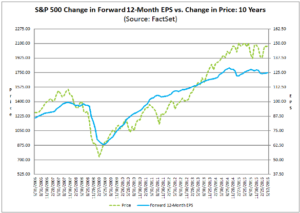
Stock prices have levitated, but the most fundamental determinant of stock price support — an uplift in corporate earnings — has gone soft. The S&P 500 earnings actually declined 7.1% year-over-year and the US and moreover global economies that support it are sputtering on all cylinders.

Additionally, given the economic recovery from the Great Recession’s lows, wages are rising modestly — but with zero productivity, there is not much to offset these costs suggesting that profit margins will not hold up.

This comes on top of a seven-year run of stock prices that has outpaced the recovery of corporate earnings (as shown below), making for a relatively high price/earnings ratio as compared to historical benchmarks. All this concerns stock mavens and for good reason.

But on the other side of the ledger is the resolve of the central bank to provide a wealth effect for consumers to keep on consuming. While it’s quite clear that ultra-expansionary monetary policy carried out via bond purchases has elevated bond valuations and, in turn, produced low market yields, what support does monetary policy have for stock prices?

Picture1

Since the onset of Fed QE, there’s been a relationship between the money base and a broad stock price index (see below), but what’s the link that caused them to move together- as they have?

First, and most fundamentally, a central bank purchase of bonds from private parties is financed by new money. Hence, the other side of the bond purchase is liquidity in the hands of a portfolio manager, who then scans the financial landscape for a replacement asset that includes stocks. This is the process by which bond buying, paid for with new money, ripples out to affect prices of other assets.

From there, internal portfolio dynamics lead to increased stock purchases in the following way. When bond appreciation generates a wealth effect for investors’ portfolios (particularly institutional investors), then managers must re-balance assets and, in the process, redistribute the bond gains to other risk assets not purchased by the Fed.

Institutional rebalancing is further motivated these days when ultra-low-yield bonds create pressure to generate investment income somewhere else in the markets. This hunt for investment income can take the form of stock dividends or stock appreciation, both of which have generated total returns over the last seven years.

This is say, there is pressure to switch to assets that have become known as “alternatives,” and this has included equities, real estate, and (for a time) commodities. In essence, income investors have become bond migrants who have been forced from their preferred habitat to other asset classes.

Picture2

However, there is a simpler way to look at this process of spreading out the price increase. There is a cross-elasticity of demand among alternative assets in a portfolio — much like when a government supports meat prices, the price of fish also rises, even though the government didn’t actually buy any fish. This occurs because the expensive meat drives consumers to purchase more fish, which in turn causes fish prices to increase as well.

To an economist, this so called cross-price elasticity of demand, causes more intensive buying of substitutes when one item becomes expensive.

Another factor that leads to stock demand and levitated prices is a lower discount rate in the market. Institutional investors are not indifferent as to when income arrives: they discount future income to present day terms by discounting at the rate that could be earned on the asset if it were in-hand today — that is, what they are giving up when income arrives later in time.

In this regard, eight years of depressed yields has likely caused the discount rate applied to future earning to be reduced, which, in turn, causes the present value of future income to rise.

As an example, for a single dollar of corporate earnings that is projected to arrive in 10 years, if discounted by today’s low yields of 2%, would have a present value of 81 cents, whereas the same dollar discounted at a 5% rate would, in present value terms, be reduced to 62 cents. Hence, lower market yields boost the valuation of future income even if the future income is not projected to grow. In this case, there is a 31% increase in today’s value for 10-year out income when yields fall as far as they have.

The ultra-low interest rates further work to support stock prices as they induce companies to issue bonds with low yields and apply the proceeds to purchasing their own equity shares. While this doesn’t generate future corporate income, it does increase income per share and enhance stock prices as long as investors ignore adverse effects from a more leveraged future.

Equity share repurchases recently got a further boost when the European Central Bank took up the practice of purchasing corporate bonds at issuance, even for Euro subsidiaries of US companies. This is likely to add to the pool of additional buy-backs of US-issued company stock. And why not when McDonald’s was able to place a 12-year maturity at a .75% rate that would make the US Treasury Department envious?

Last, in this description of stock price levitation, one should muse on the thought that maintaining stock prices at high levels has occurred despite an absence of Fed bond purchases since October 2014.

While foreign central banks keep at it (and, in the case of Japan and China, actually purchase stocks in addition to bonds), something else must be providing stock price support in the absence of additional Federal Reserve buying.

Not much thought has been given to relative scarcity as a result of bonds being purchased by central banks and stock being purchased by the issuing corporation. These assets will not see the light of day again as there is no way for them to be offered (without a change in policy) on secondary markets.

Hence, with stock and bond issues being locked up, relatively higher prices do not elicit as much of a supply response that would reduce market prices. The historical description for this is a market “cornering,” implying control over price from collecting a significant proportion of an asset — and the central banks are cornering the government bond issues. Thus scarcity allows prices to continue to be levitated thought the Fed buying has stopped.

Indeed, with this in mind, the central banks have vowed to purchase no more than 70% of any government bond issue so as to allow some private suppliers to establish a market price without being able to put much of a dent in its level.

All this is not to say that the unease felt by the stocks mavens can’t bring more supply to the market than the bond migrants will absorb if their expectations go sour.

This would push stock prices downward. But the pent-up demand by the bond migrants for stocks, together with relatively more scarce corporate shares, has changed what we think of as the fundamental yardstick for pricey risk assets.

Thus, historical stock P/E ratios as a metric for an expensive market needs revision, as we are in a whole new history of a higher ratio of money relative to asset values along with more restrictive supplies of both high quality bonds and stocks.


Sign up to receive the Spellman Report. Bracing financial and economic insight. Now with free delivery!

Click to Email Dr. Spellman