
↓
 

The Spellman Report

The Spellman Report, Where the Economy and Markets Meet

  • About
  • Blog
  • News and Views
  • Video
  • Investment Management
  • Speaking Engagements

Tag Archives: Economic Policy

Post navigation

← Older posts
Newer posts →

The Cats and Dogs of the Equity Markets

dogcatSome 70 years ago, Congress spelled out the economic growth objectives for the U.S. economy in the Full Employment Act of 1946. The mandate was for the government to support policies that would bring about sufficient economic growth so that employment would become “full.” Congress also included a restraint to the mandate that would limit inflation, but over time, both interpretations and priorities change. After all, this is politics as well as policy.

In aiming for full employment while controlling for inflation, the greatest responsibility fell on the shoulders of the Federal Reserve, which had the short-term flexibility to vary the cost of credit to manipulate aggregate demand.

To do so, there had to be an understanding of how much aggregate spending was needed to generate employment levels considered to be “full” without accelerating the inflation rate. This led to the development of a macroeconomic target called “Potential GDP,” which defined how much GDP spending would be needed to create enough demand in markets that would cause firms to hire just the number of workers consistent with full employment. Too few, and targets wouldn’t be met. Too many, and there would be inflation.

The goal, then, was for the Fed to match an equal amount of demand to Potential. This concept and its calculation was the work of Arthur Okun in l962 that become known as Okun’s Law.

The second link of what needed to be established is how that amount of aggregate demand would relate to the Federal Reserve’s main policy instrument, the short-term interest rate. This was accomplished by the Taylor Rule in the early l990s. It provided an estimate of the short-term interest rate that would generate the demand that would cause business firms to hire enough workers so as to be at full employment.

All these machinations of determining the right short-term interest rate to drive spending to the right number that would, in turn, cause businesses to hire the right number of workers to claim that employment is full is an ongoing exercise because the relationships that determine that interest rate are constantly changing. That is to say, the latest calculation of Okun’s Law (how much spending is needed) and the Taylor Rule (what interest rate creates that amount of spending) are subject to the latest economy-wide responses — and those do change.

For Wall Street, the Federal Reserve’s plan to raise interest rates, is seen as an attempt to put a dent in the economy and, hence, corporate profit growth and — in turn — stock prices. What Wall Street doesn’t realize is that the interest rate adjustment is supposedly one that will get the economy to full employment (and prevent inflation acceleration) and keep it there.

But the stock market’s obsession with the Fed’s intention to raise interest rates is largely misplaced: The Fed is looking to maintain growth, while allowing for some inflation which is viewed as a means to depreciate debt outstanding. To the extent there will be an interest rate increase, it’s likely to be little and late and an almost symbolic fulfillment of their duel Congressional mandate.

Nonetheless, all the major stock market indexes for U.S. equities since the beginning of the year are flat, reflecting a deterrent to growth that the Fed rate adjustment would supposedly create.

But there is other reason for Wall Street to be concerned with the general advance of stock prices.

When employment growth occurs, as it has, in this slow-motion up-cycle, labor becomes relatively scarce and wages increase. That’s the whole point of the macroeconomic exercise of targeting full employment. But in turn, rising wage rates increase the costs of production, which reduces profit margins and total profit.

We are at that point for many firms. Actually, we are beyond that point.

The more ominous rate for Wall Street should be the wage rate — not the interest rate — that flows into corporate employee costs. This creates a larger dent to overall profit than is being added either by more output and/or higher prices as the economy approaches Potential.

The wage component of employee costs is now bumping along at close to a 3 percent rate, but that only partially reveals the deterioration of profit due to employee compensation. There is a rarely viewed government statistic called the ECEC, or the Employer Cost of Employee Compensation. This calculates the employment cost to employers, taking into account not only wages but also benefits. Those have amounted to a 4.9 percent increase over the past two quarters.

The employee cost component is rising, but employee benefits are rising at a more substantial pace as the Affordable Care Act (among others) kicks in.

But that still doesn’t fully reveal the dent in corporate profit that will be delivered from tighter labor market conditions. It’s not just employee expenses that matter but also the extent to which those costs are offset by greater productivity of labor. That is, if labor costs rise and are offset by more output per employee, labor cost per unit of output can actually decline, resulting in a larger bottom line. But that’s not happening. Rather, the opposite is occurring.

The Bureau of Labor Statistics indicates: “Productivity decreased 3.1 percent in the nonfarm business sector in the first quarter of 2015; unit labor costs increased 6.7 percent (seasonally adjusted annual rates).” In manufacturing, productivity decreased 1.0 percent and unit labor costs increased 3.4 percent.

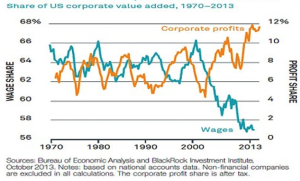
The significance of this 6.7 percent increase in unit labor cost must be compared to profit margins per unit. On average, pre-tax profit (as a percentage of corporate value added, as a proxy for profit margins) is at a very high 12 percent per unit produced, as can be seen below. Hence, we are looking at a collection of firms potentially losing half of pre-tax operating profit to employee compensation — and stock market shocks will follow.

Thus there is a built-in contradiction of achieving macroeconomic success of driving the economy to where employment is full and simultaneously providing stock market returns. The only way the two can simultaneously occur is if firms invest in capital equipment to raise productivity more than the growth in employment costs. But that happy state of affairs is not occurring.
dogs


So at this juncture of the business cycle expansion, we are looking at increasing labor cost per unit produced with a large dent to profit margins and reduced profits for firms with heavy dependence on U.S. labor. This implies U.S. service industries are the most vulnerable.

But yet there is still a stock market opportunity with widening profit margins for firms that use foreign labor (via outsourcing) and are paid in cheaper foreign currency given the stronger U.S. dollar.

Some firms will benefit from global access to cheaper employee costs. Basically, there will be a dispersion of positive and negative shocks from firm to firm with the ratio of the advancing-to-declining stock decreasing. Some stocks will become dogs and other will be purring cats of profit expansion due to cheap foreign labor.

The implication for investing in a broadly diversified range of firms would mix the dogs with the cats and the outcome would reflect the same: stagnant returns on average, along with a general sense of uncertainty as some firms experience earnings surprises, both positive and negative.

Firms that benefit from this macroeconomic environment are those that deliver goods to U.S. consumers that are produced more cheaply abroad. Detecting and targeting those cats from the dogs in this environment is more the issue for U.S. stock market investors than a generalized fear of interest rate liftoff.


Sign up to receive the Spellman Report. Bracing financial and economic insight. Now with free delivery!

Manna from Heaven and Government Debt


mana

Baby Boomer entitlements, long viewed as an over-the-horizon problem, are now upon us. These unfunded liabilities are morphing from a forecast into actual debt, a process that will continue for decades, and the accumulated debt is already undermining aggregate economic performance. It’s a problem that is crying out to be addressed and the sooner the better.

The implications of government debt accumulation have been the subject of posts on this site and throughout the blogosphere, but the topic usually receives a “head in the sand” treatment from governments and politicians, alike because the implied cure — to rescind entitlements — is a political third-rail.

If not addressed, debt default ultimately occurs, but that doesn’t seem to even arouse a response other than the hope that it occurs on someone else’s watch. (Observe the Greek debt theatre being played out.)

So the question is: What fixes can governments apply now that can still sustain the economy and all the things that go with it? Certainly supply-side policy should be front and centre in that discussion. Everything the government does needs to be viewed from the prism of economic growth which provides the income to sustain debt.

Having run out of conventional solutions within a government toolbox of macroeconomic fixes, the European Central Bank (ECB) is implementing a desperate or some might say a creative and subtle use of its money printing ability. Sadly for Europe though, it will have unfortunate side effects.

The policy, while being labelled quantitative easing (QE), is much more than a monetary policy to create extreme low interest rates. It also has a Manna from Heaven component that can be used for multiple purposes. Allow me to explain.

Quantitative easing originated in Japan and also turned up in the U.S. as large-scale central bank bond purchases. While it seems on the surface to be Keynesian interest rate policy, its more pressing, unspoken reason was debt service containment, both for government and private debt.

Manna from Heaven is unleashed when QE, as implemented by the ECB, is taken to the next extreme level. The ECB intends to buy a large quantity of Euro investment-grade debt, including sovereign debt on secondary markets. To reach their target requires that the ECB offer a higher price to induce present owners of investment-grade debt to sell their holdings to the central bank.

Investment-grade bond purchases by the ECB have been targeted to be approximately twice the current issuance of investment-grade debt (for both private and government issuers) hence reducing the available supply of investment-grade bonds in the market. That puts financial institutions and foreign central banks in a bind given their mandates to hold bonds of this character.

Therefore, there is great competition for Euro-denominated investment-grade debt, and it becomes scarcer with each ECB purchase, driving investment-grade bond prices not just higher but in excess of the principal and all interest until maturity for most debt issues. This is the definition of negative interest rates and reveals how it comes about for market-traded debt. The premium prices paid for by new money issuance is the Manna from Heaven and generates windfall gains for the sellers.

And in the hope of not being considered too irresponsible, the ECB has put a cap on the price premium above the bonds’ total proceeds of 20 percent (which puts a floor under just how “negative” interest rates can go).

Despite the premium prices the ECB is willing to pay for investment-grade bonds, it has come to believe that there will not be sufficient availability of offered bonds on secondary markets to meet their quantity objectives. As a cover narrative, they claim their quantity goals can only be reached if they also purchase original issuance of Euro sovereign bonds at up to the 20 percent premium despite the Euro prohibition on such transactions.

Now think about what that means, as it means a lot.

First, the premium prices paid produce negative yields not only for the central bank buyer but also for pension funds, insurance companies, banks, and endowment obligations (or savers in general who invest in this market). While the central banks can “afford” negative yields, most certainly the private institutions cannot — and they are ultimately on a collision path of not being able to fulfil their contractual obligations when their investment income derived from bonds declines so dramatically. They then become future government bailouts waiting to happen that would substantially add to government debt.

Second, the ability of the central bank to pay premium prices for investment-grade bonds results in windfalls for both debt holders and debt issuers. For them it’s veritable Manna from Heaven financed via central bank printing.

Third, with the price paid being greater than all future commitments on the part of the debt issuers’ means there now becomes a large incentive to keep issuing debt, including government issuers, as they receive greater proceeds than their corresponding obligations. Or to put it another way, they are being paid to borrow.

Fourth, the Manna becomes a new free policy option for governments. Their choice becomes to use the excess cash proceeds to either retire other government debt obligations and dissolve their debt overhang or will they choose to issue yet more debt for which they are being paid? Or yet will they take the cash proceeds and lock up an amount equal to their future obligations of principal and interest and spend only the Manna? They are being given those three options by the ECB. Whatever way is chosen it’s an incredible test of the inclinations of government to act responsibly and address the debt problem or keep on spending and borrowing.

Fifth, irrespective of governments’ use of the Manna, there is a balance sheet effect for the government whose debt is purchased by its own central bank.

As an aside, when the ECB as a policy board orders a buy of a country’s debt, it is purchased by the country’s own central bank. (Yes, the individual country central banks continue to exist even though there is an ECB. The individual country central banks are the operational banks within the Euro system, as are the 12 Federal Reserve Banks carrying out Federal Reserve policy.)

Now, if a Euro central bank purchases its own government’s debt, it defeases (annuls) that debt. A balance sheet defeasment occurs when the government and its central bank balance sheets report on a consolidated basis. The debt of the parent organization (the government) is owned by its subsidiary (its central bank) and, as a result, only net debt not owned by the subsidiary can be reported. Indeed, the U.S. now reports government debt outstanding on a net basis to mollify those concerned about government debt balances.

Sixth, the ugly government debt problem disappears (on a net basis) when central banks buy its sovereign’s debt and pays monetary premiums for it but, in its place, there is a classic fear that there will be an inflation tax. That is a real reduction in the value of fixed income assets held by the public due to inflation. This is a fear that is totally justified despite today’s weak and deflationary-prone environment, as the increase in the monetary base would be very, very large.

For example, in the U.S., if the Fed were to monetize the total outstanding $18 trillion of U. S. government debt, and with some premium paid above that amount equal to the ECB premium, the total monetary base would easily go above $20 trillion. This compares to a monetary base of $0.8 trillion at the outset of the Great Recession. That would cause a 25-fold or 2500 percent increase in the money base as compared to a cumulative 13 percent increase in real output over the same period. It might take some time to play out but this will certainly lead to inflationary devaluing of fixed income assets and currency and result in capital flight to a more stable medium of exchange.

This is no way to run a government and its finances if a country expects the world and its own citizens to hold wealth denominated in its own currency. Indeed, it is second-best policy not just due to the inflationary potential but also as a result of undermining insurers, pension funds, banks, and endowments to perform on their obligations. Furthermore, negative yields create a poverty class of retirees, of which there will be many.

But somewhere between zero defeasance and total defeasance of government debt is likely to be a better place for debt overloaded countries, giving them the option to use the proceeds to retire rather than squander the proceeds or give in to the incentives to borrow and spend even more.

Manna from Heaven, on its face, can be helpful if done on a very limited and disciplined scale, but when have we ever seen governments do that? The Manna becomes a litmus test of governments’ inclination to act responsibly and effectively, as it could either defease debt or be incentivized to add to debt.

At best it can only be a small help as compared to policies to unleash the supply-side of the economy to generate growth that will sustain the developed world’s debt problems.

Given all this, we find that the monetary sleight-of-hand to produce Manna only goes so far before producing unwelcomed side effects. It’s not a replacement for containing debt within supportable limits. All in all, John Maynard Keynes did a disservice some 80 years ago to suggest otherwise.

We must conclude, the rules of propriety have changed. Many naïve among us believed that when governments borrowed they intended to subsequently tax in order to retire debt. But at least it was thought that taxes would pay interest to service the debt. This too has proved to be a false premise as central banks drive interest rates to zero or negative to accommodate over indebted governments. And now in the final assault on propriety, governments are being paid by central banks to issue yet more debt.

Sign up to receive the Spellman Report. Bracing financial and economic insight. Now with free delivery!

The Point of No Return for Government Debt

Economic growth in the developed world is falling well short of the post-WWII experience, and there are identifiable causes.
Globalism — the opening of global trade — has caused developed economies to lose exports to lower-wage emerging nations and is but one factor. Another is the slowing of population and labor force growth (and, in some cases, both are shrinking). This contributes to the problem of slow economic growth as it restrains both aggregate supply and demand.

Furthermore, when populations stop growing, what outpace economic growth are age-related government entitlements as the age-profile of the population becomes top heavy with retirees. This, in turn, means taxes rise disproportionately on the backs of the relatively fewer workers, or the country — more realistically — resorts to debt financing.

Entitlements accelerate the accumulation of government debt now being piled on top of decades of Keynesian deficit spending that were an attempt to nudge higher growth rates.

It has long been a vague concern that government debt accumulation would be the ruination of an economy, and that sovereign defaults would occur as they have many times in that past. That issue is now front and center in both Europe and Japan, with the U.S. perhaps a decade behind.

Larger debt loads, however accumulated and whether from Keynesian economic stimulus, entitlements, war financing, or financial guarantees, cause tax rates to be higher than would be otherwise be necessary to pay yesterday’s incurred interest. It becomes a struggle for a government to merely pay interest without the possibility of retiring debt.

For example, in Japan, the debt-to-income ratio is a staggering 250 percent. This means that despite very low interest costs on government debt, 43 percent of tax proceeds are devoted to paying interest on its past debt.

Raising tax rates to pay debt service impacts the present as it becomes a negative incentive for investment spending. So past debt retards today’s economic growth.

The great danger of a high debt-to-income ratio is that it becomes self-reinforcing: We induce higher debt ratios not only via higher taxes to pay interest but also because the resulting economic slump unleashes Keynesian automatic stabilizers that have been built into an economy’s spend-and-tax reflexes.

As an economy’s growth rate slows, this kicks in income maintenance programs like unemployment support. At the same time, a slumping economy’s tax revenues erode more than in proportion to the slowdown in economic growth, which is a by-product of a progressive tax structure.

For example, in the first year of the Great Recession, U.S. government debt expanded by 15.8 percent while income declined by 2.8 percent, and together they ratcheted upward the debt-to-income ratio.

The economic slump produced by debt adds to government deficits resulting in yet more government debt and more taxes, which in turn reinforces the slump. The causation runs both ways: debt slows growth, and slow growth widens country deficits and accumulates debt.

What is being described is a self-reinforcing endogenous debt accumulation process in which the debt-to-income ratio rises until it can no longer be financed, resulting in a sovereign default.

The critical threshold when the self-reinforcing process of debt accumulation outpaces income growth has been aptly called the “bang point” by Reinhart and Rogoff (R & R). Their research, contained in their book “This Time Is Different,” shows that over many years, for many countries, that the threshold for debt to grow exponentially occurs when the debt-to-income ratio reaches approximately .9 — that is, when a country’s debt is 90 percent of its GDP.

R & R find that on average, for many countries, when that threshold level of the debt ratio has been reached, economic growth becomes retarded by 1 percent. In today’s world, much of Europe (and certainly Japan, too) is well above that point, and income growth has certainly declined and is barely positive.

For the U.S., at a debt-to-income ratio of 100 percent, economic growth is also being sucked into the endogenous web of debt in which, at best so far, GDP growth appears to be have been retarded by 1 percent annually.

The U. S. finds itself this year in a relatively weak cyclical upswing in which the growth of income and debt are both rising at approximately the same 2 percent rate so that the debt ratio is being maintained at the present time, but any slump in growth accelerates the debt ratio.

As a deterrent to debt accumulation, a heroic attempt is taking place in Japan and the U.S. to reduce the interest expense of government debt. Europe, via its European Central Bank (ECB), has recently engaged in a similar battle.

The debt service reduction is being described as Quantitative Easing and is being discussed and sold to the public as being a monetary policy to offer lower interest rates to stimulate interest rate-sensitive private spending. That is, low rates to stimulate growth.

Indeed, many of the central bankers are well trained Keynesians and they think that way, but to the political class, the central bankers are used as pawns to neutralize the government’s debt burden.

There is much debt service to be neutralized at current levels of debt, especially in Japan and Greece. What greatly complicates the problem of maintaining debt service with a high debt ratio is that the government bond market, when it senses that the debt problem is getting out of control, will only finance the government’s debt with elevated interest rates that imbed a sovereign risk premium.

To get a sense for a country’s interest cost exposure to sovereign default pricing, take a simple example of a debt-to-income ratio of 1 and an (unrealistic) interest expense that averages 1 percent on all government debt issues. In this case, taxation would only need to capture 1 percent of a nation’s GDP to service country debt. This expense is manageable.

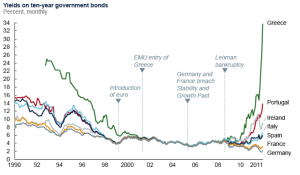
But to be more realistic, sovereign bond yields on 10-year debt maturities are shown below for several different recent European sovereign bond market eras.

Untitled


Prior to the common currency that arrived in 1999, when the Euro countries were on their own (in the sense of no support from by each other or by a central bank), sovereign yields were priced to reflect sovereign risk.

At the start of the common currency in 1999, the sovereign rates came together at Germany’s base rate during the honeymoon of the Euro zone when it was presumed that the stronger countries would come to the aid of the weaker if need be — and if not, there was a central bank to provide assistance. Also debt control was a pre-requisite to be a member of the Euro zone.

This presumption of aid to the weak became questioned after the financial crisis, and there was a weakening of country debt control. This relevant era began in 2008, at which time the market priced country vulnerability with little or no help from neighbors or by the central bank because “monetary finance” (or central bank financing of governments) was still taboo.

That environment reveals clearly how hard markets will punish sovereigns with debt problems. High single digit sovereign yields existed, and Greece, which was headed for its first default, experienced a 30 percent market cost of finance for 10-year maturities.

In this case, for a country with debt equal to 250 percent of annual GDP, and if its sovereign average cost of funding for all maturities was merely 10 percent, that country would need to capture fully 25 percent of GDP to pay interest alone without any of the other costs of government being covered. There would be debt cost of that magnitude likely for both Greece and Japan.

That is the process by which default is brought on when the debt-to-income ratio reaches the bang point. It might take a few years, but the process grinds on until the income lost attempting to tax and service the debt becomes impossible to bear.

So, in a last ditch effort to avoid default, the central bank intervenes with quantitative easing to reduce interest rates paid by sovereigns. QE is in process in Europe, but as things currently stand, Greece’s sovereign debt is not investment-grade and, hence, is not eligible for purchase by the ECB unless the rules are bent or the rating is changed which is a likely response in the pragmatic business of saving the sovereign, otherwise known as “Whatever it takes.”

Alternatively, Greece would need to drop out of the currency union, likely default on its debt in whole or in part, and go back to its own currency from which they can continue to play the money game to depress interest expense. In the case of Japan, the pretense continues, but they are past the bang point and — short of some new exogenous source of demand for their products revealing itself — they are sinking deeply into the morass of debt and debt service.

But will central bank QE really contain the debt service problem? The answer has to be no because the side effects of the debt solution becomes its own problem.

With such low investment returns in-county, capital flees to higher-yielding locations and, without capital, there is no financing of private investment and the real physical capital stock becomes a relic of yesterday. This erodes income and raises the debt-to-income ratio further.

Once having reached the bang point, QE is too late and counterproductive


Sign up to receive the Spellman Report. Bracing financial and economic insight. Now with free delivery!

Oil Boombustology

boombustologyIt’s long been in the DNA of economists and market observers, going back at least to the Austrian School of Economics, that when boombustology_2money growth outpaces the economy’s growth, booms are created and so are busts: Boombustology, as coined by Mansharamani of Yale University.

Certainly quantitative ease as practiced in serial form by today’s central banks fan that concern, but for the most part, the sentiment of central bankers, politicians and the market seems to be “please let there be a boom” and we’ll dodge the bust.

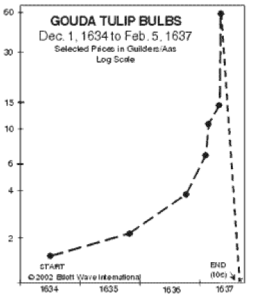
There are all kinds of booms and busts. Some are of a benign form called behaviourism. They are born of the belief of ever-increasing prices. Tulipomania during Holland’s seventeenth century was a classic. Though it might not carry an entire economy into excess but the rise and fall of tulip bulb prices surely redistributed wealth.

But some booms involve financing to purchase the item that is booming whatever it is. In that case lenders also have to buy into the boom to make it happen. When the item booming requires industrial equipment to produce it, the economic ripples become far reaching.

The boom mood creates over-building of the capital goods and eventually, the oversupply of the booming item whether we call it tech, housing or commodities. Then, the rising price of the item that precipitated the borrowing and building turns into a free-fall of prices, borrowing and building. There follows an air pocket of demand for the capital goods in question which can then become a generalized demand suppressant and a financial bust.

The lethal combination of reduced demand and over-supply brings into play all the D Words: deflation, default (on the financing), depressions if wide spread and possibly devaluation of the currency, if capital flows to safer ports of call.

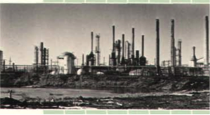
Certainly the Great Recession was deep and long not just due to the overindulgence of borrowing and home building but also the permanence of the physical structures left behind that creates a following air-pocket of demand in some places called Ghost Estates. boombustology_3That is, the durability of the over built real capital determines the duration of following depressed demand and soft prices. And this condition continues and defines the duration of the bust as long as the excess supplies are a silhouette on the horizon as shown to the right.
In contrast, was the boombustology of over-built agricultural capacity during World War I to feed a world at war. At the war’s conclusion, Europe went back into production and this expansion of U.S. agricultural capacity created a supply glut in the commodity markets when Europe went back into production. But given the short life span of the crop and the ability to cut back production, the US deflationary depression of 1920-21 that followed was short, sharp and self-correcting.

In today’s post Great Recession environment, fear still persists that the economic ship has not been righted. The duration of a housing bust has been long given the duration of the over-built houses that still dot the landscape in some places.

Central banks are reluctant to take their foot off the proverbial gas pedal and, instead, push the pedal to the metal. And they, still with faith in the Keynesian multiplier, apply ever-cheaper credit (if that is any longer possible).

So where has the money induced boom arising out of the central banks QEs been hiding? To pick up the trail, all one needs do is follow the deflating prices of what is over-built. That leads us to oil, and much the same can be said about commodities in general, especially in the emerging nations.

During the boom phase in the U.S., oil drilling and boombustology_4extraction have been highly instrumental to the U.S. cyclical recovery.
The oil boom didn’t quite take the overall U.S. to a giddy boom, unless you were in Texas or North Dakota or a few other states but its contribution to spending of $300 to $400 billion per year has been the difference between a 2 percent real growth rate and an economy being dead in the water.

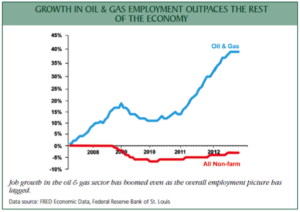
Furthermore, as reported by the Manhattan Institute, the economy’s employment growth has been highly concentrated in the oil and gas industry (with other sources of employment growth barely moving the employment needle).

As it turns out, the shale oil industry mainly via the energy investment banks of the region financed over $1 trillion — or an amount equal to approximately 40 percent of Fed-provided liquidity during the Great Recession.

Bloomberg reports that there was $353 billion of IPO in the industry, $286 billion of joint ventures, boombustology_5and $786 billion in lower rated bonds financing this capital intensive undertaking.

Now the oversupply of oil from their success has turned against the drillers. The U.S. marginal increase in oil and gas production to global supply along with generally softening economies in the developed world has caused oil prices to decline in the neighborhood of 50 percent. This boom is now in the bust phase, and additions to production are in retreat.

This represents a world of hurt for the investing entities (generally small firms) and their employees as well as those who hold the energy securities in the form of low-rated bonds or commercial bank loans. Fortunately, the amount does not threaten the mainline financial institutions that hold only a small portion of them, so the financial bust is confined but the physical remains of the boom are silhouetted on the landscape as shown above.

But there is a silver lining to this boombustology. For one, the active life of a fracked well is in the neighborhood of two years during which time 90 percent of product is extracted. The short duration of the income stream from fracked wells allows for a smoother adjustment on the downside and re-fracking will only continue if supported by price increases.

But more importantly, the 50 percent price decline for energy which is used by all other sectors of the economy is provides a large cost savings that is equivalent to a tax cut. Moreover, for the corporate sector, the cost savings represent an increase in net cash flow and higher profit margins and hence broad market support for both stocks and bonds.

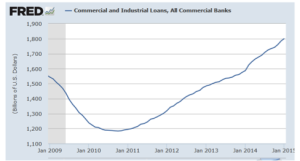
But the real issue is will the economy shift gears and sustain the growth of recent years in the absence of an oil thrust? The now-50 percent increase in bank lending to commercial and industrial uses since the bottom of the Great Recession in 2009 along with the “energy tax cut,” suggests that the usual mechanisms of monetary policy are beginning to work to sustain economic expansion beyond oil and commodities.

There are all kinds of booms and busts, and this one could well have a silver lining of generalized higher income after energy costs across the landscape, without a generalized financial meltdown. All in all, the oil and commodities booms and lower prices, even with their industry losses have a net positive effect on economic growth, all things considered.

So, on the spectrum of booms and busts this one will likely be more in the category of the self-limiting agricultural deflationary depression of the early 1920s than the housing boom and bust of recent memory.

Indeed, it has been sufficiently underway to cause the Fed to state its intention to end its quantitative ease. Furthermore, now that there is a stated intention to shift to a monetary tightening, it raises the question of what is left of growth in the US economy without oil expansion? The oil and commodity bust leaves us with a tilt toward deflation and an expansion that remains to be seen.

Sign up to receive the Spellman Report. Bracing financial and economic insight. Now with free delivery!

Goodbye to the Robinson Crusoe Bond Market

image003With the U.S. economy having achieved lift-off momentum, the Federal Reserve has ended, at least for now, large-scale bond buying — better known as quantitative easing. Furthermore, the Fed is taking a big gulp and is working up its collective courage to move to interest rate “normalization,” if anyone can remember what that is.

The thinking is that by merely removing the Fed’s large-scale demand for U.S. Treasury bonds, those prices would revert to whatever private buyers will sustain. And with less demand and lower prices, we would get to the correspondingly higher market interest rates. If so, this would be the normalization of rates on autopilot, as no further Fed action would be needed.

That intuition is so strong that a recent Bloomberg survey of economists showed they forecasted not just higher interest rates for 2015 but also that the 10-year T-Bond yield would rise from its year end lows of near 2% back to the 3% level as it was in the beginning of 2014 (shown below).

crusoe1Moreover, not only was this the economists’ consensus, but all participants forecasted higher rates in defiance of the multi-year downward trend, including last year. It is indeed a rare event when economists’ forecasts are not merely a trend extrapolation but rather based on deeply ingrained training and historical experience.

The intuition behind this forecast is, no doubt, based on the classical idea that absent a Fed intervention, market demand rests solely on the shoulders of motivated savers and with the bond sell-side being dominated by businesses that offer bonds up to the point at which their borrowing cost is just supported by investment returns to real capital.

For the sake of argument, let’s call this the Robinson Crusoe island world of finance. It’s quaint, uncomplicated by government actions and constraints, and all bond buyers and sellers are domestic investors. It is the veritable island economy without a central bank.

However, with the advent of globalism, government buying and selling, and regulatory manipulations of all sorts, market-determined interest rates have moved to a new setting. With the elimination of capital barriers, the global financial industry can now move capital across borders for many purposes and reasons and, in so doing, move U.S. financial prices. Of all markets that are not islands, it would be the U.S. Treasury bond market that is still the main holding for other countries’ external reserves and global investors’ go-to asset.

The U.S. 10-year Treasury bond is nearing a 2% yield, and while that is very low both in absolute terms and by historical comparison, it is much higher than similar 10-year government debt in a host of countries that matter.

With Germany at 50 basis points, Switzerland and Japan at 30 basis points, and even troubled Spain at 60 basis points, these countries make the U.S. 10-year T-bond’s 200 basis points very appealing, especially when the U.S. dollar is appreciating against other currencies.

And then there have been institutional developments and a regulatory framework that influences asset choice. Accumulated consumer savings now reaches the demand-side of bond markets via pension funds, banks, wealth managers, and insurance companies where interest rates reflect many categories of private risk. The one that stands out most is the fear of deflation taking place in Europe and Japan and with falling oil prices in many other places as well. This biases the demand toward fixed rate financial contracts in the strongest currency.

Bingo, dollar-denominated Treasuries win again.

And then there are other contortions to market demand for Treasuries when fearful regulators weigh the default risk of different assets in an institutional portfolio and assess a charge in the form of risk-weighted capital. And, as you might have guessed, U.S. government regulators assume U.S. Treasuries are absolutely riskless and, as a result, no institutional capital need be set aside for owning Treasuries as compared to private debt.

Well, the recent push for more stable and capitalized banks suddenly makes the U.S. Treasury asset class more desirable for regulated institutions even at extraordinarily low interest rates because U.S. Treasuries provide capital shields in addition to their puny interest rates. As a result depository institutions have added over $120 Billion to their portfolios in the last three years.

And then, as discussed last month, there are the central banks of the rest of world. They are lining up to buy U.S. dollars (and in turn U. S. Treasuries as a foreign exchange reserve) with their own printed currency. This is a bi-product of the “currency wars” for the purpose of depressing the relative value of their own currency in order to recapture lost global exports.

crusoe2

Just behind the official foreign government purchases are the foreign private investors that are sucked into US dollar assets as a result of the twin appeal of higher U. S. yields and the US dollar appreciation that is occurring relative to 31 currencies. None of this was ever seen in a Robinson Crusoe bond market.

And this phenomenon is likely to kick into higher gear shortly as the European Central Bank (again) reassures its constituents that it will have a QE of its own. It will be directed to Eurozone Sovereign bonds in the first instance, but with Euro domestic yields already so puny, the expectation of a Euro QE is already causing private investors to redirect their wealth away from Euro investments into higher yielding, dollar-appreciating U.S. Treasuries.

As you look up and down the line-up of players and motivations, interest rate normalization will not likely take place by the Fed simply sitting on the sidelines of the Treasury bond market. There are too many other sources of Treasury demand in this divergent, deflationary, regulated economic world causing T-Bond demand to wash up on our shores. Rising rates attained on autopilot, as a result of the Fed’s ceasing to be a buyer of Treasury bonds, will not be enough.

So then if rates were to return to historically normal levels, it’s likely to require not just a hands-off autopilot approach by the Fed but also that it enter the market as a seller of U.S. Treasuries (and if not Treasuries, then something else). That would be a reverse QE, if you will.

And it’s possible that the Fed doesn’t have enough 10-year Treasuries on its balance sheet to sell to drive the price downward in the face of these motivated foreign buyers. But it does have a larger supply of shorter dated Treasuries that can be sold. Additionally, by raising the rate that it lends to banks, it can drive short rates higher and pull some private demand out of the long-dated Treasury market, effectively leading to a yield curve flattening.

In general, it’s a good bite easier for central banks to drive bond prices upward by turning on the printing press and buying something in large enough quantity so long as they do not run out of paper and ink. But to directly lower prices of a financial asset, it needs a sufficient inventory of the item to sell.

There are other manipulations possible to push rates higher: the Fed could raise the cash requirement of commercial banks to take bank-allocated funds out of the treasury market and even force commercial banks to shrink their balance sheets. But this runs counter to all their efforts during the Great Recession and seems unlikely.

And then there is the new, interesting weapon in the Fed’s arsenal to raise rates: sell Federal Reserve debt. That would be a refinancing of the Federal Reserve’s liabilities side of its balance sheet. Sell Federal Reserve bonds that are paid for by Federal Reserve Notes (cash). But does the Fed have the statutory ability to sell Federal Reserve debt? Well technically no, but it has been engineered around to functionally do so.

The Fed has entered the “Reverse Repo” market, selling claims collateralized by its U.S. Treasuries holding, of which it has an abundance on its balance sheet. This end-run provides the same result, and the Fed has been running about $200 billion as an experiment of the technique. Allowing the Fed to issue bonds or interest-bearing debt is a novel idea to suck some of the cash out of the system, and it has finally come to fruition. In this complicated global world, it needed an additional instrument of market control.

So whether or not the market self-corrects to the Fed’s interest rate target, it can still achieve its objective. But it will not be Robinson Crusoe on autopilot.

The interest rate environment is not what it used to be in the good old days of a closed country home central bank monopolized game. Now there are other central banks effectively creating monetary policy in U.S. markets.

Achieving policy objectives in a global financial system is a far more difficult, multi-faceted problem when foreign flows, both private and governmental, offset the domestic policy dictates. The Fed is no longer all-powerful over U.S. markets.

Slow or chronically weak economies with deflation and with foreign governments hell-bent on achieving export share are causing financial spillover into the U.S. market that would be difficult to offset, leaving the future course of longer maturity Treasury yields a major question. Rising rates would depend on how determined the Fed is for normalization, even if it has to sell a lot of something to mop up excess currency.

Welcome to the Brave New World of domestic policy constrained by open global financial markets. Robinson Crusoe would hardly recognize it, and for that matter, many Fed Governors don’t recognize it either.

Sign up to receive the Spellman Report. Bracing financial and economic insight. Now with free delivery!

The Deflationary Trap and the Central Bank Game of Chess

chessMy financial start in life came in the 1970s when rent houses seemed to be a good idea. That was because its rental stream was ratcheting upwards in an inflationary environment and could also be acquired with its original fixed-rate mortgage still intact.

What made the investment especially appealing was that the inflationary wind was to my back; rental streams grew while the mortgage’s interest carry remained low and locked at a fixed rate that reflected earlier and more modest inflation.

And as you might think, the combination of inflation-enhancing income streams and cheap fixed rate financing is an environment that promotes the building of more of the same — not only more houses but more importantly corporate plant and equipment that grows jobs and output. Hence, economic performance benefits from inflation, to some degree.

A return to these conditions is what central banks of the world, especially in Europe and Japan, lust for today. Instead, they find themselves on the edge of exactly the opposite — a deflation that neutralizes the benefit of the low fixed rates that central banks have manipulated since the onset of the Great Recession.

But one must appreciate the full extent of the deflationary threat facing many developed countries today that drives policy and markets.

Deflation more than neutralizes the low interest rates provided by central banks because investment in real physical assets is deterred by the prospect of deflating income streams. And that reduces spending on new physical assets which, in turn, reinforces the deflationary environment.

That is, while deflation may be the product of previous soft economic conditions, it inhibits further physical investment in real assets thus reinforcing the existing deflation.

This is known as the deflationary trap.

And that’s not the end of the self-reinforcing deflationary damage. Deflation also shrinks top-line income of the corporate, government, and consumer sectors which diminishes spending and in turn makes it more difficult to repay existing debt. In other words, the real value of debt increases leading to default and default takes down not just the borrower but also the lenders.

centralbank

The iconic scenes of bank panics of yore in which depositors line up to withdraw their funds tell a story. The depositors believe deflation induced defaults in the banks’ loan portfolios will cause the banks to fail and they had best retrieve their deposits while they can.

The dynamic leaves the banks not only with loan losses but no lendable cash. It still plays out today though not as visibly as deposit withdrawals are on-line as in southern Europe.

That was the story of the l930s.

If both the desire to borrow and the ability to lend go away, the wheels of an economy no longer function in the way we are accustomed, no matter how much money supply the central bank spreads around.

Since the developed countries are on the edge of the deflationary trap, many of their central banks are resorting to quantitative easing (QE). These epic asset purchases do not produce the lending and spending or inflation that monetarism suggests, nor do the QEs reduce interest rates, as they are already at the near-zero floor. Rather, in a great Hail Mary, the QE at this stage is intended to devalue the home currency so that domestic produced goods become relatively cheaper for foreign buyers and they do buy more.

That is the motive for quantitative easing — to gain greater global market share through a cheaper currency and hence goods, which is all that monetary policy contributes these days.

While selling currency on the foreign exchange markets is the direct route to a cheaper currency as practiced by China, it goes against the rules of central bank monetary chess. So the currency selling needs to be more subtle.

The preferred way to accomplish the same is a QE of large-scale asset purchases of domestic financial assets. The central banks claim its domestic monetary policy and leave it up to private investors seeking higher yield to head for the financial markets of other countries where slightly more than microscopic yield still exists.

In the process, the investors heading abroad sell their currency and cause the currency devaluation and do the dirty work for the central bank. It’s not much of a cover-up, but it’s what central banking has come to be these days.

What other reason would cause, for example, Japan to roll out yet another QE in heroic proportions and then, less than a month later at the news of yet another Japanese recession, to increase its very recent QE by 33%?

If successful, a cheaper Yen attracts foreign buyers of Japanese goods and enough demand to turn deflation into inflation that generates inflation streams for home-grown investment in physical capital. It also gives domestic producers pricing power, when the prices of imported goods rise in terms of the Yen.

So the self-reinforcing deflationary depression leads to often contentious policies of currency devaluation via investors in an effort to capture greater global market share and some modicum of inflation. The Fed’s QE3 of the previous two years that ended last month paid dividends for the U.S. in this game at the expense of Europe, Japan, and others, which, in turn, triggered their re-entry into the currency wars just as the Fed ended theirs.

Other countries are now in retaliation mode in this game of central bank monetary chess, hoping to steal some demand back from the U.S. This leads to not just the depreciation of their currency but the ascendency of the U.S. dollar and the value of U.S. assets, which was nice at first until we find out it’s gained at the cost of a now-perceptible slowdown in the U.S. economy. In this stage of the currency wars, the U. S. is about to lose some of what it previously gained when the Fed was in QE3 mode.

Hence, quantitative easing is no more than a cover-up for currency devaluation: it allows government officials to claim their hands are clean from a practice that is globally frowned upon.

In the process, central banks have revealed that money growth is not the inflationary threat once thought, at least not in this environment. We have come to the understanding that in the deflationary trap, neither fiscal nor monetary policies are what the textbooks say they are.

Public policy has come down to the sorry state of manipulating growth and inflation at the expense of someone else’s deflation. It’s a zero sum game of redistribution among countries that adds little overall lift to the global economy.

Few who lived through the “runaway” inflation of the 1970s would have dreamed that someday inflation would be a desirable public policy? We have come to find out that it surely beats deflation. But how to achieve inflation has proven to be elusive when lenders are fearful of deflationary induced default and business investment borrowers need more inflationary wind to their back.

Sign up to receive the Spellman Report. Bracing financial and economic insight. Now with free delivery!

The Keynesian Dead End: A Watershed Moment

UntitledIn the midst of the Great Depression, John Maynard Keynes set out in his book, The General Theory of Employment, Interest and Money, the idea — radical at the time — that a struggling economy benefits when governments borrow and spend.

Of importance was the idea that spending be financed from borrowed funds in addition to tax receipts. This is to replace the savings leakages of others back into the spending stream. In turn, that government spending generates income to those who sold the goods to the government, and that newly generated income results in a chain of additional spending and income known as the multiplier.

This case for debt-financed spending, which Keynes euphemistically called “loan expenditures,” caused otherwise circumspect governments to do the unthinkable: to incur mountains of debt.

Not that debt-induced spending didn’t work to create a multiplier; we had the WWII era to prove that. But when debt accumulates from past stimulus, the spending benefits are ephemeral and spread out in a global economy, and the future reckoning is additional taxes that must be collected to cover at least the interest carry. Today, this is called “austerity,” and it’s playing havoc in Europe and Japan.

Beyond fiscal policy, Keynes also suggested that during economic slumps, the monetary authority provide easier and cheaper financing options to entice private “loan expenditures” through the banking system.

All in all, this was what was thought at the time among many in the governing and academic classes to be the enlightened notion that governments could stimulate an economy through monetary and fiscal policy.

Over the years, the distinction between the two has become blurred. Government deficit financing has, in the years of the Fed’s QE, been largely paid for by the central bank rather than by the savings of others.

But it is all in the spirit of The General Theory in which Keynes argues (p. 129):

“If the Treasury were to fill old bottles with bank notes, bury them at suitable depths in disused coal mines which are then filled up to the surface with town rubbish, and leave it to private enterprise on well-tried principles of laissez-faire to dig the notes up again…, there need be no more unemployment and, with the help of the repercussions, the real income of the community, and its capital wealth also, would probably become a good deal greater than it actually is. It would, indeed, be more sensible to build houses and the like; but if there are political and practical difficulties in the way of this, the above would be better than nothing.”

With this logic, governments resorted to enacting fiscal and monetary policy with each subsequent recession with little-to-no thought by the true believers that there are costs of running both the government and private debt meter.

And worse, in an open, global economy, the deficit-strapped economies undermine other trading partners as well when global purchasing power goes soft. That interaction now catches the US in the web of European and Japanese debt.

And there are also costs of too much money to entice “loan expenditures” from the private sector that the Fed is now belatedly thinking about.

Ceaseless monetary expansion in Keynes’ terms leads to the collapse of “capital wealth.” And the Fed is just belatedly taking asset-price bubbles under advisement, but is too late. The trap has been set, and they set it.

But that consideration didn’t stop the Japanese who, this past week, again resorted to an even larger QE, which leads one to the conclusion that desperate governments do desperate things.

Still, there is an inner logic to it. The Bank of Japan is again purchasing mountains of government debt that they themselves have demonstrated has but little effect on the economy. However, it does defease the government debt, which causes it to disappear from the market and from view in the vault of the central banks that dutifully reimburse the government the interest paid as owners of said debt.

All in all, if the governments stuck to Keynes’ notion of burying old bottles filled with bank notes (cash), we’d be less exposed to excess debt that needs excess future taxes and central bank-financed buying power to support the economy as extra taxes come due.

A more constructive alternative would be if Keynes’ buried money were newly printed central bank notes to be taken to the shopping malls and spent by the money-miners. It would be interest- and debt-free and would be funneled to goods markets instead of financial markets to create “capital wealth” without a risk of financial meltdown.

We are approaching a watershed moment when even governments are beginning to understand the game is up. This past week, the UK announced that it will (retire) some perpetuities (debt without maturity) originally issued to finance Word War I, not by a cash pay-off but by a refinancing. No, government debt doesn’t go away. All it does is accumulate, and that particular debt tranche has cost more than five times in interest what the original debt cost in the first place — and that’s just to date.

“Loan-expenditure” policies have come to a dead end.

Sign up to receive the Spellman Report. Bracing financial and economic insight. Now with free delivery!

The Evils of Serial Quantitative Ease and the “Welfare of Everyone”

Officials from the Federal Reserve have agreed that their quantum asset purchases, financed with new money through a process known as Quantitative Ease (QE), will conclude next month — that is, unless they find a new problem on the horizon for which another dose of quantum money seems in order.
 

And lest we presume that we have lived through the conclusion of this epic historical monetary experiment, we now find the European Central Bank [ECB] has re-ignited. And ditto for the Bank of Japan, as things are not going well in either location.

And just like the Fed — in an effort to take Keynesianism not just to the limit, but beyond the limit of credulity — the ECB has set a negative nominal rate target.

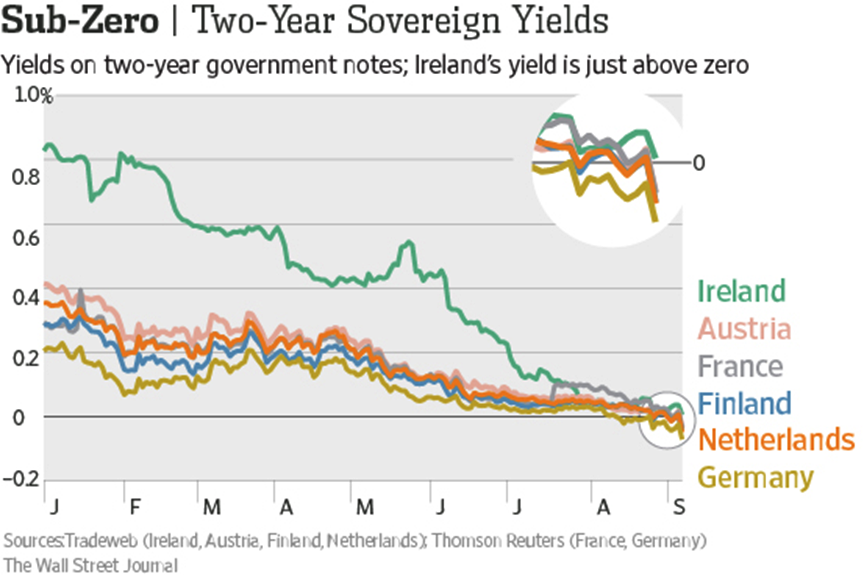
Now, it’s one thing to set a service fee on deposits that exceeds any interest paid to achieve a negative rate. But if you can image it possible, market yields of traded European sovereign bonds have actually turned negative for possibly the first time in human experience, as shown below:


This is achieved when an investor voluntarily pays a price for a debt instrument that is higher than the investor will receive back in both principle and interest. And mind you, this is by contract, not by default.

Not since the days when Mark Twain’s Tom Sawyer charged his friends for the privilege of painting his fence has the world gone quite so upside down and backwards.

And upside down and backwards it is when central bankers, in their zeal to entice borrowers to borrow in the hope that they will spend and generate income, have now pushed interest rates not to zero but actually into negative territory. This amounts to the subsidization of borrowers (whether they are consumers, businesses, or governments) saying: “Please, take the money and spend it, and you don’t have to pay it all back.”

So the question is, why would central banks do this? Well let’s examine the rationality in Fed Chairwoman Yellen’s own words:

“The Fed provides this help by influencing interest rates. Although we work through financial markets, our goal is to help Main Street, not Wall Street. By keeping interest rates low, we are trying to make homes more affordable and revive the housing market. We are trying to make it cheaper for businesses to build, expand, and hire. We are trying to lower the costs of buying a car that can carry a worker to a new job and kids to school, and our policies are also spurring the revival of the auto industry. We are trying to help families afford things they need so that greater spending can drive job creation and even more spending, thereby strengthening the recovery.

When the Federal Reserve’s policies are effective, they improve the welfare of everyone who benefits from a stronger economy, most of all those who have been hit hardest by the recession and the slow recovery.”

Well I beg to differ with you, Madame Chairwoman, on your narrow-minded concept of the “welfare of everyone.”

Who, other than central banks, has the luxury of being more or less indifferent as an investor in zero (let alone negative-yielding) market debt? The trillions spent to put the relatively small group of now-reluctant workers with challenged skills to work inflict serious economic pain on the other side of the coin, so to speak.

And on the other side of the cheap money coin is the absence of investment income of a large generation of savers and future retirees called Baby Boomers (amounting to 30 percent of the U.S. population), as well as their supporting institutions such as pension funds, insurance companies, and endowments that provide medical and educational benefits.

Zero interest rates do not come anywhere near the assumed earnings rate of individuals or institutions to service future retirement or endowment obligations.

But normalizing to higher interest rates generates another larger problem than the immediate problem of a semi-lackadaisical economy.

And that problem is that a subsequent shift to normalized higher interest rates (to create investment income for institutions and individuals for retirement purposes) causes the enabled borrowers in the ultra-cheap money scheme to face rising costs of repayment, which in turn requires them to reduce their spending.

This is the conclusion of the Bank of England with regard to central bank encouraged household debt and the fiscal austerity in Europe and the implementation of a national sales tax in Japan is a de facto recognition that previous borrowing binges at cheap interest rates compromises the economic future.

This demonstrates that Keynesian notions of debt-enabled spending policies have maxed-out, as there is too much accumulated debt, and the process has become counterproductive. For the U.S., we have a bit more running room until we hit the wall, but in the decades ahead, Baby Boomers will suffer the consequences of previous central bank myopia.

Ultra low interest rate enticements to spend create multiple future problems. Those with the debt subsequently seek to deleverage especially when interest rates normalize thus creating future recessions. Then in an effort to prevent those future recessions, the central bank returns to yet, lower interest rates for a longer period of time thus compromising the calculations and welfare of savers. This is the story of Japan and now Europe. They’ve returned to the money well as the Fed itself has done three times since the onset of the Great Recession

When will the Fed’s monetary zealots understand that future recessions and diminished investment income is not in the “welfare of everyone?”

Debt-generating demand policies were not meant to be a long-term, ceaseless debt accumulation but rather a short-term, cyclical shoring-up of an economy to allow for debt retirement in an ensuing period of prosperity.

At this point, all that is left is supply-side policy, and in that there are rich dividends. Countries will seek out a Plan B, as discussed here that nurtures companies and commerce with a minimum of regulation and taxation to foster economic growth. Keynesian, demand-side policies have been taken to their logical, counterproductive conclusion and the Chairwoman’s sense of “the welfare of everyone” is in the best interest of no one.

Sign up to receive the Spellman Report. Bracing financial and economic insight. Now with free delivery!

America’s Exorbitant Privilege is Skating on Thin Ice

thiniceAt the conclusion of World War II, there was a meeting among the Allies in Bretton Woods, New Hampshire. There, it was agreed that institutional arrangements would enhance the U.S. dollar for across-country payments (as opposed to gold or another currency, such as the British Pound).

The choice of the U.S. dollar was a logical one. The United States had both the largest share of global trade and the largest share of gold, which it pledged to redeem to foreigners in exchange for their accumulated U.S. dollars. Given the U.S. dollar’s share of global trade at that time, size alone made it the preferred currency because markets for all currencies versus the U.S. dollar were deep. As a result, markets for foreign currencies versus the dollar were more liquid and less volatile, which reduced exchange rate risk and transaction costs.

This was a great encouragement for global trade and for capital to flow to its highest and best use across the globe.

Without it, consider what would occur: If a Peruvian farmer purchased goods from an Outer Mongolia craftsman, the transaction would require a counter party in the very thin and volatile cross of their two currencies. Instead with a recognized and institutional enhanced U.S. dollar, the buyer traded his currency for the dollar, and the seller, in turn, earned dollars that were either held for future purchases in U.S. banks or more easily sold into their home currency with low transaction costs.

This U.S. dollar-based system, with some modification, has worked for 70 years but is now threatened.

And there will be winners and losers.

While a stable and liquid medium of exchange provides benefits to all traders, the U.S. has been the primary beneficiary when its currency is the accepted medium of exchange. This is because private parties and governments hold U.S. dollar balances in banks, and these transaction balances are quickly invested into U.S. dollar denominated financial assets by the banks or are held directly in U.S. investments by the foreign owners.

Hence, worldwide transaction balances and foreign savings were biased toward U.S. assets investments, which produced a wealth effect for U.S. assets. This produces not just elevated and more stable prices but also higher investment returns relative to those of other countries.

So U.S. dollar acceptance as a reserve currency did much the same as the current Fed’s Quantitative Easing in which financial purchasing power from outside U.S. private sources enhanced the value of all U.S.-denominated securities as well as non-financial wealth such as real estate.

Wealth effects have become the policy tool to promote spending and all good economic things that follow – such as income, employment, and government collection of tax receipts that reduce government deficits and the accumulation of U.S. debt that will need to be serviced in the future.

Moreover, the willingness of both private and government foreign sources to hold financial assets denominated in the U.S. dollar greatly enhances the ability of the U.S. to borrow in U.S. dollars cheaply from the rest of the world. Note that there were two parts to that statement: cheaply and in U.S. dollars. And both matter.

It has worked to the advantage of the U.S. First, U.S. government debt has been heavily financed by foreign governments, which hold 60 percent of U.S. government debt not owned by U.S. government entities.

Now, for a country such as the U.S. that has a burgeoning debt problem —which will become more strained as Baby Boomer entitlements challenge our collective futures over the next decades —the ability to place bonds, denominated in U.S. dollars, cheaply to foreigners means we can more easily fund our government deficits and do so at lower interest rates. Without Exorbitant Privilege — the benefit the United States has because our currency is the international reserve currency—our government would require its citizens to add U.S. dollar risk onto their tax bills as interest rates on U.S. government debt would otherwise reflect.

This is the basis for the rest of the world’s U.S. envy that goes by the name of “Exorbitant Privilege.”

In contrast, for countries that do not enjoy Exorbitant Privilege, their government debt is more expensive to carry and, when more questionable, can only be sold markets if the foreign government debt is denominated and owed in U.S. dollars. To appreciate the problem, take a trip to Argentina. They will be most eager for your dollars because markets doubting the value of their currency have forced them to sell their country’s debt, denominated in the U.S. dollar.

As such, each tax payer in Argentina has assumed home currency risk if U.S. dollars, relative to their currency, become more expensive. And they have, as a result of lagging exports and/or forceful capital outflows.

That is what happens when a country does not have Exorbitant Privilege.

When funding government debt becomes unaffordable, what follows is a government bond default and then no one lends to you anymore. In our case, it would be the end of Baby Boomer entitlements.

As we have moved far from the time of the Bretton Woods Agreement, the success of global trade has caused other countries of the world, both those who oppose us as well as those we consider to be friends, to covet the U.S.’s Exorbitant Privilege.

For example, this past week, the central banks of Switzerland and China have agreed to a currency swap designed to boost trade and investment between the two countries. Switzerland joins a parade of 20 countries hoping to become offshore hubs for trading the Chinese Renminbi. Also as a result of this agreement, the Swiss central bank can access and intends to hold China’s government debt as a portion of its foreign exchange reserve thus moving away from US Treasuries.

The infrastructure to not deal in U.S. dollars when purchasing Chinese goods is developing across the globe. Other countries taking action to either provide exchange facilities with central bank back-up liquidity facilities in Chinese currency include Germany, the UK, the European Central Bank, New Zealand, Australia, and the BRIC countries. It’s worth noting that Russia and China have agreed to settle Russian energy exports to China in the Renminbi.

What this means is one no longer needs to deal in U.S. dollars to conduct business with China, but it will morph into the Remnimbi becoming a reserve currency for all cross-country trading and with China extracting Exorbitant Privilege from the rest of the world.

So the pendulum is swinging and is not confined to Europe or the BRIC countries. Now even U.S. Fortune 500 companies such as Ford are using the Renmimbi as a reserve currency in trade with China.

In addition to the morphing of global transaction currencies away from the U.S. dollar and U.S. financial assets, there are other disturbing developments that provide self-inflected wounds to U.S. Exorbitant Privilege.

FATCA, or the Foreign Account Tax Compliance Act, has gone into effect this month. Aggressive U.S.-required reporting, withholding requirements, and fines are chasing U.S. citizens out of non-dollar holdings back to the U.S. and the U.S. dollar. But FATCA and its IRS enforcer are being equally aggressive with foreign holders of U.S. assets and financial accounts. In particular, U.S. Treasuries, which had been tax-free to foreigners, are now subject to a 30 percent interest income withholding and must comply with IRS reporting regulations. This will encourage foreign holders of U.S. financial assets to invest, instead, in other currencies.

To further disincentivize foreign holders of U.S. dollar balances in financial accounts, the U.S. and its allies has resorted to enacting sanctions as leverage over foreigner governments, both their leaders and their economic and political friends. For example, going after Putin personally andthe Russian Oligarchs has its costs. What government or foreign leaders or their supporters will be willing to hold U.S. assets with the arbitrary and capricious ability of IRS to withhold income or freeze or seize their personal assets?

The BRIC countries seemingly have had enough and are laying the ground work for a structure that would serve as an alternative to the U.S. dollar, the U.S.-dominated IMF and World Bank.

It’s true that there are natural economic forces that cause Exorbitant Privilege to gravitate to successful exporters, but U.S. policies are accelerating the shift to China and other ports. But FATCA and sanction policies amount to capital controls that accelerate the demise of U.S. Exorbitant Privilege. A key element of obtaining Exorbitant Privilege is the freedom of capital to leave a country, and without that, capital does not enter. And the freedom of capital outflows now is de facto on the wane.

There are clearly benefits that accrue to a country’s economy and financial markets and investment returns if the policies of a country afford it Exorbitant Privilege.We have had it for so long (about 90 years) that it’s been taken for granted, but the current administration is squandering that privilege. Exorbitant Privilege is not a God-given American gift, and with the simultaneous implementation of FATCA and sanctions as a foreign policy, the ice we are skating on just got thinner.


Sign up to receive the Spellman Report. Bracing financial and economic insight. Now with free delivery!

Financial Price Discovery Postponed for the Duration

FPD1In the financial bust of just five to six short years ago, prices of financial assets across the board were in free-fall. Even when prices stabilized at bargain levels, liquid and solvent buyers were frozen in place, unable to bid.

This is because in a deleveraging-inspired selling panic, prices disconnect from the underlying understanding of value. It left potential investors yearning for price discovery.That is, they sought the comfort of believing that financial assets trading in the market were priced below what one could expect from investors attuned to both upside possibilities as well as downside risks.

Much the same is happening today — not that prices are falling relative to some traditional notion of value, but rather prices have thrust beyond what traditional metrics of value easily justify.

A further source of discomfort is not just the level of prices but the pricing inconsistency between bonds and stock. There now exists strong support simultaneously for both, which typically occurs in eras associated with greater efficiency in production, widening profit margins and strong economic growth, without inflation.

And that expectation is not widely held today.

Rather, there are a variety of worries still on the horizon, some near-term and some longer-term.

They include a continued respect for the Great Recession, the economic and financial implications of debt finance or taxation to pay the Baby Boomers’ entitlements, and the uneasiness that the central banks are setting markets up again for another asset bubble, among others.

Pick your economic poison and there are lots of candidates that impact investors’ assessment of profit realization and growth, sovereign debt risk, currency risk and inflation risk, all the things that investors pay attention to.

What creates the great pricing disconnection is that central banks indeed share many of those fears, as do investors — and as a result, they purchase financial assets as a nostrum for all those ills. The liquidity provided to investors from the sale of their assets to the central bank is then spent on other investments, which in turn drives prices upward across the board.

And more central bank fire power was added recently when the European Central Bank joined the other major central banks. In the case of Europe, there are multiple problems being addressed via large-scale asset purchases, including economic lethargy, commercial bank funding problems, government debt sustainability, and the fear of deflation.

Given that array of serious issues, the ECB one-upped the Fed’s zero interest rate policy with a negative interest rate policy, not just in real terms but in nominal terms (at least for bank deposits at the central bank).

Not to be outgunned, the Fed made another addition to the list of concerns that require large-scale asset purchases: The eradication of long-term unemployment among those short on job skills.

But moreover there is now a dynamic that is setting in among the major central banks. They can’t be outgunned in asset purchases or their currency will rise in value and create comparative advantage problems that would inhibit their exports and their economic recovery.

So the central banks are getting close to the interactive dynamic of having to respond with enough asset purchase intervention to offset the pressure for their currency to appreciate due to the intervention of others. We have entered a modern day beggar-thy-neighbor dueling of central banks that seek to lock in exchange rates with asset purchases. This of course elevates asset pricing across the board of investment categories and across countries.

The result is that perceived risks are not being translated into lower market prices by investors; they are being translated into higher market prices by central banks — which is equally true for bonds and stocks.

The irony is that we have one large financial segment buying because of their economic fears (central banks) and the fearful private investors are buying despite some of the same fears because they believe that central banks won’t quit supporting their assets.FPD2

The net result is very high bond prices and a bottoming out of yields and yield spreads, which in the case of the Euro Zone has taken some of the periphery bonds yields lower than U.S. bond yields.

And in the equities markets, the medium P/E ratio (shown below in red) is elevated unless one expects broad-based improvement in economic growth with rising profit margins.

As a result, financial prices do not reflect market expectations of anything but central bank willingness to participate in the asset buying fix. FPD3

And there are too few niches in the markets that will be unaffected or protected from the vulnerability of central bank restraint if it were to occur, but the search is on and is centering on “alternative” assets.

As long as this pricing disconnect continues, there are a lot of textbooks and mindsets that need to be revised as to what prices are trying to tell us about risk and opportunity.

At the moment, financial market prices float detached from the anxieties of market investors as long as the same anxieties drive the central banks into action.

Somewhere there are real market prices to be discovered when the central bank fog is lifted, but for an individual central bank to drop out of the fix requires all central banks to simultaneously back off of this modern day beggar-thy-neighbor interaction in concert, or else they would be at a relative disadvantage in foreign trade.


Sign up to receive the Spellman Report. Bracing financial and economic insight. Now with free delivery!

Post navigation

← Older posts
Newer posts →

Receive The Spellman Report Monthly for Bracing Economic and Financial Insight


Click to Subscribe Now
Click to Email Dr. Spellman
Tweets by spellmanreport
Lew Spellman

Lew Spellman is Professor of Finance at the University of Texas McCombs School of Business. The Spellman Report seeks to interpret current and future trends in the economy and financial markets from the perspective of history, theory and policy.

Other Commentary

Frank Beck, Beck Capital Management
Bill Gross, Janus
The Grumpy Economist
Jeffrey Snider, Real Clear Markets
Ben Bernanke
Hoisington Management, Economic Overview

RECENT POSTS

  • The Pernicious Effects of Debt Accumulation: An Interview with Lacy Hunt
  • Is your Child’s Lemonade Stand Against the Law?
  • For the Millennials, The Social Security Chickens have Come Home to Roost
  • Does Mega Money Result in Dead Weight Debt?
  • In The New Monetary Ballgame, the Game Is Rigged for US Treasuries (Part 2)
  • It’s a Whole New Ballgame: The Fed Has Been Stymied: (Part 1)
  • The House of Cards: EU Edition
  • The Mad Genius of the Zero-Forever Bond
  • Bond Refugees Flee to Stock Lands
  • Negative Interest Rate Neverland

POSTS BY TOPIC

Disclaimer: The Spellman Report is not an offering for any investment. It represents only the conclusions and analysis of Professor Lewis Spellman. Any views expressed are provided for information purposes only and should not be construed in any way as an offer, an endorsement, or inducement to invest.
© 2016 The Spellman Report
↑