↓
 

The Spellman Report

The Spellman Report, Where the Economy and Markets Meet

The Spellman Report
  • About
  • Blog
  • News and Views
  • Video
  • Investment Management
  • Speaking Engagements

Search Results for: "economic news"

Post navigation

← Older posts

Economic Direction as Seen Below the Radar

The Spellman Report

The financial press’s take on the economy and financial markets has lately been cloudy. The growth rate has indeed been drifting and the economy is being subjected to adverse shocks. But let me suggest there is good reason to believe there is a positive direction emerging below the radar of the cross-currents.

One way to reveal patterns of growth is to break down or decompose economic time series into long-term secular trends, cycles and shocks, which take on a pattern of random noise. Since the noise sells newspapers, it receives the lion’s share of daily attention, and it can also cloud the economy’s overall sense of direction. Certainly, the recent plethora of shocks — whether tapering and then more tapering, the emerging market sell-off, Obamacare’s attendant ripples, or adverse winter weather — can create a sense of economic drift or even contraction.

But it seems to me that more important cyclical forces are unfolding below the radar, moving the economy so slowly that its movement is barely detectable.

When I say cyclical forces are moving the economy, I mean that they have a life and momentum of their own apart from the shocks and the secular influences. That is, economies slipping downward don’t go to zero, and economies moving upwards don’t go to infinity. Growth sets in constraints — which typically are overinvestment in durables and plant and equipment — indeed leading to an absence of investment in the recession that follows.

Similarly, during times of recession, a backlog of deferred replacement for capital goods occurs and is ultimately fulfilled. This is true whether the capital goods or durables are those of the consumer, business or even the government.

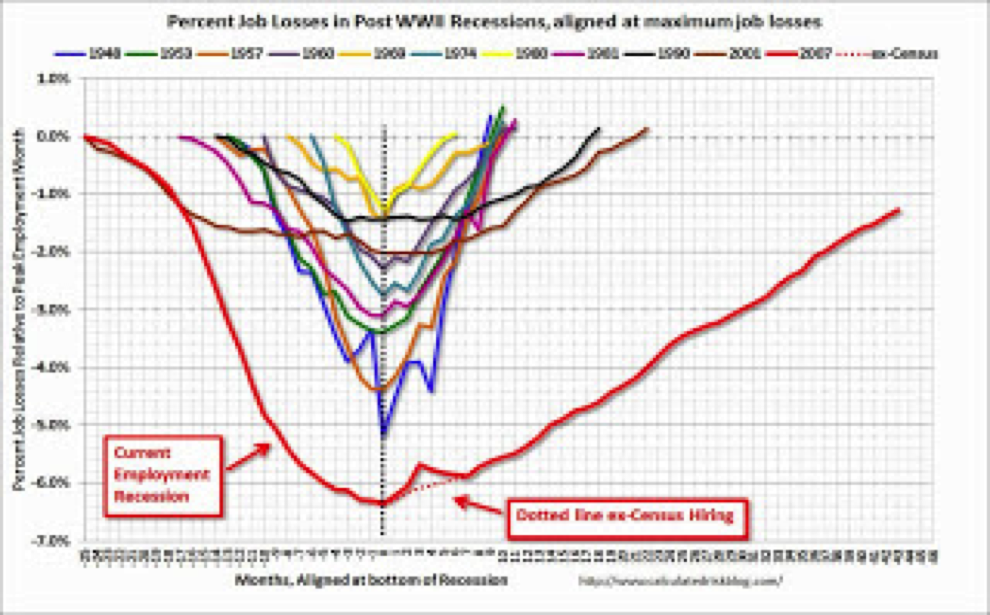
The below graph depicts the duration and amplitude of U.S. employment cycles during the last 70 years or so. The graph reveals that when the economy goes down, so does peak employment from the previous cyclical high. The depiction of cycles is centered on the cyclical employment bottom, which is measured relative to the number of months since the beginning of the recession.

As you can see, most of the post-WWII cycles were relatively short and mild compared to our current episode (shown in red), which is still struggling to return to peak employment six years later. The current recession is a long-bottoming-out saucer that stands out from the much shorter and shallower post-WWII business cycles. The graph shows how the current “recovery” has been slow-moving but nonetheless persistent.
Easier and cheaper money has been the usual driving force that lifts the economy out from a cyclical bottom. In the first wave, it stimulates consumer durable spending, including housing after an absence of durable replacement. This revival has already occurred in the U.S., causing a bottoming out of our current great saucer.

The typical second wave of a cyclical recovery is business investment spending on plant and equipment, which kicks in after demand rises faster than the supply side is expanding. The usual pattern is that business meets higher demand levels first by adding labor, which becomes more expensive as it becomes scarce.

The availability of skilled cheap labor in the U.S. is becoming constrained due not just to rising employment levels but also to an unprecedented drop-out factor in labor participation. Furthermore, much of the globalism movement of the past 30 years (i.e., moving production to countries with large pools of cheap labor) has pretty much run its course.

In that situation, the recessionary lag in business investment spending tends to kick in, driving the next phase of a cyclical expansion.

The usual benchmark for this to occur is when industry capacity utilization reaches 80 percent — and U.S. total industry utilization is now knocking on that door at the 79.2 percent level.
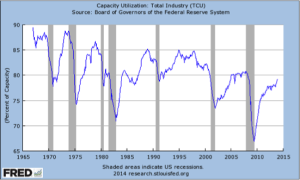
capacityFurthermore, most of our emerging market competitors’ utilization rates are above those of the U.S., so the expansion of the capital goods industries is likely to be a global phenomenon.

Basically, there has not been a capital expenditure boom since the tech go-go years in the late 1990s, and the capital equipment we do have is aging, with an estimated life of 22 years (up from a more usual 19 years.

Much like my 1999 Pathfinder of the tech year vintage, it has physically worn out, and the usual capital goods replacement phenomenon has me reaching for my wallet. But in that regard the business sector is cash-rich like never before, so the usual obsessing over interest rate elasticity of investment spending is less relevant. If it were relevant, rates are low enough.

Indeed on the financing front, a great deal of financing occurred last year via the non-bank banking sector on top of retaining earnings for years during the recession. To the extent that the Ma and Pa shops did not get in on last year’s financing bonanza, the commercial banking system is showing signs of loosening up credit six years after the shockwaves of 2008, and banks should again become relevant for them.

So basically we are at the point where the baton to keep this race moving forward is in the hands of business cap spending, as consumers are showing signs of constraints in paying for more expensive health care.

The other missing sector that has not been heard from (or at least is not making a lot of noise) is the gradual removal of the net export drag. Available domestic energy is a very positive and long term “shock” to the system.

So cap goods spending, which disappears in recession, reappears at about this juncture of the business cycle, fortified by physical obsolesce, a shortage of skilled labor, and ample cash on hand.

Will this be a typical business cycle recovery? Well, there is nothing about this recovery that is totally classical, as it’s been a classic all to its own. But this fundamental impetus from deferred demand for capital goods stands a high probability of being realized to keep the ball rolling forward.

Moreover, despite governments at all levels attempting to get their fiscal houses in order, there is also a deferred infrastructure demand that will pressure the replacement if not the expansion of the existing roadways across America that are in critical neglect.

While there is good reason to believe that the current cyclical movement will continue into its next phase, one must realize that as employment grows and labor markets become tighter — especially for the skills needed for today’s plant and equipment — labor costs tend to rise as a percentage of the corporate top-line revenue leaves a thinner margin of corporate profits.

So we get into the anomalous territory where growth continues but profit margins and total profit growth decline. So the growth of the economy and the growth of profit diverge at this juncture as an aggregate number, but the focus on the growth industries in this environment makes this a stock-pickers market — unlike last year, when the broad indices outperformed the economy.

As a last note: Cost-push inflation often creeps into this second stage of a cyclical recovery, which causes fixed-income prices to decline in the later portions of cyclical patterns. We should anticipate much the same to happen again, which makes inflation-sensitive income streams more valuable at this juncture.


Sign up to receive the Spellman Report. Bracing financial and economic insight. Now with free delivery!

Dominos: From Financial Crisis to Economic Crisis to Government Crisis

The Spellman Report

The dominos are falling. It’s the modern version of a 1930’s bank run. Since everything is bigger (the leverage) and faster (the computers) these days, so is the downfall in financial prices and institutions.

The lead domino is an asset class becoming untenable. This time around it’s the subprime sovereigns of Europe, whereas three short years ago it was subprime mortgages. Then, as now, it was thought to be a small problem (if we count only Greece) of almost the same magnitude: $400 billion in subprime mortgages that was thought to be contained or walled off. From there you should get the general idea, as the subprime story should be fresh in your minds.

Since the most conservative and regulated institutions hold large proportions of sovereign bonds in their portfolios, the default of the bonds becomes their balance sheet insolvency. The next domino is the withdrawal of the funding from banks by those who lend to them on a short-term basis and suspect the banks’ solvency is compromised.

Since demand deposits, just as the name suggests, are payable on demand, they are the next domino. This funding source exits the banks because of the suspected insolvency. To replace the lost deposit funding, banks borrow overnight from other banks or from “repo” lenders on a collateralized basis. When these sources find lending to the suspect bank too risky, they stop lending and another domino falls.

This is the part when everyone says, “Oh, don’t worry; I’ll go to the central bank to replace the lost funding.” At this stage, the banks complain of “liquidity” drying up but in reality but what is driving their liquidity problem is the market sensing their insolvency problem. The liquidity then flows until the central bank hits the wall and another domino falls. The central bank has constraints, and when the collateral offered is no longer investment-grade as the ECB Treaty requires, then the ECB hits the wall and another domino falls.

Then, borrowing from other central banks (like those of the U.S., U.K., Switzerland and Japan) kicks in as it did three weeks ago. Because the Fed has over-extended its balance sheet, it recently took a pass on net economic stimulus, opting to buy assets financed by selling other assets so as not to further expand its already stretched balance sheet. Hence our central bank as lender of last resort is constrained, it can’t help the economy and another big domino falls.

When these sources no longer provide the liquidity necessary to support the right hand side of bank balance sheets, the bank’s stockholders start to leave in the form of selling bank stock. So the next domino falls. Then stockholders of the banks and other institutions around the world ask their management whether they lent to the hedge funds whose collateralized assets are falling in value. The answer is obviously yes; as we examine the worried look on the face of a very large celebrated hedge fund manager who is pondering what to sell next in order to pay off his leveraged loans and cash out his investors seeking liquidation of their stakes in the Paulson Funds.

So then hedge funds which are larger in aggregate than U.S. banks sell, sell, sell to pay off short-term funding as well as equity owners who want out. This compresses their balance sheets, and all kinds of assets unrelated to subprime sovereigns fall wickedly in price such as gold, and the equity and debt of successful emerging nations.

So another domino falls. This doesn’t diminish these assets’ long term worth, but it sure puts a dent into value believer’s portfolios for now.

The next dominos from there are just beginning to enter the public consciousness. Can this top-down shedding of assets and compressing balance sheets also take down the economy? Well, yes, as all financial institutions are seeking to liquidate assets to meet the demands of their funding sources. So the next businessman who walks into the bank asking to roll over his loan and add to the balance to finance some new opportunity is met with the news that the bank expects payment in full on or before the current loan’s term. This, too, is a big domino as the financial crisis takes down businesses and the economy.

I would like to think it’s over from there, but it is becoming increasingly clear that taking down wealth, taking down the economy, and shutting off business and employment opportunities can easily lead to revolutionary changes in government. This is a very big domino that has hit the streets in Europe and here as well. It will also lead to revolutionary changes in Europe’s governance and institutions. On this side of the pond, the Federal Reserve is likely to be taken to task for pumping up the asset bubble with easy money known as QE2. This could result in changes in the voting membership and control of the Open Market Committee that makes monetary policy decisions. The Fed could quite easily lose its cherished independence, which is perhaps the biggest domino of all.

Whether the financial meltdown goes into overdrive as in 2008 depends on whether systemically important (large) institutions are allowed to fail as with Lehman. That lesson is now clear and the intention is to not repeat that episode says Secretary Geithner. If the government doesn’t have the ability to recapitalize banks and the financial market can’t absorb the rush of additional asset sales from the liquidation of a Lehman sized institution, then the “too big to fails” will be left in suspended animation with an upside-down balance sheet (better known as zombie banking) and glossed over with cover-up accounting. Zombie banks liquidate bank assets slowly but make no loans. At least the liquidation is measured rather than instantaneous.

Of course, only knucklehead governments do not immediately replace fallen bank lenders with fresh entry into banking — a concept known as “good” and “bad” banking. But we have a knucklehead government that doesn’t permit bank entry, so viable banks to finance growing businesses are few and far between.

The financial implosion could end if the central bank really goes over- the-top and purchases stock, either common or preferred, in the commercial banks, restoring their solvency. Our government can’t afford to do this, given its fiscal limitations. There won’t be another TARP. Central bank financing was ultimately the key to making zombie banks in Japan whole again in 2003, after more than a decade of being zombies. We’ve done lots of over-the-top things with the printing press, but at least this one makes constructive sense and is likely the last silver bullet left in the Fed’s and the government’s arsenal. As for Europe, even if Greece is saved their banks need saving and their governments also can’t afford it.

What I have described is not an ordinary recession in which over-investment in some sector causes a lull in new investment and trickles down to slow the economy without taking down the financial system or blowing up the government’s balance sheet. This is, instead, a top down financial shrinkage that takes down institutions, wealth, market valuations, the economy, governments and governmental institutions. How far it goes in Europe and in the U.S. will be determined over the coming years. One thing for sure, this one will go into the history books. The only thing in question is will it be merely the history of prosperity and depression or will it also include the history of government evolution.

The Korea Times: ‘Carry Trade’ Comes Back on Economic Recovery

The Spellman Report

Link to Article: The Korea Times: ‘Carry Trade’ Comes Back on Economic Recovery

The Goose that Laid the Golden Egg and Nobody Wants It

The Spellman Report
The Goose that Laid the Golden Egg and Nobody Wants It, THE Spellman Report

The European Central Bank (ECB) recently announced that it is back in the business of attempting to stimulate a moribund Euro economy with yet another dose of monetary steroids. Apparently, the Great Recession has not been put to bed over there. 

As the central bank prints more money and buys more bonds, it is paying prices that exceed not only the return of principal when the bonds mature, but also all interest collected in the interim. That is the formula for negative interest rates: You pay more than what you get in return. 

A bond purchaser under these terms has a known sure loss—that’s what negative interest rates mean. At some point in the accounting cycle, the bond purchaser’s losses become recognized on the balance sheet and fall to the bottom line. The price the ECB is paying for bonds is so steep that it translates to losses on the transaction, thus extinguishing the central bank’s own net worth or capital over time.

Now, as long as the central bank purchases bonds generally from commercial banks, it pays an amount in excess of what the bond will yield in both principle and interest—and surely more than what the bank paid for it in the first place. 

The central bank thus subsidizes the commercial banks with the hope and expectation that these banks will turn around and make funding available to private borrowers under terms that do not require the full repayment of the loan amount. To further facilitate negative interest rate lending, the central bank lends directly to the commercial banks at negative rates, expecting them to pass on these negative interest rates in loans to their commercial borrowers.

For example, commercial banks might lend, say, $1,000 to a private borrower who would only need to repay some smaller amount, say $900 in total. By doing this, the ECB hopes private-sector borrowers will take that subsidized money and build plant and equipment that would generate output, jobs, income, and maybe even exports for the home economy.

The ECB has propped up these “deals” for private borrowers in the Euro market since 2014, and economic growth appeared to be picking up marginally by 2018. At that time, the central bank finally discontinued paying prices that resulted in negative interest rates. But alas, growth began to diminish again just months later, prompting the ECB early this year to resume its strategy of making money available by buying bonds on terms that translate into negative interest rates. It is now looking like central bank subsidies to private borrowers via the commercial banks has become a semi-permanent feature of the Euro economy. 

What does that tell you? There has to be something in the calculus of business investment in the Eurozone such that even subsidized access to funds is insufficient to cover other problems of investing in real physical capital. Hence, this monetary policy is not ramping up investment spending enough to drive the economy. It is as if the central bank were a goose that laid a Golden Egg that private borrowers do not want or at least find unacceptable if it requires investing those funds as well as their own funds in the Euro economy.

This is a clear indication that there must be some supply-side barriers—such as regulation or costs or taxes—that deter the private sector from responding with investment spending when being paid to take the funds and investment them. You cannot fault the central bank for trying to be ultra-Keynesian by lending at not just low rates but negative rates to businesses via banks. However, at this point it’s clear that that the golden egg is not enough to overcome whatever barriers exist, and that is where the policy attention must shift if there is to be sustained private-sector recovery and growth.

To put it another way, the ultra-Keynesianism of demand-side monetary policy has reached its limit in Europe, and isn’t working. It is time to figure out why not, and fix it. 

A clue is offered by quick reference to the World Bank Doing Business Indexby country. 

A country needs to pay attention to the environment and barriers thereto and hence the ability of a private entity to operate successfully. Indeed, there is a new competition-taking place among countries with India and China among the five most improved in this past year. 

As matters stand, business is not accepting the gift of the golden egg of extreme monetary policy if the quid pro quo is investing their own funds and efforts trying to succeed at “do business” in the EU.


Is it Risk or Uncertainty?

The Spellman Report

It’s not likely to be news to anyone reading this blog that the US equity market has been consumed by volatility and in a downdraft for the last several months. Given the lags between observing, writing, and publishing a blog, it might already be over by the time you’re reading this, hence amounting to no more than a small footnote in the history of stock market vacillations. 

As distasteful as this downdraft in market prices is to an investor, feel fortunate that you are not in the financial media business when such an event occurs. If you were, it would become your task to find someone to interview who might comment on the risks that have caused such large-scale selling. 

Additionally, you would be tasked with running down sources who could tell you whether the decline in stock prices constitutes a forecast of a recession, or if the stock price decline itself will cause a recession.

To me, the event most similar to our present situation came on October 19, 1987, which was given the nickname “Black Monday.” With a one-day S&P market decline of 23%, it made our recent correction a piker — at least up to this point. But, there are similarities that provide insight into our present situation.

On Black Monday, I was on a trip to Boston for a morning meeting that would utilize real rate financing, after which I scrambled to catch an afternoon flight to Manhattan for a dinner meeting at the Harvard Club, in all its antiquity. I had heard of the market decline while in Boston and otherwise did not know how the market day had ended.

Click to Subscribe Now

I still have a clear memory of walking into the Club to find its members stumbling and mumbling incoherently to anyone who would listen, including me. In my life up to this point, I had only seen mass shock of this sort following the Kennedy assassination, so I began to hope that old Ronnie Reagan was O.K. As far as the stock market was concerned, it took eight months to recover on its own and rebound to new highs.

It did not take long for the media to beat the question of cause and effect to death (as it would do to an even greater degree today). In the mad search for possible causes, it turns out there was relatively little on the economic horizon in October 1987 that would logically have caused investors to flee the market all at once and drive stock prices down 23% in a single day. With little in the way of a large and obvious cause, financial pundits had to use their imaginations to fill the paper with risks to report on. 

As it would turn out, investors had been feeling some mild discomfort due to the effects of exchange rate manipulation by central banks in the post-“Plaza Accord” era. It was a first time central banks agreed to manipulate exchange rates after decades of fixed exchange rates. This economic climate was relatively unfamiliar to not just investors but also to economists and news reporters.

What had happened is that that during Reagan’s first term as president, worldwide capital flowed heavily to the US dollar and hence into US$-denominated assets. As foreign capital flowed in, it caused the US dollar to become more expensive and in turn increased the price of US exports to foreign parties. 

For the US, consequences of the more expensive dollar included a decline in exports and a trade deficit. Somehow, Treasury Secretary James A. Baker secured the agreementof our G-5 allies and trading partners to go along with a plan to cheapen the dollar in order to offset the US trade deficit, at the expense of a reduction in their own trade surpluses. 

This was a benefit to the US economy, but because it was done in the new and unfamiliar environment of currency intervention, it was too much new ground for stock market investors to digest without perceiving it as a risk. A similar situation is occurring today, as investors have not easily embraced the Trump administration’s efforts to seek tariff reductions via trade wars as a benefit to the US economy. 

So overall, the 1987 stock market seemed to perceive the central bank’s effort to cheapen the price of the US dollar in an effort to improve the trade balance as a risk to US stocks (which it is, to some extent, as imported intermediate product would become more expensive). 

However, it was not actually a risk that was being priced, as Frank Knight explains in his early finance classic “Risk, Uncertainty and Profit,” published in 1921.

As Knight points out, what distinguishes risk from uncertainty is that to properly evaluate risk, investors need a means for evaluating the probability and extent of losses due to risk, based on theoretical and/or historical precedents.

This is a matter of course: every day in the bond market, for example, a bond’smarket price is discounted based on the probabilities and the extent of losses in a bond’s purchasing power due to inflation. A history of occurrences — and the corresponding extent of inflationary loss in value to the bond — is necessary for investors to reliably judge and price risk. For inflation and bonds, there is more than a century of observed data, with the connection first being made in by Irving Fisherin about 1927.

Today, the leading issue on the table is the probability that a trade war will reduce economic output, and how that might adversely affect the earnings of traded stocks. No history or models of these outcomes exist, so this falls into the category of uncertainty.

The problem is that there is precious little evidence upon which to judge the outcome, and instead we are left with free-floating anxiety. In that case, those wagering on outcomes typically move to the sideline until they can establish odds.

Actually, we have more than trade wars on the psychologist’s couch these days. Brexit and its effect on the EU (and in turn on the US) are also in the inbox of the odds makers.

And then there is Fed uncertainty: will they or won’t they, once again? There is also enormous political change and other major distractionsin play, such as the threat of impeachment, the transition in leadership of the Department of Justice, and the Democrats taking control of the House of Representatives. In addition to these issues, there are future US debt burdens and other palliatives, such as the economic impacts of the corporate tax cut, the repatriation of foreign earnings, and US investment spending on highways and byways.

While there were new occurrences for market investors to spec out, both then and now, in both cases there appears to be another common factor that could generate a market crash.

Interestingly, part of the blame in 1987 fell on the shoulders of a former professor of mine, who along with a few others devised something called “portfolio insurance.” 

The idea was simple enough: computerized program placing sell orders of assets that are falling in value in the markets. The additional sell orders in turn keeps prices moving downward. At that time it was called portfolio insurance, and today its known as high speed trading,which has already come under review for regulatory changes.

Whatever the uncertainty that got us to where we are today, asset prices — more generally than just stocks — have taken it on the chin. Since we are in an environment that is still generating profit growth for assets that are priced more cheaply in markets, opportunities exist. Cash on cash market yields are now available in a number of areas of the markets. 

That would include dividend-paying common and preferred stocks, oil pipeline, and most especially REITs with yields that generate sufficient income to cover IRA minimum distributions requirements without the need to liquidate principal for some time to come.

If you have questions and care to get in touch with me you can use the e-mail link on TheSpellmanReport.com or leave a message at 512 345-6789 extension 301.

Click to Subscribe Now

Déjà Vu All Over Again: Today’s Suspicious Looking Stock Market

The Spellman Report
yogi berra, The Spellman Report,
This year has seen high after new high in US stock price indexes and this comes on top of a run that dates back to March, 2009. There was a time when rising stock prices with or without rising earnings would attract a crowd of eager investors wishing to join the momentum.

But today, like so much else in economics and finance it seems to be working upside down and backwards. As the WSJ recently put it, “Earnings drive latest (price) leg, but money has been flowing out of stock funds.” While, it’s hard to image rising prices if money is actually flowing out, but judging from today’s anecdotal comments, confidence is certainly flowing out.

So as Yogi Berra, the erstwhile New York Yankee catcher and the King of malapropisms would likely ask, what Déjà Vu All over Again are investors seeing?

Well today’s baby boomers, with the majority of investable wealth, have been around long enough to have lived through the tech boom and bust, the dot.com boom and bust, the oil boom and bust and don’t forget the housing boom and bust and that’s within the past twenty years. And there are more as there have been 11 post-WWII cyclical recoveries that end in the next recessionary induced dips in stock prices.

The signaling device they are employing seems to be stock price prosperity is followed by recessionary events and if not, surely falling equity prices. Stock market enthusiasm has become a signaling device to get out and historically there is some justification.

This mechanism has occurred many times as cyclical expansions ultimately become more expensive for producers to produce additional output and hence reduces profit margins and total profits. This would occur when labor becomes scarce and expensive while worker output at the margin declines when adding labor faster than machines. The implication of rising wages and poorer labor productivity at the tail-end of a cyclical expansion is an increase in the cost per unit produced hence depressing profit margins and total profit.

So cyclical tail-end expansions have been the breeding ground for stock market reversals and many stock market “veterans” of this phenomena are reliving the nasty experience.

But funny things are happening these days so this might not be typical at all. After the weak but lengthy cyclical expansion from the depths of the Great Recession, earnings are not declining for the leading and most highly weighted areas of the market. At least judging from the last two quarterly corporate earnings reports both profit margins and total profits are generally rising.

This is not the usual happening at this stage of the cyclical expansion and to boot we are not getting the usual late cycle inflation when producers try to pass along the higher costs of production to consumers in the form of higher prices.

Instead, inflation keeps going lower and lower.

So we have a mature cyclical expansion but yet rising profit margins along with declining inflation!

So how can that happen?

Well, let’s see…The backbone of the “typical” expansion is a demand driven uplift with relatively slow motion improvements in supply capability. Today we have the opposite. Supply capability is moving forward faster than demand so markets clear at lower prices. Such a condition would be more visible and recognizable if the supply capability were the result of some new and improved technology with a substantial viewable physical presence as it has been in other episodes of revolutionary economic change. These are often referred to as creative-destruction episodes which in today’s parlance is being called disruptors and the disrupted.

The leading historical examples of the creative episodes is perhaps the steam engines era of the 19th century. It was first applied to shipping, then to the “iron horse” locomotive and then to machinery driven production. Another great transformer to production and efficiency was electricity being the driving force of assembly-line production and yet another was the internal combustion engine that relegated the horse and carriage to the scrap heap of transportation.

A more recent example is the “tech boom” that started with the large mainframe computers and branched out decades later to the personal computer.

And now the creative-destruction process is flying under the radar screen via the now ubiquitous but unimposing handheld device most every consumer carries in their pocket and enables the user to search the globe for the best deal possible and have it shipped to them.

This is a bona fide reason for supply curves in so many industries to be shifted downward and outward generating lower market clearing prices along with higher profit margins. In this case the lower business costs are due to economies in marketing, distribution and payments.

The new tech that is reshaping businesses and business efficiency is perhaps best explained by what was describe to me as a joke. Well, you decide whether it is funny!

A pizza customer calls his favorite local pizza parlor and asks: “Is this Mike’s Pizza?

Pizza Operator: “No, sir, we are now Amazon Pizza. Do you want your usual”?

Customer: “How do you know my usual?”

Amazon Pizza: “Well sir, our records indicate you ordered pizza with pastrami and thick crust for your last seven orders. Do you want that?”

Customer: “Well, ok”

Amazon Pizza: “Sir, could I suggest you add some vegetables, this time”

Customer: “Why do you say that, I hate vegetables?”

Amazon Pizza: “Sir, by cross matching phone numbers we find that your medical records indicate you have a cholesterol problem.”

Customer: “I don’t need vegetables, I take anti-cholesterol medication”

Amazon Pizza: “But sir, we see that you have not reorder your medication in 4 months”

Customer: “To show you how much you know, I recently purchased over-the-counter cholesterol medication.”

Amazon Pizza: “But sir your credit card shows no such charge.”

Customer: “To show you how little you know, I paid in cash.”

Amazon Pizza: “But sir, your bank account shows no cash withdrawals in some time but our location finder on your IPhone indicates you are at the corner of 4th and Main and our drug distribution center is only a half a block down Main. Would you like me to order the medication to be ready for your arrival?

Customer: “This is too much. I am being hounded and spied on. Where is my privacy? I want to leave the country!”

Amazon Pizza: “Sir, I’m sorry to inform you, your passport expired five months ago, but if you go on our web site and click “Renew” we can have it processed and delivered to you within 5 days for only $50.”

This is marketing and distribution in revolution. Go on either Amazon or a search engine such as Google and do a search for a totally generic item, like aspirin.

Well the aspirin producers pay for being at the top of the list and this is not a revolution in production or product development but in marketing, distribution and payment, which are significant business expenses. The manufacturer cuts costs and increases profit margins and the third party online delivery service generates profit for performing these functions.

And recently, Amazon has applied in twelve states for wholesale drug distribution licenses and the Wall Street reports it is in talks to purchase a major drug retailer to drive the buying to their own outlet for another slice of the profit. It won’t stop at Whole Foods!

So your IPhone started out to be a revolutionary way to keep track of your kids but now it’s become the means by which your suppliers keep track of you and all your tastes and wants and payment means. This is called “big” data.

This is a marketing and distribution revolution. There will be survivors of the changes who will profit from them and there will be new devises (and their producers) such as driverless cars, lockers, and drones that will do the actual distribution.

Books, newspapers, music, golf lessons and education have already been impacted as content is delivered via your handheld device leaving many traditional purveyors out in the cold. And those left out are seen on the landscape as it includes traditional retail shops and the shopping malls they inhabited.

We are only at the beginning of sorting out who will be the successful disrupters and which of the disrupted face extinction in this new industrial revolution— but stock investors placed with disruptors will be the real winners here.

So who will those winners be? As the great Yogi Berra said, “It’s tough to make predictions, especially about the future.” But we know that the disruptors are adding to and redistributing profit at this late stage of the housing cyclical recovery and its generating fresh enthusiasm for the stock market outlook.

Bridge Over Troubled Waters: The Plunge Protection Team at Work?

The Spellman Report
6.2.17spellmanreport, Bridge Over Troubled Waters: The Plunge Protection Team at Work?
There have been many recent references to US stock prices relative to earnings (P/Es) being uncomfortably high. Not in absolute terms, mind you, but relative to historic norms considering the lagging growth rate of the economy and earnings. This inconsistency is being taken as evidence, by some, that there is another “conspiracy” underway — this time by the government’s Plunge Protection Team to raise and then support those higher stock prices.

Well there is a mechanism by which the government’s Plunge Protection Team can support stock prices (see below), but today’s market action doesn’t meet the plunging prices criteria for their involvement. Actually, we have exactly the opposite: upward price drift with relatively low volatility.

This doesn’t mean there isn’t central bank support of stock prices and other risk assets — there is, and it’s epic. But this post is about why and how this support of asset prices, including risk assets, is occurring.

First off, it shouldn’t be news to anyone that we have a worldwide economic system that is plagued with very high debt levels. The concern is not in the absolute level of debt so much as in the debt relative to the income resources needed just to cover the interest. The global debt problem includes not just the developed countries (the US, Europe, and Japan) but also China, as well as most emerging nations.

This growth of debt relative to income creates troubled waters for which a bridge is needed to safely navigate the obstacles.

First, the existence of the debt pressures the debtors of the world, both public and private, to reduce spending so as not to add to their debt overload. This has an adverse effect on the demand side of an economy, emanating from either the public or private sectors or both. For example, we can see the pressures mounting as Congress comes to grips with the size of the Federal deficit, which is acting as a constraint on more spending, which in turn leads to less demand for goods.

Spending less in order to stop adding to debt works for individuals. But if a country were to spend less — let’s say by the government or the consumers in aggregate — it also reduces country income. That is, frugality or austerity (depending on how one views it) can work for the individual because it doesn’t really reduce one’s income.

But for a country it does, and this is the debt trap we are in now. These are the troubled waters of compromised economic growth.

The second problem arising out of excess debt is vulnerability to another financial crisis like the one from 2008. Generally speaking, when there are extreme quantities of anything, an over-supply means downward pressures on the market price of the over-supplied item. And that includes government and private debt.

So this puts into motion a process by which those who purchased and hold the debt become vulnerable to a deterioration in market value. To those owners of the debt, whoever they may be (banks, pension funds, etc.), the market debt instruments are their assets, and if there is too much of it, per se, there are downward pressures on the value of institutional assets.

For the institutions owning these assets, this is a major problem. It can cause the financiers of those institutions (depositors or repo lenders, for example) to give pause and not automatically roll over their funding to these institutions owning the vulnerable debt. Thus, even without a concern for asset quality, the over-supplied debt sitting on the institutions’ balance sheets is a red flag. (Think what happened to the institutions last time around in 2008 when they held oversupplied mortgages.)

As a result, those who fund the institutions’ asset purchases naturally become concerned and start to demure from requests by the institutions to roll over their funding for longer periods of time.

This over-indebtedness creates the fear of declining asset values, and it becomes self-actualizing even if there’s not an actual default on those assets. The trigger is when the nervous funders seek to cash out their funding and, hence, force the institutions to sell the over-supplied assets in order to be able to pay the funders who want out. And selling those assets depresses their price while the line to cash-out gets longer and longer.

The institutions in question include banks of all varieties: commercial, investment, and shadow. It also includes money market mutuals and all asset-backed securities that, by definition, hold the over-supplied debt whether it be government debt, student loans, auto loans, or corporate junk debt.

If you believe this is a matter for only to those in high finance and that you are not subject to this risk, think again. This is the description of a deposit run on commercial banks, savings banks, and credit unions in which the “man on the street” is the funder (otherwise known as a depositor), and that includes you and me.

The policy solution to this problem that visited us worldwide not 10 years ago was to keep asset values afloat, especially when a government has written a blank check to cover the losses to depositors (called deposit insurance) or other Federal asset guarantees such as on mortgage-backed securities or student loans.

So this is a motivation on the part of policymakers not to allow the over-supplied institutional asset values to decline a la the financial crisis of 2008 — particularly if the government has guaranteed the funding. In that case, the short fall becomes a government and taxpayer liability, otherwise known as deposit insurance or other government third party guarantees.

Central banks are the first, second, and third lines of defense against a financial meltdown, but now they have an incentive to foster an asset inflation lest one of its protected banks experiences a deposit run, which would create uncertainty for all banks.

Of course, this motivation for asset support is not expressed, because if the Fed’s concern for asset prices is reflected in a public statement, it triggers the very event they are attempting to prevent. Therefore, a cover-up is in order.

So, in a way, it’s a conspiracy.

As a result, the Fed’s rationale for being in financial asset support mode is couched in terms of helping the unemployed when the central banks of the globe buy, buy, and buy to create the demand equal to the bloated outstanding supply of debt — and in so doing provides support for their prices.

The chart below shows the assets of the major central banks over the last decade (and does not include China and the Emerging Market Countries). The major central banks’ balance sheets have been the ongoing solution to maintaining market values of debt, as their debt purchases have risen by $12 trillion from a base of $6 trillion in 2008. This compares to an issuance of US government debt over the same time period of approximately $10 trillion. So in round numbers, the added demand ($12 trillion) just from major central banks offsets the added supply ($10 trillion) of US government debt.

Now getting back to the “conspiracy” of how that affects equity pricing and things as the market P/E: It must be understood that central banks tend to purchase government debt but that “official” buying of “official” assets bleeds into market support for ALL assets, including risk assets such as stocks, real estate, etc.

The indirect market support for risk assets is a twostep processes. In the first step, central banks purchase “official” assets (government bonds) from private sellers (not the government).

In the second step, the private sellers of the government bonds now has the cash and is looking for a replacement asset that, for whatever reason, they deem to be more desirable than holding the “official” asset that it just sold to the central bank. So the new, at-the-margin financial buying power spreads out and elevates the price of risk assets across the board, including in foreign markets if the acquisition of assets wanders there.

All this is a long way of saying that under the cover story of providing jobs for the unemployed, the Federal Reserve and most other central banks around the globe are creating higher asset prices and providing private sellers of official assets with the cash in-hand to purchase risk assets and, therefore, are generating an elevated P/E ratio for stocks.

The same can be said for the market valuation of real estate. That is to say, risk assets are substitutes for official assets. Indeed, the private portfolio managers sell off official assets to the central banks because they think they found a “bigger fool” who will pay more for them.

But that’s not the end of the “official” buying of “official” assets because when some private managers direct some of their replacement buying to foreign financial markets as indicated above. This elevates risk asset prices abroad as well. It also drives foreign currency prices upward relative to the US dollar because the buying moves through the foreign exchange market to reach the foreign asset.

In turn, typically, the emerging market’s central banks then intervene in the currency market to lower its exchange rate to the US dollar to where it had been prior to the foreign financial inflow to its market. This re-setting of its currency allows them to continue enjoying a trade surplus against the developed countries.

This link to the foreign central bank reaction is sometimes called “The Currency War.” Their purchases of US dollars in the foreign exchange market, paid for with their own currency, resets export competitiveness. The US dollars purchased in this transaction are noted on their balance sheets as foreign exchange reserves, but there is no reason to hold US dollars that do not earn income. So it has become the standard for foreign central banks to turn around and purchase interest-bearing US dollar debt with newly purchased dollars. Some even purchase US risk assets with the dollar proceeds, including corporate stock.

This additional market support from emerging market official buying amounted to another $6 trillion over the same time period considered above. In essence, there is a “money supply multiplier” in that the developed countries’ monetary expansion causes export-reliant countries to also expand their central bank money and purchase US assets. So the developed world central banks expanded by $12 trillion, and the EM central banks expanded their US assets by an additional $6 trillion.

The bottom line is that excess country debt has become targeted by central banks because they have a vested interest not to allow their bond prices to decline in market value. This, in turn, supports risk asset prices because risk assets are substitutes among investors. These risk asset purchases create higher equity prices and relatively stable P/E ratios irrespective of the changing fortunes of the underlying corporate earnings and the growth of those earnings. When a company’s earnings disappoint, central banks do not panic and sell, sell, sell. If anything, they are motivated to disallow a price correction and intensify their buying.

In essence, central banks have been building bridges over the troubled waters of excess debt, slow economic growth, and the vulnerability to asset price meltdown.

Thus, those US stock market mavens have good reason to be wondering what in the world has happened to their understanding of market P/Es. They are no longer consistent with what one would historically expect from a slow growing economy.

It’s indeed difficult to relax as an investor when you know you’re crossing troubled waters. The government has built bridges for us to cross, but those bridges are producing high P/Es that are out of line with the underlying fundamentals as we used to know them.

Hence, an excess debt environment creates pressures for austerity and low growth and puts the central banks in the unseemly position of indirectly supporting all asset prices and using a smoke screen to do it (we are here to save the unemployed). So as the mavens suggest, there is a mechanism at work to support risk asset prices, but it’s not the Plunge Protection Team… though they will likely be called in if the bridge doesn’t hold.


*The Plunge Protection team is the name given by the Washington Post to the government group that first acted in l987’s flash crash. It now has authority to intervene in the stock market. There are four voting members to do so: the Federal Reserve Chairman, the Secretary of the Treasury, the Chairman of the SEC, and the Chairman of the Commodity Future Trading Commission. In order to intervene, it requires a vote of at least three members and the approval of the president. The method of doing so is typically for the Federal Reserve to lend or fund an investment bank asset purchase of stocks to be wound down at some future time when the prices have been re-established. This loan obligation is annulled to the extent that losses might occur.

In The New Monetary Ballgame, the Game Is Rigged for US Treasuries (Part 2)

The Spellman Report
Every financial debacle that takes banks down is an open invitation for governments to impose regulation with the aim of preventing a reoccurrence. The financial crisis of 2008 was no exception.

Unfortunately, revisions in the banking environment generally end up with unintended consequences, and they are far-reaching.

The regulation in question are designed to reduce a banking system vulnerably to being caught with insufficient liquidity in a market-driven flight to cash. (It’s something that Deutsche Bank no doubt should be thinking about at this time.) All this is explained in Part 1 of The New Monetary Ballgame, which is a deep dive for those most interested.

But in brief summary, the Bank for International Settlements (BIS) — the central bank for central banks — is imposing liquidity and solvency criteria on the banks for all member countries of the G-20. This is being imposed because the financial crisis of 2008 was worldwide, and now all member governments have accepted the BIS’ dictates.

The immediate thrust of these regulations is to impose substantially higher liquidity requirements on banks. The purpose is to allow banks to retire all bank claimants who want out if a bank run à la 2008 were to occur. Liquidity means being prepared with cash. And if not, banks are forced to sell assets en masse. This could create a far-reaching financial selling crisis, which in turn forces governments into the financial rescue business.

In this new monetary ballgame, banks can choose from a menu of assets set out by the BIS to satisfy the new and higher liquidity requirements. Obviously, cash on hand or deposited with a central bank (not necessarily their own) qualifies. In addition, the BIS wants these assets to be interest-bearing so as not to sacrifice bank profitability in the quest for more liquidity. As a result, some marketable interest earning assets also qualify for the liquidity requirement. But which?

In general, the preference is for banks to hold interest-earning assets for which there is a robust secondary market that could turn those assets into cash with little discounting during a financial crisis.

This narrows the potential candidate assets very quickly because most assets substantially decline in value in secondary markets in the midst of a financial crisis. Hence, what banks need in a selloff is what market traders refer to as “flight to quality assets.” In regulatory jargon, this is now being expressed as High Quality Liquid Assets (HQLA).

Certainly highest in the pecking order among HQLA would tend to be sovereign bonds and perhaps highest quality corporate or muni bonds, with the regulators permitting.

And that is the way the discussion rolled out with the European members nominating their own country bonds to be considered HQLA.

But you can image what followed when, for example, Greek sovereign bonds with a Moody’s Rating of Caa3 would have become eligible to meet the HQLA requirement. As could be expected, the US objected. In its opinion, only US Treasury securities qualify to be HQLA for all countries’ banks.

While on the surface this appears to be an argument about bond quality, at the Machiavellian level this is an argument over whose bonds will be imposed on the banks of all the G-20 countries. Result? The US won. Banks from all G-20 countries can now satisfy their BIS liquidity requirements by holding US Treasuries.

So when the global bank regulator can, under the guise of “safety and soundness,” impose an incentive to hold US Treasury obligations, it has established a mechanism to finance US government debt at lower yields than would otherwise be the case. That comes just in time if you ask me, as the US structural deficit has widened to $0.6 trillion/year with decades of rising baby boomer entitlements staring us straight in the eye.

So you can see the advantages involved from winning the Machiavellian jostle and be deemed, the king of sovereign debt issuers. The US sovereign bond prices will be higher and the yields will be lower. Indeed, over the summer, the 10-year US Treasury yield fell to its all-time low of 1.37% just as banks across the G-20 were approaching the September 30th deadline to fulfill their new liquidity requirements.

In comparison, the BIS allowed US investment corporate grade debt to be counted as bank liquidity but with only a 50% weight. That is to say, anticipate that corporate debt would sell in the market during times of stress at a 50% discount. Not bad when you realize that even investment-grade US municipal bonds receives a haircut of 100% in the calculation of its contribution to bank liquidity. Thus municipal bonds clearly lost out in the Machiavellian jostle as none of it counts for bank liquidity.

As a result of this weighting, the market yield spread has widened between assets classes such as US Treasury bonds and investment-grade muni bonds. With muni debt having less regulatory value, their yields have risen relative to those of the US Treasury that does have regulatory value.

What is yet to come over the next two years is higher ratios of equity capital for commercial banks. This means banks will need a larger amount of their own banks’ stock on their balance sheet to increase their net worth and ability to take asset losses without going insolvent.

But every additional share sold dilutes existing stockholders’ claim on banks’ profits. When substantial increases in bank equity capital need be raised, especially at times of very low market pricing of bank equity, it will take a lot of shares at low prices to raise the required amount of additional bank capital. This will dilute existing shareholders into a nothingness.

But in this rigged game, there is an alternative to bank stockholder dilution: Hold larger proportions of US Treasuries as assets and, since they are anointed by the regulatory to be “riskless,” a bank has less need to protect itself from losses as the regulator claims those assets will not deteriorate in value. Hence, the regulatory mandate for higher equity capital is waived against those assets by holding more US Treasury obligations!

The result is that yet more G-20 country banks, especially weaker European banks, will add to their holdings of US Treasuries rather than dilute their existing stockholders via the sale of a ton of additional bank stock.

It’s so obvious, one doesn’t need to take a step backwards to get perspective. When assets must be bought and held by developed world banks which are a very large asset pool (a multiple larger than central bank assets), it generates considerable demand for that asset that doesn’t go away. It becomes a rigged game because the price of the issuers’ debt is supported in the market and the issuer’s borrowing costs decline.

In turn, it encourages the subsided issuer to keep issuing more debt.

Therefore, it’s no great surprise that we find ourselves at a point where the developed world countries are talking about issuing yet more country debt and spend the proceeds as the way to generate more aggregate demand. This would constitute a shift toward fiscal policy and away from monetary policy to manage a depressed economy.

Another major implication is that the textbook treatment of interest rate determination based on investor queasiness from inflation and default still remain. But those influences on interest rates pale by comparison to the fiat demand generated by G-20 commercial banks for US Treasury securities.

Stay tuned. It’s a new ballgame, and we’re going to have to relearn many of the things we thought academics and history had taught us.


Click to Email Dr. Spellman

The Mad Genius of the Zero-Forever Bond

The Spellman Report
That the developed world governments are accumulating debt shouldn’t be news to anyone. To give you an idea of the proportions involved, during the Obama administration, US government debt has risen from approximately $8 trillion, accumulated over the previous 218 years of the US’s existence, to above $19 trillion and counting.

This is a 137% increase in merely seven and a half years.

Furthermore, we have now reached the point in time when Baby Boomer-related entitlements are adding to the outstanding cumulative debt. It is projected that the present value of unfunded federally obligated benefits is somewhere between $55 and $222 trillion — currently serviced by an undersized income stream of only $17 trillion.

In this state of indebtedness, the interest bill alone becomes an impediment to being able to fund entitlements (as well as everything else) unless there are some tricks up the government’s sleeves — and they are tricksters.

And here is the trick: Central banks of the developed world are pursuing ultra-low interest rates to reduce the interest burden of their governments’ debt. Indeed, Germany’s effective borrowing rate on the entirety of its debt has declined to .43 of 1 percent, and is now able to come to the market with a 10-year, zero-rate offering that will reduce it even further.

Another means to reduce the debt burden is to play games, not just with reducing interest carry but also with debt maturities. With interest expense being so cheap, there is the natural inclination by the debt managers in the US Treasury and all highly indebted countries to lock in the low rates for as long as possible.

Hence, government bond maturities are being reconsidered. The longest maturity bond of fiscally solid governments that could be sold in markets to private wealth sources had been 30 years, and few governments were able to extend debt that far out.

Or not? First, the 30-year bond maturity was stretched to 50 years in Spain and Italy, neither of which should be considered investment grade. And now France, Belgium, and Mexico have introduced “Century Bonds” — a quaint title — for debt that won’t come due for 100 years.

So the issue of how the interest cost of the debt will be handled is being settled by the mad geniuses in the world’s treasury departments. Expect to see governments placing debt maturities as far out into the future as they can. Selling debt maturities of 30 years, 50 years, or even 100 years is amateurish. The ultimate goal is to stretch the maturity into perpetuity.

And combining a zero-interest rate with a maturity of forever makes for what might be called the “Zero-Forever Bond,” which means no interest or principal will ever be owed or paid.

And here are some of the implications.

The appeal to the government issuer is that debt refinanced as a Zero-Forever Bond is the functional equivalent of a repudiation of its debt. The debt remains on the government balance sheet in perpetuity but with no consequence for the issuing government, as neither interest nor principal is ever paid. At the same time, the Zero-Forever Bond remains an asset for its owner, who never receives interest or principal.

But who would possibly purchase a Zero-Forever Bond?

To answer that question, realize that the great majority of government debt is typically placed with financial institutions that are in the business of store-housing private savings. Their combined balance sheets are well more than that of the central bank.

But without economic incentives for a private financial institution to purchase the Zero-Forever Bond, the governments would need to create some.

This is easily accomplished by financial regulation — and, in fact, it’s already underway. Just require financial institutions to appear “safe and sound,” by requiring them to purchase government debt instead of holding “risky” debt.

In addition, enticements are being given to the money market mutual funds (MMMFs) that must hold significant proportions of Treasury bonds in order to receive government insurance against shares declining to less than “a buck.”

Similarly, insurance companies are generally required to hold conservative portfolios (for which Treasuries fit the bill) and additionally Treasuries offset insufficient surplus in order to remain in regulatory capital compliance. The regulatory presumption that Treasuries are safe and sound is also used for pension fund compliance to be eligible for Federal Pension Benefit Guarantees. The Zero-Forever Bond fits the regulatory bill for all.

Basically, the Zero Forever has two sides to it: It saves the government from an actual default no matter how large its debt relative to tax proceeds because it pays nothing. But if held by private financial intermediaries as described above, they will be challenged to make good on their commitments to private savers because they won’t earn investment income on those assets held as Zero Forever Bonds (and yet, they’d be required to hold them to be in compliance).

The Zero-Forever Bond is not unlike achieving ultimate zero in other fields that causes relationships to be reversed.

In paraphrasing physicist and economist Gary Shilling, who, while commenting in his Insight publication on the central bank pursuing zero short term rates in September 2011, noted:

“….there is an analogy between interest rates near zero and temperatures near absolute zero where all activity of sub-atomic particles ceases…. Near that temperature, strange things happen [italics added]. Thermal energy arises from the motion of atoms and molecules as they collide, but at low temperatures, they don’t and atoms act identically like a single super atom. Substances that are magnetic at higher temperatures become nonmagnetic, and vice versa. Some nonconductors become super conductors — that’s why some computers are kept very cold. Others become super fluids that seem to defy gravity by crawling up the sides of their containers. Near absolute zero, a gas becomes a super liquid that can leak through solid objects….”

Well, the Zero-Forever as a perpetuity bond, which bears no interest and is crammed down on financial institutions that hold private savings, must be considered a change in nature, and in Shilling’s words would cause strange things to happen.

This effectively cancels government debt and thereby increases the net wealth of the government sector. This is done at the expense of the wealth of the financial institutions entrusted with private savings because they must hold an asset that produces absolutely nothing, compromising institutions’ obligations to private savers.

This is how governments’ prospective default is shifted to the private sector. And it’s already happening.

This is being accomplished by some Mad Geniuses in the Treasury Departments of various debt-strapped governments. It requires no public discussion, no legislation, no warnings, and no apologies. It is all quietly slipped under the rug, so to speak.

You will never hear much about it until your insurance company, pension fund, bank, or money market mutual fund is unable to deliver on its contractual obligations to you. And these institutions, not the government, will be held accountable.

Click to Email Dr. Spellman

Negative Interest Rate Neverland

The Spellman Report
For any good or commodity, if supply increases and there are too few takers, the price will fall.

If supply increases further and demand is still low, prices can fall all the way to zero.

If supply increases thereafter, and there are still too few takers, the supplier can offer a cash incentive to those willing to take the accumulated goods off their hands.

This is a negative price, so it turns out that zero is not a lower-bound price for anything.

The implication for the supplier is that the good generates negative revenues and earnings, so doing business at negative prices dissolves the supplier’s net worth. Offering products at negative prices is not a good business to be in, and if you are, you won’t be for long.

As absurd as it might seem, this has become the business model for banks in countries that are persevering under negative interest rates, primarily in Europe and Japan — and the US is not far off.

Banks and other financial institutions supply credit within the credit markets, and if there is great supply and soft demand, the interest rate (as the price of credit) can fall to zero, as in the example above.

The US and most developed countries have been at the borderline zero price of credit since the Great Recession. But it turns out that zero is not a lower bound in financial markets either.

In a sense of desperation, the European Central Bank (ECB) and the Bank of Japan are pushing the interest rate into negative territory because they are supplying credit at a negative rate to their governments and banks. That is, they are offering the borrower a zero interest rate and, in addition, paying the borrowers to borrow by requiring less repayment for the funds loaned.

So, given the need for financing ever-expanding government debt accumulation, and being scarcely able to afford its already existing interest carry, the interest meter for government borrowing goes into negative territory thanks to central bank generosity. This means governments receive more cash with each borrowing than they are required to pay back on the bonds originally purchased by the central bank.

And those terms are also being extended to private borrowers by their banks.

From the central bank’s point of view, negative rates are in vogue because they seemingly kill two birds with one stone: First, they are seen to revive a weak economy (if only the economy behaved as in Keynesian textbooks) and second, it reduces the government’s interest carry, which is great news for debt-strapped governments.

But think what that does to the lenders who are caught in the middle. Earning a negative interest rate on their assets is a net cost for lenders, so instead of receiving investment income, they are instead subsidizing borrowers.

Hence, negative interest rates are an unlegislated wealth transfer from lenders to borrowers, something, no doubt, The Bern would approve of.

In this upside down world of negative interest rates, you might ask why banks lend money with the certainty of getting less in return. This is compelled to some extent via bank asset regulation and central bank pressure to hold government bonds and deposit at the central bank at negative interest rates.

The net of it is that lenders are resisting as bank shrinkage is taking place and bank capital is being run off the books — and the equity market, understanding this, has marked down European bank stocks by 25% since the beginning of this year.

This is a financial extremum, and it doesn’t just undermine banks.

Banks are on the pathway to insolvency, and the same calculus affects all financial institutions that generally live on investment income. In addition to banks, this includes: savings banks, insurance companies, pension funds, endowment funds, and a variety of trusts (both government and private), all of which are being force-fed very low and even negative returning assets.

So you should now see the larger picture of what’s unfolding before our very eyes.

Low and negative interest rates have become the new means to subsidize broke governments and broke businesses with debt outstanding.

Now then, why have central bankers (Draghi of the European Central Bank and Kuroda of the Bank of Japan) recently renewed the pledge for yet a deeper plunge into negative interest rate Neverland? And Yellen is studying it.

Negative Interest Rate NeverlandIs their loyalty to government subsidization above their responsibility to their own central banks’ balance sheets and the commercial banks they regulate? Or are they fools who have been seduced by Keynesian central bank ideology in which lower interest rates are seen as always better for the economy? And that includes Ben Bernanke.

There is a mindlessness going on ­— a failure to pay attention to the blatant damage to financial institutions that investors in bank stocks more clearly see. Where are the thinkers who can think beyond the dusty textbooks of the post-WWII era in which lower interest rates are applied but fail to result in the usual positive multipliers of bank credit, investment expenditures, and job creation?

Moreover, do the central banks — responsible for driving the negative market interest rates — warn the governments that all stripes of lenders will not be able to survive on such low rates on invested assets and, furthermore, expect they will come knocking on the door for major bailouts that cannot be afforded by already debt strapped governments?

This is the road we are on, and it’s a road that leads to promises made and never delivered by commercial banks, by insurance companies, by pension funds, by saving banks, and by trust funds.

When citizens come to realize that their bank deposits or pension fund payments or insurance annuities are worthless pieces of paper, will they not take to the streets in anger? From there, will not the military be called in to contain the destructive anger of its citizens and, in turn, suspend statutes and Constitutional law and place the country under a military dictatorship? It’s happened before — not in the US, but in many places in the Americas. The alternative would be to merely fire up the printing presses and satisfy those private obligations with more printed money.

So when the history book is written, who will be seen as the villain for devising negative interest rate Neverland? Will the mad genius be seen as a Treasury official of a broke government seeking an interest cost subsidy, or will it be the misguided central bankers for being enablers with their zeal for Keynesian orthodoxy?

Those are the issues and stakes involved. However, there is a positive way out, and that is for the government to change the economic environment (via regulation, taxation, or by winning the globalism competitive battle as a national goal). Sufficient economic incentives and the elimination of barriers can bring about an environment in which businesses are born and prosper and become viable borrowers and employers that can pay off loans at positive interest rates as in the good old days of yore.

These changes are within the domain of the government — not the central bank — so the upcoming elections are of extreme importance to the future of the economy, financial institutions, and the government as we know it.

Incenting and allowing businesses to be able to borrow and repay with positive rates needs to be the new operational objective of public policy. No more, “Let’s reduce the interest rate, even if already negative, as long as there are some remaining unemployed.”

Central bankers stuck in negative interest rate Neverland are naively undermining the very foundation of governments, retirement promises made, and even democracy in the process. This is darn profound stuff and well beyond being merely a Keynesian fix that has been overcooked so that it generates major adverse side effects.

The only constructive thing left for central bankers is to stand up in unison and in public and let the government know that they have done all they can and the ball is in their court. Only the legislative and executive branches can change economic incentives and remove impediments to business success so that business borrowers are once again willing and able to pay positive interest rates.

Sign up to receive the Spellman Report. Bracing financial and economic insight. Now with free delivery!

Click to Email Dr. Spellman

Post navigation

← Older posts

Receive The Spellman Report Monthly for Bracing Economic and Financial Insight


Click to Subscribe Now

Follow The Spellman Report

Click to Email Dr. Spellman
Tweets by spellmanreport
Lew Spellman

Lew Spellman is Professor of Finance at the University of Texas McCombs School of Business. The Spellman Report seeks to interpret current and future trends in the economy and financial markets from the perspective of history, theory and policy.

Other Commentary

Frank Beck, Beck Capital Management
Bill Gross, Janus
The Grumpy Economist
Jeffrey Snider, Real Clear Markets
Ben Bernanke
Hoisington Management, Economic Overview

RECENT POSTS

  • The Goose that Laid the Golden Egg and Nobody Wants It
  • Is it Risk or Uncertainty?
  • The Recovery from the Great Recession is over. What Happens Next?
  • The Anniversary Blues
  • The Trump Tariff Offensive
  • The Inflation Divide
  • The Debt Boomerang
  • At the Cross Roads of Money and Inflation
  • The Bitcoin Mania
  • Déjà Vu All Over Again: Today’s Suspicious Looking Stock Market

POSTS BY TOPIC

Disclaimer: The Spellman Report is not an offering for any investment. It represents only the conclusions and analysis of Professor Lewis Spellman. Any views expressed are provided for information purposes only and should not be construed in any way as an offer, an endorsement, or inducement to invest.
© 2018 The Spellman Report
↑