↓
 

The Spellman Report

The Spellman Report, Where the Economy and Markets Meet

The Spellman Report
  • About
  • Blog
  • News and Views
  • Video
  • Investment Management
  • Speaking Engagements

Search Results for: "financial market regulation"

Post navigation

← Older posts

Bill Gross and the Rise and Fall of Bond Market Nirvana

The Spellman Report

Bonds are fun to own when interest rates are very high and then bond prices start to rise. That simultaneously makes for favorable income and capital gains. Such was the opportunity bond investors in U.S. markets enjoyed commencing in 1981 … and then for three more decades until recently. It was Bond Market Nirvana, which unfortunately for investors is fading into the rear view mirror.

The anomalous double-dipping of both high-yielding checks in the mail and capital appreciation was due to a favorable confluence of macroeconomics.

Nirvana first required bonds to be extraordinary cheap as an entry point, and the rising energy-related inflationary pressures of the 1970s created that condition. Bond prices became dirt cheap at the end of that decade, making for sky-high (historic) yields, as the accompanying graph depicts.
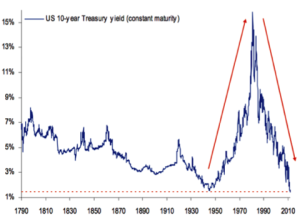
What set up the entry point for Bond Nirvana was the bond market flight that preceded it. Then when the inflationary environment was replaced by persistent disinflation as the result of ongoing emerging nation competition, it caused investors to return to a bond market opportunity, not just of a generation but in the history of the Republic. The graph reveals no higher highs in interest rates than in 1981 and no greater sustained plunge of rates caused by the rise in the secondary market value of bonds.

The favorable bond environment persisted because business conditions were sufficient to marginalize default possibilities with but a few cyclically correcting deviations. But more importantly, through most of the Nirvana period, there were foreign capital inflows to the U.S. associated with globalism, and foreign capital was parked in U.S. marketable debt.

Another development in the later stages of the three-decade run was the invention of the shadow banking system, in which very cheap short-term financing was available for some investors (hedge funds, for example) to leverage up on the higher-yielding and appreciating bonds.

But about 26 years into Nirvana, it was propelled into another major upward spike.

As a response to the financial and economic crisis of 2007-08, the Fed began a bond buying program not in the tens of billions as before, but in the trillions of dollars — and with that much buying power in the bond market, prices were driven to an even higher plateau.

And on top of propelling Nirvana, the Fed’s purchase of U.S. bonds provided more spending power to those selling their bonds to the central bank, thus allowing them to purchase higher-yielding bonds — many of which were from offshore markets. This in turn caused foreign central banks across the globe (including developed-world central banks) to purchase U.S. assets in order to control their currency appreciation (by selling their currencies for U.S. assets).

Aside from the favorable macro-environment for bonds, there were regulatory and behavioral factors that favored bonds as an investment class, which added further fuel to Bond Market Nirvana.

After three decades of persistent and consistent positive returns to both current income and appreciation, bonds became not just an investment class for regulatory constrained financial institutions whose portfolios required bond exclusivity, but also an attractive option for investors enamored with the income and appreciation bonds provided — and why not? After three decades of success, too many projected it to be a permanent financial gimme, and they still do.

In the ascendancy of bond Nirvana, the primary beneficiaries were financial institutions and pension funds that by regulation or self-imposed rules of allocation were required to own bonds as a substantial portion of their asset portfolios. Indeed, it was a wealth windfall to financial institutions, and the equity price of the financial sector outperformed the industrial and trade sectors for some time.

So bond-oriented investment managers, either by orientation or inclination, went public to the retail market, and their clients enjoyed the run as well via bond mutual funds and ETFs.

The name most associated with this success is Bill Gross of PIMCO, who became known as the “Bond King,” though there are others as well.
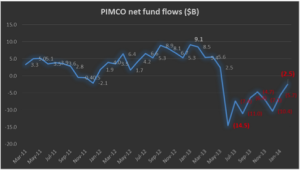
But when the juggernaut reached its ultimate ascendancy, bond prices were historically elevated and interest yields were at the Republic’s lowest. This a piece of history likely concluded in August 2012.

One can only make an educated guess that there must have been great stress in the Bond King’s world as cracks in the facade of effortless investing brilliance revealed the boom to be dependent on macroeconomic tailwinds. In 2013 these bond-oriented clients took a loss of 3.7%, which is relatively small compared to stock market volatility. But as a result, the bond fund suffered a 14.4% redemption rate by those surprised clients who did not receive their accustomed appreciation. Indeed, the vulnerability was great enough to cause four times the rate of redemptions as compared to investors’ annual losses — a ratio that no money manager can long sustain.

Since investment management is paid according to money under management, there was consternation in bond land, and someone needed to be found guilty. As one could expect there was a high profile resignation at the co-CEO level, a shakeup in top management, and statements of client caring and diligence ahead. Indeed, PIMCO and all other bond specialists are fighting an uphill battle and need to reassure investors, lest there are any more defections from the USS PIMCO and Bond land in general.

And there is lots of bravado in PIMCO’s online commentary, in which it pledges to navigate the market change without changing course! There are actually cracks and crevices in which to seek shelter from the bond market fallout, and they pledge active management, but they are on the slippery downward slope and they know it.

As far as their investors are concerned, they need to realize that the income received from their interest payments do not cover the losses in market value of their bonds. Basically, they are consuming their capital when they receive their periodic interest payments.

PIMCO said it all in a recent online posting in which it warned investors that “a high allocation to U.S. Treasuries, which are more sensitive to changes in interest rates … may have poor growth prospects due to an unhealthy balance sheet” — I presume of the U.S. government, not theirs. Ironically the bond losses would be greater for Treasuries at the same maturity than bonds of all pedigree, including Muni’s, but bond losses nonetheless are on the horizon.

Actually, the end of Bond Nirvana does indeed relate to the increasingly poor shape of the U.S. balance sheet better known as pricing-in sovereign risk — but it is also happening because the long wait for a deflation to make the bonds more valuable in the market has not occurred. There is also good reason to believe that mildly increasing inflation is in our future despite inflation softening in Europe.

This is based on a growing effective labor shortage and a still-expanding economy despite the winter’s weather-related slowdown. And then there is minimum wage legislation and executive orders regarding overtime pay that ratchet up wages and, in turn, business costs and prices.

But that is not all that threatens Bond Nirvana. The other basic tenants of Bond Nirvana are also crumbling. The foreign trade surpluses to the U.S. are shrinking, causing a slowdown in foreign accumulation of dollars and bonds. Furthermore, the shadow banking system of financial leverage (think hedge funds) will be constrained when short-term interest rates rise.

And there is now a new counter-force to Bond Market Nirvana. The U.S. is now actively looking to impose “financial constraints” on countries that do not follow our foreign policy (in this case, Russia). By seizing or freezing foreign assets and making access to the dollar payment system off limits to those we seek to discipline, our government will cause foreign capital to move to another currency and another country quickly. Indeed, foreign central banks’ holdings of U.S. Treasuries — with the U.S. Federal Reserve acting as custodian — had record withdrawals immediately. We are on a new global control path that will have adverse consequences to the foreign holding of U.S. bonds and to Bond Nirvana.

And then there is tapering — not just by the Federal Reserve but also by the emerging nations that are being hit hard by the taper and selling their dollar investments in order to support their own currencies. And recently, the Fed let the cat out of the bag and let it be known that increases in short term policy rates are on the horizon.

Altogether, these forces are too powerful for one to believe that Bond Nirvana is not in the rearview mirror. Indeed, such a large deviation from financial norms as Bond Nirvana required a number of simultaneous moving parts to create such an epic market opportunity.

Though favorable expectations and the bond reflex are still strong after such a long reinforcing run, there is too much going against the trend for investors to think they can rely on it in the future.

Bond Market Nirvana is one for the history books on the scale of a 300-year flood, but alas income and growth can be found elsewhere in the growing sectors of the economy, though regrettably not on the scale of Bond Nirvana.


Sign up to receive the Spellman Report. Bracing financial and economic insight. Now with free delivery!

Regulation, Gravity and The “Isms”: The Education of a President

The Spellman Report

obamaEconomic regulation and its counter-effect on economic growth — a rising background issue until now — has just vaulted to the front pages with President Obama’s recent speaking tour, signaling a redirection of policies and mischief ahead.
The concern about regulation today, as always, is that it is leads to a hardening of the economic arteries that restricts entrepreneurship and negates the income and jobs that follow.

In limited circumstances, well-structured regulation can be worth the economic cost by yielding benefits most found in the areas of health, safety and the environment, as China can attest.

But most economic regulation is mindless and costly — not just in terms of opportunity cost, but also government administrative costs and the reporting and compliance costs that come with operating under a regulatory regime. All of that reduces real economic activity and real income, so regulation is effectively an out-of-the-limelight, macroeconomic issue.

When the Fed complains endlessly about “headwinds” to economic growth, it implicitly recognizes regulation as a ghost factor that neutralizes its own monetary policy. This leads to the economy repeatedly falling short of the Fed’s expectations and yet more accommodative policy, as occurred this week.

When R.A. Posner studied the common causes of regulation in 1974 (another regulatory era), he observed that regulatory intervention is a tempting option for those in government who don’t believe that market prices and allocation mechanisms create desired social or economic outcomes.

Posner also indicated that income inequality is a further cause for governments to turn to regulation.

Hence, there is nothing like a Great Depression or Great Recession with depressed income and wider inequality to become a regulatory breeding ground that indeed deepens the macroeconomic quagmire.

Slowing economic growth comes about when regulatory barriers and costs makes production less viable, at least in the U.S.

As former Intel CEO Paul Otellini explains it, even the job- and income-generating computer chip industry is moving away, not just for production but also for R&D.

The decision to relocate or stop production altogether occurs when the rules of regulatory fiat restrict investor incentives to deploy capital and enterprise to activities in which prices and profits are rising, and divert them away from activities in which the reverse is true.

This is the heart of the system in which prices direct the commitment of resources, a policy that used to be known as laissez faire — a case for the passivity of central direction.

According to Wikipedia, “laissez faire stems from a meeting in about 1680 between the powerful French finance minister Jean-Baptiste Colbert and a group of French businessmen led by a certain M. Le Gendre. When the eager mercantilist minister asked how the French state could be of service to the merchants and help promote their commerce, Le Gendre replied simply “Laissez-nous faire” (“Leave us be”, lit. “Let us do”).”

But regulation becomes a costly visible hand of government that overrides the “Invisible Hand” in which Adam Smith also saw the market providing for wants as a superior guidance for outcomes.

As indicated above, the most fertile time to give rise to perceived needs for regulatory corrections to market outcomes would presumably be the shock of a Great Depression. Due to that and the exigencies of World War II, the command economy emerged out of Washington DC and bureaucrats, as they came to be known, overrode economic decision making.

And of course, it creates scarcity that markets do not rectify.

My views on the subject were formed early on. As a teenager I accompanied my father to Washington, where he testified at a hearing conducted by the now-defunct Interstate Commerce Commission having to do with the difficulties of obtaining trucking capacity, which was obstructed by a command-and-control agency for a myriad of perceived purposes — take your pick. For me, it was an introduction to government and a lasting impression of regulation. (I was impressed with the stately Hearing Room!)

By the 1970s, following decades of regulatory dead-weight loss, the wisdom of Washington’s visible hand was questioned by yes, a Democrat, Jimmy Carter, who lead the way to deregulation industry by industry and agency by agency, followed up in the 1980s by Ronald Reagan and Maggie Thatcher in the U.K. The repulsion of mindless regulation then appeared to be a bipartisan conclusion.

By 2007, celebrating 25 years of economic deregulation, Robert Crandall of the Brookings Institution calculated that the 25-year deregulation movement dating from Carter’s time had liberated the regulatory controlled economy and reduced prices by 30 percent in the industries it directly affected. Hence, deregulation represented a substantial gain in real income per person.

But alas, the celebration of the deregulatory gains in America was premature.

At the very time when Crandall was tallying the gains from deregulation, we were on cusp of a great financial/economic shock and a spreading war on terrorism that had the same one-two punch to send Washington back down the regulatory road as it did in the 1930s and 1940s.

In today’s environment, the regulatory and tax tone is simply anti-business, not just preventing new firms from getting off the ground, but also causing large companies to redirect activities to those countries where business is most welcomed.

To add to the compulsion for regulation in this Great Recession, the U.S. government is in a financial bind. Without the ability to legislatively change broad-based tax rates or benefits, it does so in a de facto way by putting its citizens through a greater burden of proof for tax deductions and eligibility to receive benefits as an indirect means of deficit control.

Art Laffer, a classmate who went on to be a champion of supply side economics, has studied the regulatory and compliance costs imposed from U.S. taxation. He deems these amounts to be 30% of total income taxes collected, increasing with tax complexity. That’s the situation we’re in now that the fiscal bind is ramping up.

Which brings us to Obamacare. Not only is there regulatory complexity and reporting to produce and receive benefits, but moreover the loss in aggregate efficiency in U.S. production could grow even larger. For example, John Mauldin reports that many businesses are reorganizing their work forces to deflect the Obamacare tax by working with subcontractors that employ no more than 50 workers each who work fewer than 30 hours per week.

But how do you document lost production from the loss of the cohesiveness of a work force? It would be like fielding an NBA basketball team with a group of underpaid rented part-timers on the way to their next hiatus. (Incidentally, to appreciate the role of player connectivity and continuity in professional basketball, take a look at Phil Jackson’s new book, “Eleven Rings”).

Also in this post Great Recession re-regulatory environment, let me not fail to mention the costs of financial regulation. There are crippling reporting and compliance costs involved, so multiple government agencies can judge the appropriateness of a loan for both borrower and lender in banking. As a result we are not using our financial resources provided by the Fed.

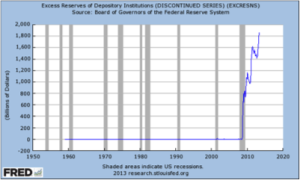
As the graph indicates, we are in an unprecedented situation in which trillions of dollars of excess commercial bank cash reserves are sitting on deposit at the Fed rather than being loaned out. While indeed there are other causes as well for the unloaned cash accumulation in commercial banks, financial regulation is under-rewarded for praise.
To attempt to document the growth of regulation, some have taken to counting the numbers of new regulations that have been codified which is more than alarming, but only implies economic loss without measuring it. Others count the number of regulatory and compliance lawyers and accountants.

But the Weidenbaum Center at Washington University in St. Louis and the Regulatory Studies Center at George Washington University in Washington, D.C., have put the regulatory compliance and administration cost in dollar terms. They jointly estimate it to be 11.6% of GDP as of 2011, and no doubt rising with complexity.

But how to put a cost on the whole ball of wax of regulation so as to clearly see the implications for lost growth? After all, it’s not possible to generate statistics on what didn’t happen. That is, it is effectively impossible to measure the opportunity cost of investments not undertaken, nor plants not built, nor inventions and potential jobs that fell by the wayside, except indirectly by the lost output capability of the U.S. economy.

On that there is one rough measure of the decline in the pre-Great Recession projections of the U.S. Potential GDP. The estimate of the frontier of possible output has shrunk and the supply side of GDP is projected to be growing at a slower rate than previously projected. This is a very rough measure of the shrinkage of the supply capability of the economy.

Other evidence of malaise reported by Lacy Hunt includes the fact that real median household income today is back to its 1995 level. Something is clearly amiss, and it’s not from a lack of mega-demand-side fiscal and monetary policy.

In a rare reflective moment regarding jobs not created and middle-income not produced, President Obama this past week conducted a series of hinterland college speeches in which he indicated that jobs and middle-class opportunity were missing from the American landscape and that we are suffering “unfairness” in income distribution. The opportunities are not there any longer for the middle class, he proclaimed.

Well how do you achieve fairness in income distribution except to redistribute from the top down? Rather than uttering income redistribution and being declared a socialist, he prefers “fairness” making himself a modern day populist in today’s discussion of the “isms.”

To be sure, there is a link between a lack of business development and middle-income jobs, but it runs from a lack of incentives or ability to navigate past regulations and taxes, obtaining financial resources and being unleashed to produce so that middle class jobs are forthcoming.

But in Obama’s world, the linkages run from middle class income to generate spending for companies to prosper. He explains this phenomenon as “leading with the middle class, an economy that grows from the middle out, not the top down.”

If this were physics, he would have gravity running upside down.

But it is welcome that after nearly 4 and a half years as President he is grappling with how to effectively produce jobs in America. Let’s hope he is a fast learner.

What I find interesting is that for the few one-off exceptions to promote an enterprise in order to keep jobs, the President provides subsidies, special tax breaks and a reduction in the paperwork that needed to be filled out (which to him seems but a minor irritant). Now the question is, can this selective perception be generalize to all endeavors?

It’s important since we have amply demonstrated that demand side policies have been applied beyond their useful limits, and supply side policy is all that is left. But what it requires is for the control freaks in Washington to let go. They must leave laissez-faire alone.

Since most lawyers who run for office are on a mission to do something to make a difference, laissez faire is not their inclination, and Obama has indicated that he will use executive orders that push the limits of Presidential power. For that reason, I’m not optimistic, as regulation is an adverse macroeconomic policy and income redistribution (under the guise of income “fairness”) eliminates income differences at lower levels of income for all.

It will probably take another farmer President like Jimmy Carter who toiled under the USDA to appreciate the virtues of laissez faire and allow it to thrive again.

Sign up to receive the Spellman Report. Bracing financial and economic insight. Now with free delivery!

The Anatomy of a Financial Meltdown

The Spellman Report

The Euro debt situation continues to deteriorate and the U.S. is not far behind. All the distress that is now focused on government debt comes from excessive private indebtedness as developed world countries seek to support the private sector. This has shifted the debt burden to the government sector, and now the government is the problem, not the solution. This is the outcome of a debt-bloated economy. For more background on this topic, I recommend that you watch the splendid discussion I had with Dr. Lacy Hunt a week ago — the video, “The Morass of Debt,” is linked and posted below. It covers the extreme difficulty of resurrecting an economy that has a debt overload. Regarding the Greek debt containment status, consider the following;

The grand containment scheme — as noted in the previous two posts, “Why These People Are Smiling” and “As Greece Goes So Goes Europe: How the Unthinkable Happens” — continues to deteriorate. Cover-ups tend to unravel when there is a hole so large and getting larger relative to the resources available to fill it; this happens even faster when the cover-up involves so many moving parts and requires so many volunteers to take the hit, particularly when there are strong private incentives not to volunteer. A partial list of the unraveling of the past week is as follows:

The banks that were to rollover Greek debt at ridiculously low yields, considering their risks, have largely already dumped their bonds to get out of the charity business.

The rating agencies have shown some backbone (or creditability survival instincts) by downgrading Portugal and Ireland to junk, expanding the necessary cover-up.

Depositors are fleeing Greek banks (and probably others, as short-term funding rates in Europe rise), creating a liquidity crisis in which banks are loath to lend to other banks for fear of a default. A liquidity crisis morphs into a solvency crisis if banks are forced to dump bad assets at the already depreciated market terms and dump otherwise good assets at deep discounts to fund the deposit withdraw. Each asset sale is noted by the bank accountants as a reduction of income and capital.

Greece and other Euro banks are under a depositor flight that used to be called a bank run. The ECB is called in to lend to these banks, but the rules require investment-grade collateral for these loans. Since the banks do not have unpledged investment-grade collateral available, the ECB has indicated that it would accept virtually any opinion of quality (besides those of the three major rating agencies, which are now being realistic) to qualify as lawful collateral. The standards are depreciating, and the ECB will be left holding the bag of bad assets, adding to the loss of confidence in holding wealth denominated in the Euro.

To make matters even worse, a new bank stress test is supposedly being released that will make some ludicrous assumption of the value of government bonds. It is an intended cover-up of the situation and will add to Knightian Uncertainty —increased uncertainty from not having the facts to evaluate the risk causes depositors to flee and markets to sell off banks’ stock, making it impossible for banks to raise replacement capital of any form, except for the charity of the central bank.

In order to prevent financial insurance claims, the rules of the game are being altered. A “limited” Greek debt default is being created for the “volunteer” banks that are being forced to roll over Greece’s debt at below-market yields. The” limited” designation is to provide the basis for the argument that all other Greek debt outstanding is good, hence protecting against a financial insurance payout. We’ll see if that holds up in court as those who took out insurance want it to be paid — but that will be much later.

And now, Italy has come into focus as the second “I” in “PIIGS.” The market is turning against their bonds.Lastly the IMF, now under the former French finance minister (as of a week ago), is hardening its terms to provide budgetary help to Greece. It sea former classmate of mine, as the outgoing IMF acting managing director, pushed through a higher hurdle for Greece’s lending before the arrival of the Madame from France. Furthermore, the IMF is sticking to it as the developing countries are in the process of reining it in to prevent it from being an exclusive developed world slush fund.

There is more trouble for Greece and the PIIGS: Not only do they have debt that can’t be sold in the market and political inability to contain deficits, but the veterans of sovereign defaults from Argentina looked at the situation and claim the Greek situation is DOA (my interpretation). They point out that even if all Greek debt were somehow to disappear via default without any compensation to the debt holders whatsoever, Greece still runs a fiscal deficit.

Furthermore, in a very insightful piece, John Gilbert of GR-NEAM questions the sustainability of Greece and Portugal’s economies apart from the burden of past, present and future debt. It seems these countries have an extreme dependence on foreign energy that causes their trade deficit to balloon when oil approaches its current $100-a-barrel price tag. That is, apart from debt, these economies are toast because they can’t export enough to pay for imported energy.

Lastly, the distressed Greek assets are not finding eager buyers who are ready, willing and able to pay what Greece had hoped for.

All of the above components are the makings of a financial crisis on par with the Lehman weekend. The banks’ condition no doubt will be favorably spun with the new stress test, and the market will still run the banks. Even the Federal Reserve is making noises about the possible need for a new QE this week (what a retreat from last week), pinning the problem on slow U.S. economic growth. But the Fed’s real intention, it seems to me, is to be poised to be lender of last resort to back up the ECB as depositors flee banks here and abroad, as they did in 2008 in amounts greater than $1 trillion.

This is the outcome of a leveraged financial system that has taken a large position in an asset category (government bonds) that has subsequently been deemed to be risky: It all cascades down. The financial institution assets depreciate, and the liability side of bank balance sheets is compressed when depositors run and the banks’ capital account is written down. The market forces them to face the reality that neither the banks nor their governments wanted to face. Financial gravity ultimately wins despite the best and deceitful government efforts.

One aside: When Mexico was faced with a similar situation in 1982, banks were failing and depositors were fleeing. The response was to beef up the containment package by requiring government permission to exchange local currency for foreign currency, and on top of that, all banks were nationalized so the government could determine who was withdrawing pesos in a capital flight. Unless you stay one step ahead of regulation, you risk becoming a “volunteer” to help out the banks. I think most have had enough of that.

Now the important and relevant question is where the private wealth will flee. It is the question of the systemic flight to quality asset. The usual response, as it overwhelmingly was in 2008, was the U.S. dollar and the U. S. Treasury — but that depends on the perceived riskiness of the U. S. situation, which is not likely to be resolved before the Euro situation comes to a head. So it appears the answer will be that wealth will not flee to the usual places even if a U.S. debt ceiling deal is done on time.

This is a vital issue and I am working on an analysis of it, as all investors need a safe haven asset if they wish to preserve their wealth. Euro bank deposits are obviously not it, and U.S. investors might be shocked to understand that the usual “risk off” asset of money market funds is also not the safe haven it once was.

The Financial and Economic Morass - What is Needed for a Recovery and How Long Will it Take?

The Spellman Report

The Cost Of Government Action In The Economic Meltdown
Capital Regulation
Negative Growth and Deflation
Gifts From Abroad Or The Federal Reserve
The Market Reigns In Governments
The Expensive Way to Bail Out
Conclusion - Who Pays the Bill

The Inflation Divide

The Spellman Report

The economy is on a tear. There are many “next new things” coming to the marketplace, generating private investment to produce new goods that are in high demand. Firms that invest are seeing gains in after-tax corporate profit, thanks to expansionary fiscal policy from tax cuts and accelerated depreciation on new capital goods. There is also increased spending on military. And don’t forget deregulation, which is enabling businesses — especially small businesses — to thrive.

But the economic expansion has many observers spooked by the fear that booms will inevitably turn into busts, “just as they have in the past.” So today there is a growing chorus of observers expressing nervousness about the implications for economic and financial market performance. They do have a case to argue, as there is an endogenous mechanism that can turn an economic and financial boom into a bust. So how likely is that?

Here is the script — you decide whether to extrapolate it.

When spurts of demand growth outpace labor force growth (as is occurring now), labor becomes relatively scarce. Efforts to increase output further translate into employers paying premium wages to attract workers. This occurs when there is a very small labor pool that remains on the market, so wages almost have to rise. And if wages grow faster than labor productivity (that is, if you are paying more and labor is not producing more), there is an increase in labor costs per unit of output.

In the next step of the “boom-to-bust” chronology, employers seek to raise product prices so as not to compromise their profit margins as labor costs rise. In addition, demand growth — driven either by the next new thing or the next new government spending program — exacerbates supply-side shortages. The higher input prices then spread to other inputs including energy, transportation, raw materials, financing costs, etc. As producers attempt to pass along the cost increases into higher product prices, it sets in motion classic “cost-push” inflation.

This is a dramatic change in the environment following the weak, drawn-out, nine-year recovery from the Great Recession. The civilian unemployment rate is now 3.8%, a low last seen at the end of the decade-long expansion of the 1960s. The current situation is that job openings exceed available labor, and the quit rate is at an all-time high, indicating that labor is gravitating to higher-paying jobs. What a startling change from the struggles of the past decade.

The economy is responding positively to a myriad of next new things (and/or government-provided new things) against a backdrop of heroic monetary expansion during the Great Recession, followed by deregulation, tax cuts, incentives to repatriate corporate capital held abroad, and heavy-duty investments in military and transportation. The demand side of the economy is now doing its part.

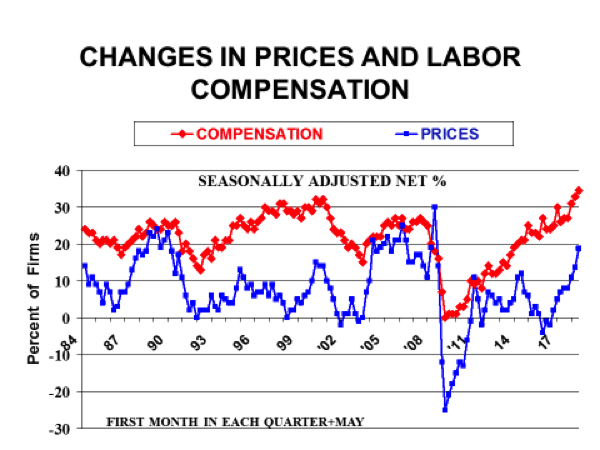
Labor compensation at small and independent businesses has been steadily increasing for the last few years, and now prices of goods are also increasing. The graph below, from the National Federation of Independent Business’ monthly small business survey in May, illustrates this trend: the percentage of participating firms that are raising prices (shown in blue) is growing alongside the portion of firms that are increasing compensation (shown in red). It should also be noted that the consumer price index rose 2.8% for the year ended in May, a trend that has started to make the bond market and the Federal Reserve uneasy. We have now crossed the inflation divide.

Other tidbits of encouragement provided in the Overview of Small Business Trends are equally eye-catching:

“The Index of Small Business Optimism increased significantly in May to 107.8, a large gain of 3.0 points. This is the second highest Index reading in its 45-year history.

  • Reports of compensation increases hit a 45-year record high.
  • Views about expansion are the most optimistic in survey history
  • Reports of positive earnings trends at a survey record high
  • Reports of positive sales trends are the highest since 1995
  • Concerns about labor quality second highest in survey history
  • Reports of price hikes the highest since 2008 (Oil $140/bbl.)
  • Plans to raise prices are the highest since 2008.”


At this point, it’s safe to say the Great Recession is behind us and the concern has shifted to the ramifications of higher inflation. This in turn sets off reactions.

First, the higher inflation rate will cause the financial markets to change course when it becomes clear that it will continue.

In an inflationary environment, investors reduce the amount they offer for bonds or other investments where the derived income is a fixed amount. Or to put it another way, bond investors only invest if the fixed yield they receive is increased to compensate for the loss of purchasing power from expected future inflation.

Expectations of rising inflation thus reduce investors’ willingness to hold bonds; indeed, bonds funds have recently experienced net redemptions and a decline in the market price of bonds.

Bonds are not alone, as the market multiplier of a dollar of income from other financial streams will similarly adjust downward — though downshifts tend to be less pronounced if inflation contributes to the income stream. (This typically occurs with stocks and real estate, which ride through inflation with less resistance.)

From there, the rise in inflation causes the central bank to tighten, which is usually done through some combination of bond sales and higher interest rates charged on loans to its bank clients. The central bank logic is that higher interest rates are a disincentive to purchase goods that require financing, thus containing the demand side of the economy so as not to further overrun supply.

But these days, with so much debt expansion as a result of the Fed’s Quantitative Ease during the Great Recession, higher interest rates serve to increase debt service on existing debt when it faces refinancing at higher market rates. I have seen estimates in the area of $100 billion annually of added debt service in the offing. This amount would be roughly ½ of 1 percent of GDP — a large but not insurmountable drain on income that would otherwise be spent.

But the bigger concern for veterans of past booms and busts is the sense that with all that debt on the books of consumers, businesses, and governments, what follows are defaults and losses to the entities holding the defaulting debt. Those often have been banks, which are then assaulted by depositors in a panicked run.

In the housing boom, financing was extraordinarily concentrated in loans for residential structures, with homes being the collateral. By the time the housing boom reached its zenith, overbuilding in the housing sector significantly reduced the market value of the houses that served as collateral on bank loan portfolios.

There will be far less financial system vulnerability this time around, as there isn’t a similar concentration of financing to a single overbuilt industry. The closest over-expanded and over-financed sector is consumer auto loans, which would be considerably less of a debt drag. Much has changed since the last financial crisis. Banks have rebuilt their capital and liquidity to meet far higher safety standards. Indeed, the largest 37 bank holding companies — which hold 80% of total banking system assets — recently passed the regulatory stress test for capital and liquidity against a worst-case default scenario.

To be sure, there will be losses to holders of defaulting debt if there is another “big one” — but these losses will be spread out, making the overall system less vulnerable to a repeat of a financial crisis a la 2008.

All in all, the game-changer right now is the ripple effect from the inflation generated by the recovery. The cost of financing purchases will become more expensive. Financial assets will generally be marked down if their income streams don’t keep pace with inflation. Enlarged debt service will drain income growth without decimating it. All this occurs on the other side of the inflation divide.


SaveSave

Houston, We’ve Had a Problem

The Spellman Report

The Federal Reserve responded to the spectacular financial meltdown of 2008 by putting a bottom under the cascading financial prices. This was accomplished by buying, buying, and buying some more. Then when the downdraft of prices reached bottom, the Fed phased in additional largescale asset purchases with the intent of providing cash resources to banks in order to start the bank expansion and economic rebuilding process. This reduced interest rates to the most affordable of all times as a way to induce prospective borrowers to spend more money.

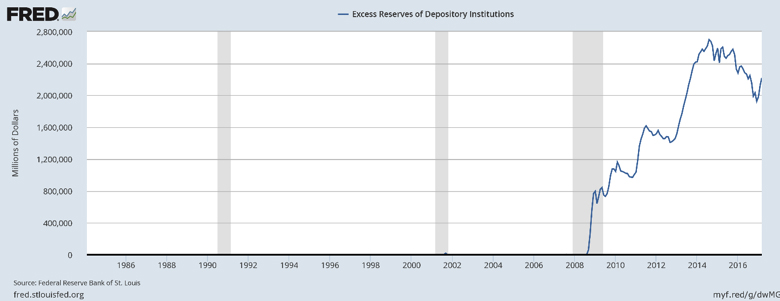
All told, the Fed buying spree increased its balance sheet assets from $ .8 to $4.3 trillion — an increase of 5.5 times. For comparison, a normal Fed buy over that time period would have increased its assets by only .36 times. When all the Fed’s buying power is deposited with banks, it results in bank cash reserves in excess of the minimum required from which the banking system can ramp up credit by some multiple.

To give you can idea of how extreme this was, the graph below shows the excess cash reserves that banks held from 1985 through 2016. This is the base upon which banks can build lending some multiple of the excess cash. Before 2008, excess reserves were essentially zero. After 2008, they went into orbit.

Nearly nine years later, there has been an economic uplift — but it has been disappointing. The economic growth rate reached approximately half the growth rate it had formerly been capable of, which appeared to reduce the unemployment rate to the 5 percent target. But this reduction was made easier as the population’s labor participation rates have been dwindling.

Even so, the Fed has claimed bragging rights for a successful economic “save,” but it still left interest rates too low to take care of its other “constituency”: Baby Boomer investors in need of a yield on (relatively) safe fixed income in order to finance their retirements, either from their savings or by way of their pension funds, insurance annuities, etc.

So for that constituency to “get theirs,” the Fed’s Normalization Plan calls for raising interest rates and cutting its own balance sheet down to size. This implied selling of Federal Reserve owned assets would sop up excessive commercial bank cash reserves. And that would prevent low interest rate bank loan expansion.

Thus, large scale selling not only sops up cash but also puts downward pressure on market determined bond prices and upward pressure on market yields, both in the open market and at the bank loan counter. It’s enough selling to absorb almost all of the remaining excess cash on bank balance sheets so that banks thereafter would be restrained from advancing credit.

This is a reversal of Fed expansion in which the Fed buys assets with new money to fuel commercial bank lending. The last three generations of macroeconomic students worldwide might recall that this went under the name “the money supply multiplier.”

So in a general sense, you can see that putting monetary policy in a serous reverse course raises the question of can a tepid economy continue its relatively slow motion advances?

Formerly, this is the sort of thing that was done in a far less aggressive form when the Fed set out to restrain an economy that was generating inflation. But today, there is no runaway inflationary dog that needs to be reined in with a tight leash, a la Paul Volcker.

What is also concerning about the tight leash is that it’s being used at a time when the new G-20 Basel liquidity requirements (meaning banks must hold more cash) are being imposed on the banks of the G-20 countries. So cash just sits on bank balance sheets and can’t be used to ramp up lending because it’s being used to fulfill those liquidity requirements.

As described in “It’s a Whole New Monetary Ballgame,” we now have duel cash regulations imposed on banks. (Just what the banks needed, more regulation!) They have both their own domestic regulatory apparatus of required cash reserves and the G-20 regulations from Basel, Switzerland.

So the removal of bank cash via “Normalization” comes at a time when the banks already need to place cash on hold to satisfy Basel’s rules. That surely suggests a constraint on bank loan growth.

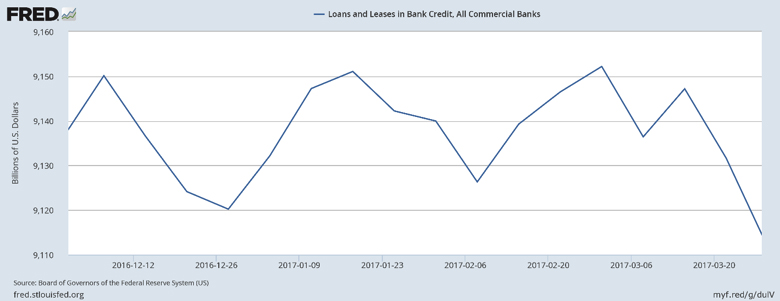
And this indeed is what has occurred over the last four months. Bank loan levels (seasonally adjusted) are shown below.

So the Basel liquidity requirements are a leading theory of why the slowdown of bank lending is occurring. At this point, though, that’s only a guess because the actual amount of cash required to satisfy Basel is based on each individual bank’s 30-day cash needs during a financial crisis as determined by an annual regulatory audit — but that’s not released to the public.

Whether or not this new cash requirement is deterring bank loan growth, it’s not consistent with maintaining economic growth, and it’s likely to cause a “Houston, We’ve Had a Problem” moment for the Fed.

If you recall, those words were transmitted from Apollo 13 to Mission Control in Houston in 1970. As the flight crew approached the moon, they heard a loud pop, and the command module of Apollo 13 subsequently began losing oxygen. This, in turn, required the crew to reverse course and attempt a death-defying return to Earth. The question is, will the Fed similarly be forced to reverse course after years of planning for normalization? Because it appears that banking lending is losing oxygen.

If so, there will be consequences for an already tarnished Federal Reserve that has fallen from esteem in the eyes of the market, Congress, and perhaps the administration. So the best laid plans to get to the moon — or, in this case, to bring central and commercial banks back to normalcy and land the economy safely with higher interest rates — has a reasonable chance of being scuttled.

So there are far more questions to this story than answers. Stay tuned to find out whether the monetary version of Apollo 13 lands “normally” with smaller balance sheets and higher interest rates while maintaining economic growth, or whether the Fed is forced into a humiliating about-face that requires it to maintain its easy money profile until the economy can be made to somehow grow on its own without monetary excess.

In order to go back to monetary and interest rate normalization, we need the economic responses that the new administration is tinkering with to unleash economic growth as we used to know it.

In The New Monetary Ballgame, the Game Is Rigged for US Treasuries (Part 2)

The Spellman Report

Every financial debacle that takes banks down is an open invitation for governments to impose regulation with the aim of preventing a reoccurrence. The financial crisis of 2008 was no exception.

Unfortunately, revisions in the banking environment generally end up with unintended consequences, and they are far-reaching.

The regulation in question are designed to reduce a banking system vulnerably to being caught with insufficient liquidity in a market-driven flight to cash. (It’s something that Deutsche Bank no doubt should be thinking about at this time.) All this is explained in Part 1 of The New Monetary Ballgame, which is a deep dive for those most interested.

But in brief summary, the Bank for International Settlements (BIS) — the central bank for central banks — is imposing liquidity and solvency criteria on the banks for all member countries of the G-20. This is being imposed because the financial crisis of 2008 was worldwide, and now all member governments have accepted the BIS’ dictates.

The immediate thrust of these regulations is to impose substantially higher liquidity requirements on banks. The purpose is to allow banks to retire all bank claimants who want out if a bank run à la 2008 were to occur. Liquidity means being prepared with cash. And if not, banks are forced to sell assets en masse. This could create a far-reaching financial selling crisis, which in turn forces governments into the financial rescue business.

In this new monetary ballgame, banks can choose from a menu of assets set out by the BIS to satisfy the new and higher liquidity requirements. Obviously, cash on hand or deposited with a central bank (not necessarily their own) qualifies. In addition, the BIS wants these assets to be interest-bearing so as not to sacrifice bank profitability in the quest for more liquidity. As a result, some marketable interest earning assets also qualify for the liquidity requirement. But which?

In general, the preference is for banks to hold interest-earning assets for which there is a robust secondary market that could turn those assets into cash with little discounting during a financial crisis.

This narrows the potential candidate assets very quickly because most assets substantially decline in value in secondary markets in the midst of a financial crisis. Hence, what banks need in a selloff is what market traders refer to as “flight to quality assets.” In regulatory jargon, this is now being expressed as High Quality Liquid Assets (HQLA).

Certainly highest in the pecking order among HQLA would tend to be sovereign bonds and perhaps highest quality corporate or muni bonds, with the regulators permitting.

And that is the way the discussion rolled out with the European members nominating their own country bonds to be considered HQLA.

But you can image what followed when, for example, Greek sovereign bonds with a Moody’s Rating of Caa3 would have become eligible to meet the HQLA requirement. As could be expected, the US objected. In its opinion, only US Treasury securities qualify to be HQLA for all countries’ banks.

While on the surface this appears to be an argument about bond quality, at the Machiavellian level this is an argument over whose bonds will be imposed on the banks of all the G-20 countries. Result? The US won. Banks from all G-20 countries can now satisfy their BIS liquidity requirements by holding US Treasuries.

So when the global bank regulator can, under the guise of “safety and soundness,” impose an incentive to hold US Treasury obligations, it has established a mechanism to finance US government debt at lower yields than would otherwise be the case. That comes just in time if you ask me, as the US structural deficit has widened to $0.6 trillion/year with decades of rising baby boomer entitlements staring us straight in the eye.

So you can see the advantages involved from winning the Machiavellian jostle and be deemed, the king of sovereign debt issuers. The US sovereign bond prices will be higher and the yields will be lower. Indeed, over the summer, the 10-year US Treasury yield fell to its all-time low of 1.37% just as banks across the G-20 were approaching the September 30th deadline to fulfill their new liquidity requirements.

In comparison, the BIS allowed US investment corporate grade debt to be counted as bank liquidity but with only a 50% weight. That is to say, anticipate that corporate debt would sell in the market during times of stress at a 50% discount. Not bad when you realize that even investment-grade US municipal bonds receives a haircut of 100% in the calculation of its contribution to bank liquidity. Thus municipal bonds clearly lost out in the Machiavellian jostle as none of it counts for bank liquidity.

As a result of this weighting, the market yield spread has widened between assets classes such as US Treasury bonds and investment-grade muni bonds. With muni debt having less regulatory value, their yields have risen relative to those of the US Treasury that does have regulatory value.

What is yet to come over the next two years is higher ratios of equity capital for commercial banks. This means banks will need a larger amount of their own banks’ stock on their balance sheet to increase their net worth and ability to take asset losses without going insolvent.

But every additional share sold dilutes existing stockholders’ claim on banks’ profits. When substantial increases in bank equity capital need be raised, especially at times of very low market pricing of bank equity, it will take a lot of shares at low prices to raise the required amount of additional bank capital. This will dilute existing shareholders into a nothingness.

But in this rigged game, there is an alternative to bank stockholder dilution: Hold larger proportions of US Treasuries as assets and, since they are anointed by the regulatory to be “riskless,” a bank has less need to protect itself from losses as the regulator claims those assets will not deteriorate in value. Hence, the regulatory mandate for higher equity capital is waived against those assets by holding more US Treasury obligations!

The result is that yet more G-20 country banks, especially weaker European banks, will add to their holdings of US Treasuries rather than dilute their existing stockholders via the sale of a ton of additional bank stock.

It’s so obvious, one doesn’t need to take a step backwards to get perspective. When assets must be bought and held by developed world banks which are a very large asset pool (a multiple larger than central bank assets), it generates considerable demand for that asset that doesn’t go away. It becomes a rigged game because the price of the issuers’ debt is supported in the market and the issuer’s borrowing costs decline.

In turn, it encourages the subsided issuer to keep issuing more debt.

Therefore, it’s no great surprise that we find ourselves at a point where the developed world countries are talking about issuing yet more country debt and spend the proceeds as the way to generate more aggregate demand. This would constitute a shift toward fiscal policy and away from monetary policy to manage a depressed economy.

Another major implication is that the textbook treatment of interest rate determination based on investor queasiness from inflation and default still remain. But those influences on interest rates pale by comparison to the fiat demand generated by G-20 commercial banks for US Treasury securities.

Stay tuned. It’s a new ballgame, and we’re going to have to relearn many of the things we thought academics and history had taught us.


Click to Email Dr. Spellman

It’s a Whole New Ballgame: The Fed Has Been Stymied: (Part 1)

The Spellman Report

As a result of the 2008 financial meltdown, The Bank for International Settlements (BIS) was tasked by the G-20 countries to change the global rules of commercial banking in order to prevent a re-occurrence. Their mandate was: no déjà vu again, if you please.

The snuffing-out of future financial crises comes via regulation, and because regulation tinkers with the equations of the “system,” it changes the built-in reactions. This requires us to rethink what we presume will occur.

For example, it turns out that when the BIS tinkers with things to make banks more resilient to meltdown, it also makes them more resilient to monetary expansions. So this explains, in part, why even though the Fed increased its balance sheet by 500% since 2008, US commercial bank balance sheets have increased by only 45%. And since commercial banks provide credit directly to businesses and individuals, the (lack of) banking and in turn economic expansion has disappointed most observers — including the Fed itself.

Before getting around to explaining how that can happen, first, some background on the dynamics of a bank meltdown. This will provide you with an understanding of what the regulators are tinkering with and why, and then what the consequences will be.

Bank runs follow a typical scenario, and 2008 was a classic example. It starts with a loss of confidence in the banking system’s assets sufficient to cause bank depositors and other providers of short-term bank funding (deposits and loans) to exercise their right to exchange their claims on the bank for immediate cash.

This, in turn, forces banks to sell assets into the market to obtain cash in order to be able to “cash out” these bank claimants. The selling of bank assets must meet the pace of the demanded cash, and if the depositors and lenders aren’t mollified, it can turn into an asset fire-sale in order to obtain the needed cash quickly.

Cash is king in a bank run, and banks in need are willing to swap assets at a discount in order to obtain it — which is what causes a banking crises to become a financial crisis. These twin crises are two sides of the same coin.

It quickly occurs to depositors and claimants (even those affiliated with banks thought to be “solid”) that their banks’ assets are being compromised in market value by these fire-sales. This, in turn, causes the depositors of the “solid” banks to become jilted out of their comfort zones and to demand cash as well — just in case.

From there, the run affects those banks thought to be doing well.

Note that the first sparks in the financial meltdown are due to obtaining liquidity, but it quickly turns into a question of “is my bank still solvent?”

Solvency is the basic issue of whether my bank’s assets now exceed its liabilities so that it can cash out all claimants if need be. If not, the regulator might even beat the depositors to the punch and seize the bank in anticipation of an insolvency, which they can do. And they can be quick on the trigger because they suffer the residual losses if they guarantee the bank’s debt.

In that case, claimants then worry whether the resolution and liquidation of the bank calls for their claims on the bank to be bail-out or “bailed-in,” with the latter occurring more frequently these days. All this increases the uncertainty and fear by bank claimants as to whether they will be made whole. This then increases their propensity to more quickly cash out their bank claims when questions of illiquidity or insolvency arise.

For any reader that saw The Big Short, this should sound familiar. That movie depicted the moment in 2008 when investor and regulator focus turned to the solvency of Bear Stearns. Its stock price went into free-fall, and its claimants wanted their cash back. It was immediately over for Bear Stearns (forced merger with JP Morgan Chase), and the only remaining question as a claimant was, would you be bailed-out or bailed-in?

So it’s with this background that one could imagine the importance of reducing the vulnerability of the trifecta of risks: bank runs, financial meltdown, and an economy that gets sucked down by the implosion of the market value of wealth.

As you now see, bank and financial crashes are the result of depositors running to cash out, so perhaps you can imagine what the BIS is requiring of banks in the G-20 countries: Hold a higher proportion of cash or assets that can quickly be sold with little discount in a period of financial distress.

These requirements are spelled out in the new lexicons of banking called Liquidity Coverage Ratio or LCR. It defines the amount of cash and cash-type assets that banks must hold. The LCR is specific to each bank and is intended to cover the bank’s 30-day forward net cash needs in the course of doing business under financial stress.

To have adequate liquidity in financial distress, there is a greater emphasis on cash as the asset of regulatory choice, so there is no need to actually sell an asset to obtain cash during a financial crisis. Actually, the emphasis is even more narrow on cash in excess of what banks would be required to hold under country-specific banking laws.

It turns out that holding excess cash deposited with a central bank has great appeal to the banks as well to satisfy its BIS liquidity requirement. But let’s be clear: For the cash to be available to cash out a bank’s claimants, it must be in excess of the minimum cash amounts that country banking laws already requires banks to hold.

The BIS liquidity requirement is on top of the Fed’s cash requirement.

But there is a problem with holding excess cash to meet the liquidity requirement. In several G-20 countries, excess cash deposited at its central bank has a net charge called a negative deposit rate. For example, the European Central Bank deposit rate for its banks is -40 basis points, and marginal excess reserve deposits in Japan are at -10 basis points. The required liquidity comes at a high cost because negative deposit rates do not produce positive earnings.

One should quickly realize that because the Federal Reserve Bank pays a positive 50 basis points on cash reserves, banks across the G-20 would prefer to hold excess cash at the US Federal Reserve instead of at their own central banks — and foreign banks can do that by making deposits at the Fed via their US subsidiaries.

Here’s the implication: There is a substantial need and incentive for banks not only in the US but also across the G-20 to hold excess US dollar cash reserve deposits at the US Federal Reserve Bank.

Below is shown total cash reserves at the Fed and its division between required and excess cash amounts, starting just prior to the financial meltdown. The total cash owned by banks rose starting with post-financial crisis QEs. Total cash derives from the Fed buying assets and paying in currency (or claims that can be converted to currency) and that cash, in turn, being deposited by the seller at his or her own bank.

By US banking law, the portion of cash from that transaction that is required is a rather small proportion of the deposit. So in total, the new cash becomes divided between required cash (shown as the narrow strip in brown at the bottom of the graph) and the “excess” of what is required.

The amount of excess cash, shown in blue, is large in absolute and relative terms ($2.37 trillion, presently) as compared to a normal level of zero held for many prior decades. That is, banks were fully loaned up given the cash amounts provided by the Fed and all cash was required.

It’s a Whole New Ballgame

This condition of excess bank cash has, since Keynes’ time, been characterized as a “liquidity trap.” It was taken as synonymous with depressionary circumstances where borrowers did not wish to borrow and lenders did not wish to lend, causing high proportions of excess cash.

But now, there is a new incentive for banks (and not just US banks) to hold excess US cash. It meets the BIS liquidity requirement while also being paid 50 basis points by the Fed. From the bank’s perspective, that is a decent return on riskless paper that cannot depreciate due to falling bond prices, which typically occurs when they need the cash most — i.e., in a financial meltdown. It’s a reasonable way to meet the LCR requirement.

So if an individual commercial bank needs to meet its LCR, it sells assets and deposits the proceeds with the Fed. It would not be putting the cash into loans and paying for the loan with deposits (the usual commercial bank money expansion method) because the deposit would create the need for the bank to use some of its new cash as required reserves and it would not contribute to its LCR requirement.

This is hardly a prescription for monetary policy to generate lending and spending to achieve the macroeconomic objectives of job growth and inflation.

So now, hopefully you see the irony. Though the Fed has embarked on multiple quantitative easing operations of expanding its balance sheet in order to stimulate commercial bank lending and spending, it’s not happening to the extent it would have formerly occurred.

It is the increased need to hold cash, as dictated by the BIS liquidity requirement, that causes banks to hold excess cash rather than lend it out. This is what is creating the liquidity trap. And it’s not just true for US banks: Cumberland Advisors estimates that 44% of the excess US bank cash held at the Fed is in accounts belonging to US subsidiaries of foreign banks.

It used to be that the money supply multiplier concept gave testimony to the importance and strength of monetary policy. It had been the case that when the central bank printed money and bought assets, credit availability would get a boost from these central bank purchases, but the far greater boost came from commercial banks’ subsequent expansion of loans. This has been called the money supply multiplier because banks expanded credit in amounts 8 to 9 times the Fed’s increase in its asset purchase.

That is quite a money supply multiplier.

This multiplier gave the Fed and its monetary policy an extraordinary influence on credit availability and a much greater impact on the economy than it would have had through its own direct purchase of assets.

It’s a Whole New Ballgame

Thus, in today’s discussion of why the Fed’s expansionary policy is not reviving the economy, one need look no further than the banks’ muted response to it. The accompanying graph shows the growth of US commercial bank assets since 2008.

The Federal Reserve balance sheet has expanded 500% since the pre-financial crisis times of 2008 via Fed QEs, while the combined bank balance sheets have increased only 45%. Or to put it another way, if the responses of commercial banks to the Fed expansion were in the same proportion as the pre-financial crisis relationship of commercial banks and Fed balance sheets, the combined commercial bank assets today would be $55 trillion vs. its actual level of $l6 trillion.

To understand how under-expanded and under-loaned banks are, realize that half of the commercial bank expansion is not due to additional loans but rather to banks holding the additional cash the Fed spent on assets that then became deposited at the sellers’ bank.

So the Fed’s influence on growing credit and on the economy has largely been stymied by the new required liquidity amounts — all with the goal of averting the next financial crisis. And the press hoopla about what the Fed will do next has become a carnival sideshow that embarrasses the Fed because when it steps on the monetary accelerator, very little happens.

What the Fed needs is a low PR profile for its own good when it comes to its ability to restore full employment and inflation. It creates false expectations that can’t be realized while there is a BIS liquidity requirement that’s neutralizing its expansionary policy.

What we have is a situation in which regulators with different mandates are working at cross purposes with each other, with the BIS forcing cash holdings (and other liquid assets) to prevent illiquidity in a crisis, and the Fed providing cash with the hope that banks lend it and borrowers spends it.

The Fed giveth, and the BIC taketh away.

The bottom line is that the Fed (and other central banks) have supplied cash, but much of it has been hoarded to make sure bank runs and financial crises are a thing of the past. So if the Fed were to provide economic stimulus consistent with its objectives, it needs further expansion rather than the “normalization” of its balance sheet to 2008 levels.

Click to Email Dr. Spellman

The House of Cards: EU Edition

The Spellman Report

It’s been an implicit theme of this blog that ultra-low interest rates, even into negative territory, pursued by economically failing developed countries, are more a problem than a solution.

Allow me to make that explicit.

The policy derives from a complete and exclusive focus on Keynesian thinking: The lower the cost of credit, the more of it will be sought and used to finance spending for consumer durables and capital equipment. This in turn might generate income and jobs. With capital investment prospects being painfully limited (which is the problem not being addressed), the enticement of low interest rates, even at subsided (negative) rates has had a meager advantage.

However, negative rates are undercutting financial intermediaries. This will only create major disasters that governments will have to underwrite.

Basically, no financial intermediary would seek to place a loan or purchase a fixed income instrument at a negative rate unless they were forced to do so. That force is called financial regulation. Simply put, negative rates do not generate investment income. Therefore, the financial intermediaries — be they banks, credit unions, pension funds, or insurance companies — will be unable to perform on their obligations to their customers.

That is, insurance companies will be unable to service annuities; banks will be faced with insufficient income to generate income for themselves or pay a positive deposit rate; depositors will flee; pension funds will need to revise upward pension contributions (and they are in the process of doing so) and will, in addition, roll-back promised pension benefits.

With all these private contracted benefits being challenged and ultimately being unmet, there becomes an enormous pressure on governments, not just from countries ruled by social democrats, to save the majority of voters who are adversely affected.

This then becomes an additional burden on government finance for countries already being supported by their central banks. In fact, the European Central Bank, despite an explicit treaty provision not to monetize government debt, is already doing so in earnest. Additional challenges to cover financial intermediary failures puts the ECB farther into unchartered waters for the use of the printing press.

Another source of funding would be to lean upon other governments to bail out depositors, as was done with Greece and Cyprus. However, this only strengthens pro-exit political parties in the countries financing the bailouts.

What one can expect next in these circumstances is capital flight because of the ultra-low returns-to-fixed-income investment and bank deposits becoming risky. This turns into full throttle capital flight at advanced stages, as the capital outflow continues to make the currency relatively cheaper. And wealth owners will flee that.

At that stage, financial prices reflect a flight to quality – a preference for currencies and debt instruments of countries not facing these issues – and precious metals.

The downer in economic circumstances becomes so great that countries then seek to reinvent themselves in a political-economy dimension. For European governments, compromises made in the context of the benefit of unification are re-appraised, seeking some advantage to go it alone. Going it alone allows a country its own rules and its own currency that cheapens with capital flight. The cheap currency becomes an equilibrating device as exporting becomes more promising.

That is the house of cards the EU has built, now falling one by one — and the latest unstable card in Europe are the Italian banks. They aren’t only suffering depleted investment income from low rates available on their investments but also from a backlog of defaulting loans. Italy is attempting to infuse €40 billion into its banking system with the pretense of covering losses well exceeding that. However, to do so violates the very responses that were agreed upon by the EU just two years ago.

At that time, the banking system was bolstered by an EU deposit insurance commitment that was never funded.

Instead, the EU decided to build a firewall around its banking problems to keep them from being met by the government. They mandated that their banks sell “CoCo” (contingent convertible) bonds. These bonds convert to stockholder shares when the banks admit losses. The question then becomes who takes the losses. In this case, the CoCo bond holders were set up to automatically take the hit ahead of depositors and protect the government from being called upon for a depositor bailout.

Well, things have become bad, and it’s time to convert the CoCo bonds to stock. However, the banks sold the CoCo bonds to retail clients seeking the high positive returns that such a risk should command. Now retail investors, among others, are in line to sacrifice their positions to protect the banks’ losses, which, in turn, protects the government from the need to cover those bank losses — but there is a catch. No self-respecting social democrat government will allow retail bond holders to take a hit on behalf of the banks, even if they were paid to do so.

So this is where the matters stands: the Italian government is attempting to raise €40 billion, despite a reported €360 billion of nonperforming loans, to provide a pretense of a capital infusion for the banks. This is despite the objections of the EU, as it varies from the “plan” of private capital backstops. And no other country, as you might expect, dares to step up at this time to aid Italy.

In the meantime, the market reflects a flight to quality in the prices, especially of US, German, and Swiss government bonds, the prices of silver and gold, and the sale of private personal safes. The market is just awaiting the next chapter of the soap opera called The House of Cards.

The only question is how far will disintegration go this round? And if not this round, the next?


Click to Email Dr. Spellman

The Mad Genius of the Zero-Forever Bond

The Spellman Report

That the developed world governments are accumulating debt shouldn’t be news to anyone. To give you an idea of the proportions involved, during the Obama administration, US government debt has risen from approximately $8 trillion, accumulated over the previous 218 years of the US’s existence, to above $19 trillion and counting.

This is a 137% increase in merely seven and a half years.

Furthermore, we have now reached the point in time when Baby Boomer-related entitlements are adding to the outstanding cumulative debt. It is projected that the present value of unfunded federally obligated benefits is somewhere between $55 and $222 trillion — currently serviced by an undersized income stream of only $17 trillion.

In this state of indebtedness, the interest bill alone becomes an impediment to being able to fund entitlements (as well as everything else) unless there are some tricks up the government’s sleeves — and they are tricksters.

And here is the trick: Central banks of the developed world are pursuing ultra-low interest rates to reduce the interest burden of their governments’ debt. Indeed, Germany’s effective borrowing rate on the entirety of its debt has declined to .43 of 1 percent, and is now able to come to the market with a 10-year, zero-rate offering that will reduce it even further.

Another means to reduce the debt burden is to play games, not just with reducing interest carry but also with debt maturities. With interest expense being so cheap, there is the natural inclination by the debt managers in the US Treasury and all highly indebted countries to lock in the low rates for as long as possible.

Hence, government bond maturities are being reconsidered. The longest maturity bond of fiscally solid governments that could be sold in markets to private wealth sources had been 30 years, and few governments were able to extend debt that far out.

Or not? First, the 30-year bond maturity was stretched to 50 years in Spain and Italy, neither of which should be considered investment grade. And now France, Belgium, and Mexico have introduced “Century Bonds” — a quaint title — for debt that won’t come due for 100 years.

So the issue of how the interest cost of the debt will be handled is being settled by the mad geniuses in the world’s treasury departments. Expect to see governments placing debt maturities as far out into the future as they can. Selling debt maturities of 30 years, 50 years, or even 100 years is amateurish. The ultimate goal is to stretch the maturity into perpetuity.

And combining a zero-interest rate with a maturity of forever makes for what might be called the “Zero-Forever Bond,” which means no interest or principal will ever be owed or paid.

And here are some of the implications.

The appeal to the government issuer is that debt refinanced as a Zero-Forever Bond is the functional equivalent of a repudiation of its debt. The debt remains on the government balance sheet in perpetuity but with no consequence for the issuing government, as neither interest nor principal is ever paid. At the same time, the Zero-Forever Bond remains an asset for its owner, who never receives interest or principal.

But who would possibly purchase a Zero-Forever Bond?

To answer that question, realize that the great majority of government debt is typically placed with financial institutions that are in the business of store-housing private savings. Their combined balance sheets are well more than that of the central bank.

But without economic incentives for a private financial institution to purchase the Zero-Forever Bond, the governments would need to create some.

This is easily accomplished by financial regulation — and, in fact, it’s already underway. Just require financial institutions to appear “safe and sound,” by requiring them to purchase government debt instead of holding “risky” debt.

In addition, enticements are being given to the money market mutual funds (MMMFs) that must hold significant proportions of Treasury bonds in order to receive government insurance against shares declining to less than “a buck.”

Similarly, insurance companies are generally required to hold conservative portfolios (for which Treasuries fit the bill) and additionally Treasuries offset insufficient surplus in order to remain in regulatory capital compliance. The regulatory presumption that Treasuries are safe and sound is also used for pension fund compliance to be eligible for Federal Pension Benefit Guarantees. The Zero-Forever Bond fits the regulatory bill for all.

Basically, the Zero Forever has two sides to it: It saves the government from an actual default no matter how large its debt relative to tax proceeds because it pays nothing. But if held by private financial intermediaries as described above, they will be challenged to make good on their commitments to private savers because they won’t earn investment income on those assets held as Zero Forever Bonds (and yet, they’d be required to hold them to be in compliance).

The Zero-Forever Bond is not unlike achieving ultimate zero in other fields that causes relationships to be reversed.

In paraphrasing physicist and economist Gary Shilling, who, while commenting in his Insight publication on the central bank pursuing zero short term rates in September 2011, noted:

“….there is an analogy between interest rates near zero and temperatures near absolute zero where all activity of sub-atomic particles ceases…. Near that temperature, strange things happen [italics added]. Thermal energy arises from the motion of atoms and molecules as they collide, but at low temperatures, they don’t and atoms act identically like a single super atom. Substances that are magnetic at higher temperatures become nonmagnetic, and vice versa. Some nonconductors become super conductors — that’s why some computers are kept very cold. Others become super fluids that seem to defy gravity by crawling up the sides of their containers. Near absolute zero, a gas becomes a super liquid that can leak through solid objects….”

Well, the Zero-Forever as a perpetuity bond, which bears no interest and is crammed down on financial institutions that hold private savings, must be considered a change in nature, and in Shilling’s words would cause strange things to happen.

This effectively cancels government debt and thereby increases the net wealth of the government sector. This is done at the expense of the wealth of the financial institutions entrusted with private savings because they must hold an asset that produces absolutely nothing, compromising institutions’ obligations to private savers.

This is how governments’ prospective default is shifted to the private sector. And it’s already happening.

This is being accomplished by some Mad Geniuses in the Treasury Departments of various debt-strapped governments. It requires no public discussion, no legislation, no warnings, and no apologies. It is all quietly slipped under the rug, so to speak.

You will never hear much about it until your insurance company, pension fund, bank, or money market mutual fund is unable to deliver on its contractual obligations to you. And these institutions, not the government, will be held accountable.

Click to Email Dr. Spellman

Post navigation

← Older posts

Receive The Spellman Report Monthly for Bracing Economic and Financial Insight


Click to Subscribe Now

Follow The Spellman Report

Click to Email Dr. Spellman
Tweets by spellmanreport
Lew Spellman

Lew Spellman is Professor of Finance at the University of Texas McCombs School of Business. The Spellman Report seeks to interpret current and future trends in the economy and financial markets from the perspective of history, theory and policy.

Other Commentary

Frank Beck, Beck Capital Management
Bill Gross, Janus
The Grumpy Economist
Jeffrey Snider, Real Clear Markets
Ben Bernanke
Hoisington Management, Economic Overview

RECENT POSTS

  • The Goose that Laid the Golden Egg and Nobody Wants It
  • Is it Risk or Uncertainty?
  • The Recovery from the Great Recession is over. What Happens Next?
  • The Anniversary Blues
  • The Trump Tariff Offensive
  • The Inflation Divide
  • The Debt Boomerang
  • At the Cross Roads of Money and Inflation
  • The Bitcoin Mania
  • Déjà Vu All Over Again: Today’s Suspicious Looking Stock Market

POSTS BY TOPIC

Disclaimer: The Spellman Report is not an offering for any investment. It represents only the conclusions and analysis of Professor Lewis Spellman. Any views expressed are provided for information purposes only and should not be construed in any way as an offer, an endorsement, or inducement to invest.
© 2018 The Spellman Report
↑